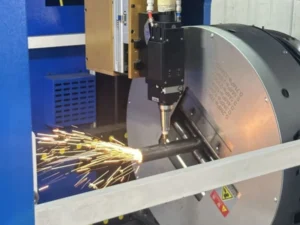
Assist gas selection for tube cutting follows the same core chemistry as sheet cutting — oxygen, nitrogen and compressed air interact with metal the same way regardless of the shape being cut — but tube geometry changes some of the practical tradeoffs enough to warrant its own look. This guide covers fiber laser tube cutting specifically. For flat sheet cutting, see our companion assist gas guide.
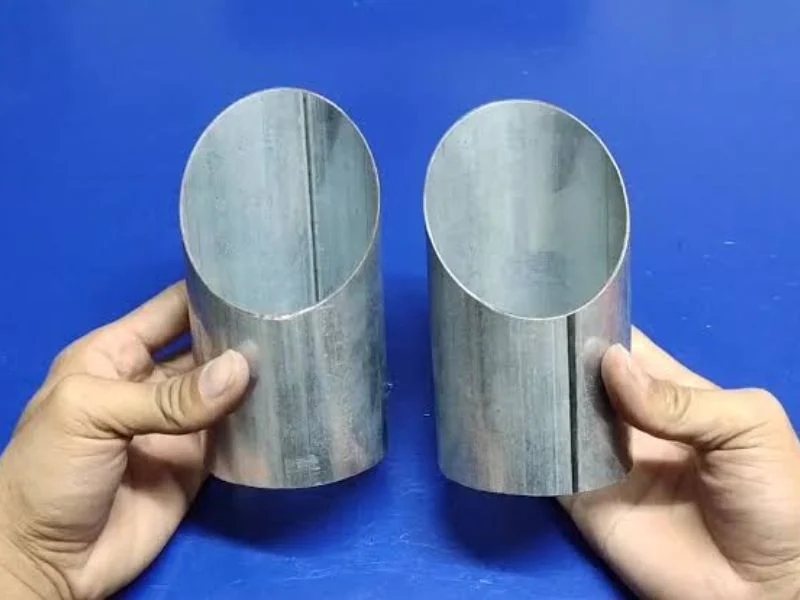
Round, square and rectangular tube, along with structural profiles like angle and H-beam, present different cutting geometry than flat sheet — the beam is often cutting through material at a changing angle relative to the tube wall as it profiles around a curved or multi-face section, which affects how consistently assist gas performs around the full cut path.
This guide covers oxygen for carbon steel tube, nitrogen for stainless and aluminum tube, compressed air for cost-sensitive thin-wall work, edge quality and oxidation tradeoffs, and what information to provide for a cutting test.
Oxygen for Carbon Steel Tube
Oxygen remains the standard assist gas for carbon steel tube for the same reason it works on sheet — the exothermic reaction with heated steel adds cutting energy, letting the laser cut faster and thicker-wall tube than raw power alone would support — with the oxidized edge it produces generally acceptable on tube destined for welding, painting or structural use where appearance isn’t the priority.
This makes oxygen the practical default for structural framing, handrail and general fabrication tube work, where the tube gets welded into an assembly and the oxidized edge either disappears into the weld or gets covered by a finish coat regardless.
Nitrogen for Stainless Steel and Aluminum Tube
Nitrogen’s inert, oxide-free cut matters for stainless and aluminum tube work destined for architectural, food-grade, or visible-finish applications, where an oxidized edge is a real defect rather than a cosmetic non-issue — handrail, balustrade and visible structural tube in stainless are common cases where nitrogen’s edge quality justifies its added cost.
The cost and speed tradeoff is the same as sheet cutting — nitrogen is slower and more expensive than oxygen — but on tube work where the cut edge is often visible in the finished product (an exposed tube end, a handrail joint) rather than hidden inside an assembly, that tradeoff is frequently worth it.
Compressed Air for Cost-Sensitive Thin-Wall Jobs
Compressed air works reasonably well on thin-wall tube where cut quality demands are moderate and gas cost matters more at high volume — it produces some oxidation, less than pure oxygen but more than nitrogen, making it a middle-ground choice for cost-sensitive production runs on tube that doesn’t need a fully oxide-free edge.
Thin-wall tube in particular is a reasonable fit for compressed air because the material itself cuts relatively easily, meaning the gas’s lack of exothermic assist matters less than it would on thicker material. For high-volume, cost-sensitive thin-wall production where nitrogen’s expense isn’t justified by the application, compressed air is worth testing against your actual quality requirement.
Edge Quality and Oxidation Tradeoffs
The same oxygen-nitrogen-compressed air spectrum applies to tube as to sheet — oxygen fastest and most oxidized, nitrogen slowest and cleanest, compressed air in between — but tube’s changing cut angle around curved or multi-face profiles can make edge consistency slightly harder to hold than on a flat sheet cut, which is worth confirming with a test cut on your specific tube geometry.
| Oxygen | Nitrogen | Compressed air | |
|---|---|---|---|
| Best for | Carbon steel tube, structural/welded use | Stainless/aluminum tube, visible-finish work | Thin-wall tube, cost-sensitive volume |
| Edge finish | Oxidized | Clean, oxide-free | Light oxidation |
| Relative cutting speed | Fastest | Slower | Moderate |
What Information to Provide for Testing
Bring tube material, wall thickness, tube shape (round, square, rectangular, structural profile), and the intended end use — welded assembly, visible finish, structural framing — to a cutting test, since gas choice should match what happens to the tube after cutting, not just raw cutting speed or cost.
Request a test cut on your actual tube geometry rather than a flat sheet sample of the same material, since tube’s changing cut angle around the profile is exactly the variable a flat sheet test can’t validate. This is the detail most likely to get skipped in a rushed evaluation, and it’s the one most specific to tube cutting versus general laser cutting.
For flat sheet assist gas selection, see our assist gas guide for sheet metal fiber laser cutting. For design considerations specific to tube geometry, see our tube laser cutting design tips.
Frequently Asked Questions
Is assist gas choice different for tube than for sheet metal?
The core gas chemistry is the same, but tube’s changing cut angle around curved or multi-face profiles can affect edge consistency slightly differently than a flat sheet cut, which is worth validating with a tube-specific test cut.
What gas should I use for stainless steel handrail tube?
Nitrogen — handrail and other visible-finish stainless tube work benefits from nitrogen’s clean, oxide-free edge, since the cut is often visible in the finished product rather than hidden inside an assembly.
Is compressed air suitable for thick-wall tube?
It’s a better fit for thin-wall tube, where the material cuts relatively easily and compressed air’s lack of exothermic assist matters less — thicker material benefits more from oxygen’s speed advantage or nitrogen’s edge quality depending on the application.
Should I test on flat sheet or actual tube before choosing a gas?
Test on your actual tube geometry — tube’s changing cut angle around the profile is a variable a flat sheet sample can’t validate, and it’s specific to tube cutting.
Does oxygen work well on structural tube that will be welded?
Yes — oxygen’s oxidized edge is generally acceptable on tube destined for welding or painting, where the edge finish either disappears into the weld or gets covered by a finish coat.
What information should I provide for a tube cutting gas test?
Tube material, wall thickness, tube shape, and intended end use — whether the tube will be welded, visible, or structural determines which edge quality level actually matters.