A tube laser can cut holes, slots, miter joints, weld-prep bevels and profile shapes in one setup that would otherwise need a saw, a drill press, a notcher and a grinder run in sequence. Most of that capability goes unused because parts get designed the way they’d be designed for those older processes, not for what a tube laser can actually do in a single operation.
Designing specifically for tube laser cutting — rather than adapting a design meant for sawing and drilling — is where the real efficiency gain shows up. The parts that benefit most are the ones where hole placement, joint geometry and weld prep are built into the cut file from the start, eliminating secondary operations rather than just replacing one cutting step with another.
This guide covers hole and slot placement, miter joints and weld-prep notches, bevel cutting considerations, reducing secondary operations, and what to include when sending drawings for manufacturability review.
How to design for tube laser cutting, in five rules:
- Keep holes and slots at least one wall thickness away from tube ends, corners and other cuts.
- Cut miters, copes and weld-prep notches into the file instead of fitting them by hand afterwards.
- Use tab-and-slot joints so tubes locate each other at weld-up without a fixture.
- Check the bevel angle and wall thickness you need against the machine’s tested range before freezing the design.
- Send a 3D model with wall thickness, material grade and critical tolerances flagged.
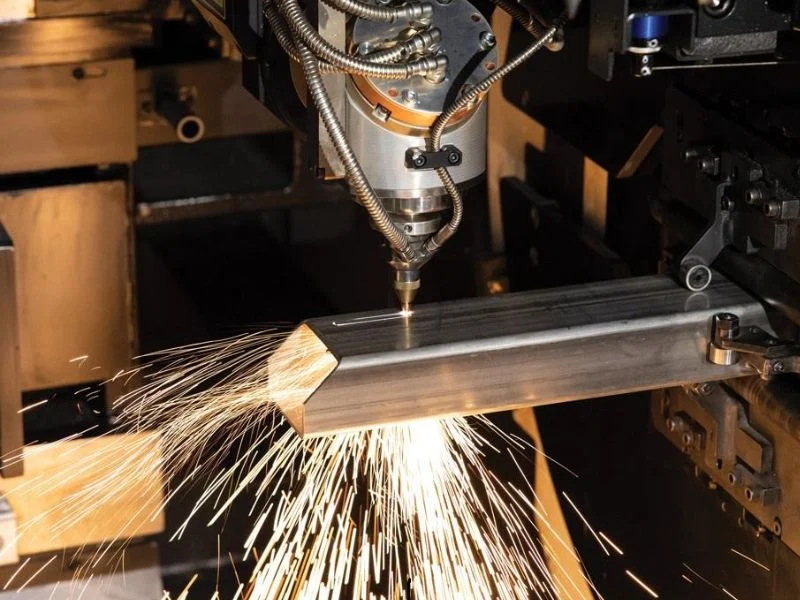
Hole and Slot Placement
Place holes and slots with enough clearance from tube ends, corners and other features — as a general rule, keep features at least one tube-wall-thickness away from an edge or another cut — since features placed too close to an edge or to each other can distort during cutting or compromise the surrounding material’s structural integrity.
Tube laser cutting can place holes and slots on multiple faces of a tube in one setup, including features that would be difficult or impossible to drill accurately by hand once a tube is part of an assembly. Design hole and slot patterns to take advantage of this — features that reference each other across faces (for a pin passing through two sides, for example) benefit from being cut in the same setup rather than positioned for a secondary drilling operation that has to relocate the part.
Miter Tube Laser Cutting: Joints and Weld-Prep Notches
Design miter joints and weld-prep notches directly into the cut file rather than planning to cut square and prep the joint afterward — a tube laser cuts a compound-angle miter or a weld-prep bevel with the same accuracy as a straight cut, eliminating a fitting and grinding step that otherwise happens by hand.
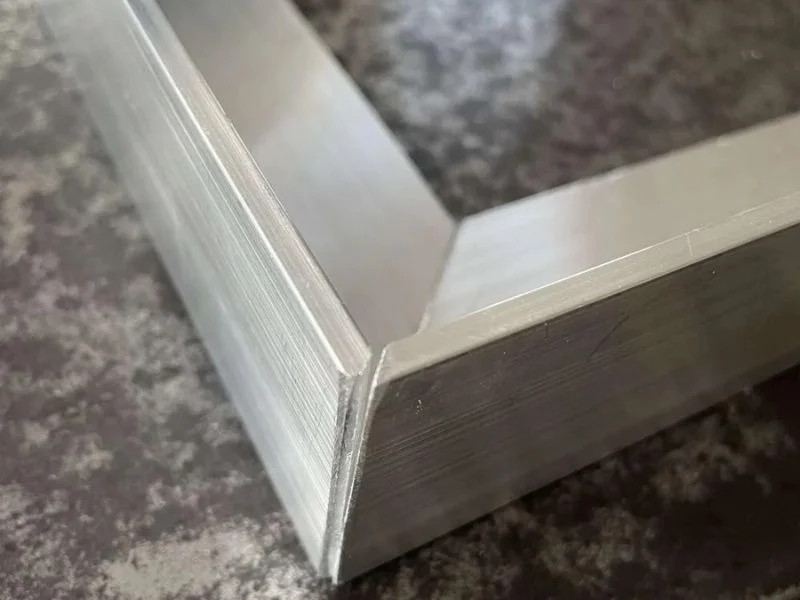
This is one of the biggest efficiency gains tube laser cutting offers over traditional fabrication, and one of the most commonly underused. A frame assembly with multiple mitered joints, each requiring hand-fitting and grinding under a saw-and-notch process, can have every joint cut to final fit-up geometry in the same operation that cuts the tube to length — turning a fitting-heavy assembly step into a straightforward weld-up.
Two more joint types are worth designing in from the start. A saddle (fish-mouth) cut profiles the end of one tube to sit on the curved wall of another — the cope that used to come off a notcher or a hand grinder. A tab-and-slot joint puts a tab on one member and a matching slot in the other, so a frame self-locates and a welder can tack it up without a jig. On a tube laser both are simply geometry in the cut file, and both remove a fitting step from every assembly. Size those slots with the cut width in mind — our guide to kerf in laser cutting explains how much clearance a tab needs.
Bevel Cutting Considerations
Confirm your tube laser platform supports bevel cutting if your joints need a specific weld-prep angle — not all tube lasers cut bevels, and machines that do have practical limits on bevel angle and wall thickness combination that are worth confirming against your specific design before finalizing it.
Bevel cutting at extreme angles or on very thick wall material may push against a machine’s practical limits even when it’s technically capable of bevel cutting in general. Check your specific angle and thickness combination against your supplier’s tested range rather than assuming general bevel capability covers every case.
Reducing Secondary Drilling and Grinding
Audit your current tube fabrication process for every secondary operation — drilling, notching, grinding, deburring — and check which of those can be eliminated by designing the feature into the laser cut file instead, since each eliminated secondary step removes both labor time and a source of dimensional variance between parts.
This audit is often where the real cost case for tube laser cutting becomes clear — not in the cutting speed itself, but in the secondary operations a well-designed cut file removes entirely. A part that previously needed cutting, drilling, notching and deburring as four separate steps can often be reduced to laser cutting plus a light deburring pass, with holes, notches and bevels all built into the single cutting operation.
Sending Drawings for Manufacturability Review
For the manufacturability review, send full 3D models or complete 2D drawings with tube wall thickness, material grade, and all feature tolerances clearly specified — a manufacturability review catches design issues (features too close to an edge, bevel angles outside practical range, tolerance stacking across multiple features) before they become a production problem rather than after a batch is already cut wrong.
Flag any features with tight tolerance requirements specifically, and note which dimensions are critical versus which have normal working tolerance. This helps a reviewer focus attention on the features that actually matter to your part’s function, rather than treating every dimension as equally critical.
For assist gas selection on tube cutting, ask the supplier to quote gas consumption at your typical wall thickness — oxygen, nitrogen and compressed air differ in both edge quality and running cost. See the full X6 Fiber Laser Tube & Profile Cutting Machine specifications.
Frequently Asked Questions
How close to a tube edge can I place a hole or slot?
As a general rule, keep features at least one tube-wall-thickness away from an edge or another cut feature — closer placement risks distortion during cutting or compromised structural integrity around the feature.
Can a tube laser cut compound-angle miter joints?
Yes — this is one of the biggest efficiency gains over traditional fabrication, eliminating hand-fitting and grinding that a saw-and-notch process would otherwise require for each joint.
Does every tube laser support bevel cutting?
No — confirm your specific platform supports bevel cutting if your joints need weld-prep angles, and check your specific angle and wall-thickness combination against the machine’s tested range.
How do I know which secondary operations a tube laser can eliminate?
Audit your current process step by step — drilling, notching, grinding, deburring — and check which features can be built into the laser cut file instead, which is usually where the biggest cost savings show up.
What should I include when sending a design for manufacturability review?
Full 3D models or complete 2D drawings with tube wall thickness, material grade, and all feature tolerances clearly specified, with critical tolerances flagged separately from normal working tolerances.
Does tube laser cutting design differ much from sheet laser cutting design?
Yes — tube geometry introduces edge-clearance and multi-face feature considerations that flat sheet cutting doesn’t have, along with joint-specific design opportunities like integrated miters and weld-prep bevels.
How do you design a miter joint for tube laser cutting?
Draw the miter at its final fit-up angle in the 3D model and let the tube laser cut it in the same setup that cuts the tube to length — do not plan a square cut and a saw miter afterwards. For tube-to-tube joints, model the saddle (fish-mouth) profile, and add tab-and-slot features where you want the frame to self-locate for welding.