The laser does the cutting, but assist gas decides what the edge looks like when it’s done — and picking the wrong gas for the job produces a technically complete cut with the wrong finish, the wrong cost structure, or both. This guide covers sheet metal cutting specifically. For fiber laser tube cutting, see our companion assist gas guide — the same gas principles apply, but tube geometry changes some of the practical tradeoffs.
Oxygen, nitrogen and compressed air each interact with metal differently during a laser cut, and the choice isn’t just a cost decision — it directly determines edge oxidation, cutting speed, and whether the part needs secondary finishing before it’s usable. Getting this wrong on a production run means either paying for gas capability you don’t need or getting an edge finish that fails downstream requirements.
This guide covers oxygen for carbon steel, nitrogen for stainless steel and aluminum, compressed air for thin-sheet work, the oxidation and cost tradeoffs between them, and what information to bring to a cutting test.
Oxygen for Carbon Steel
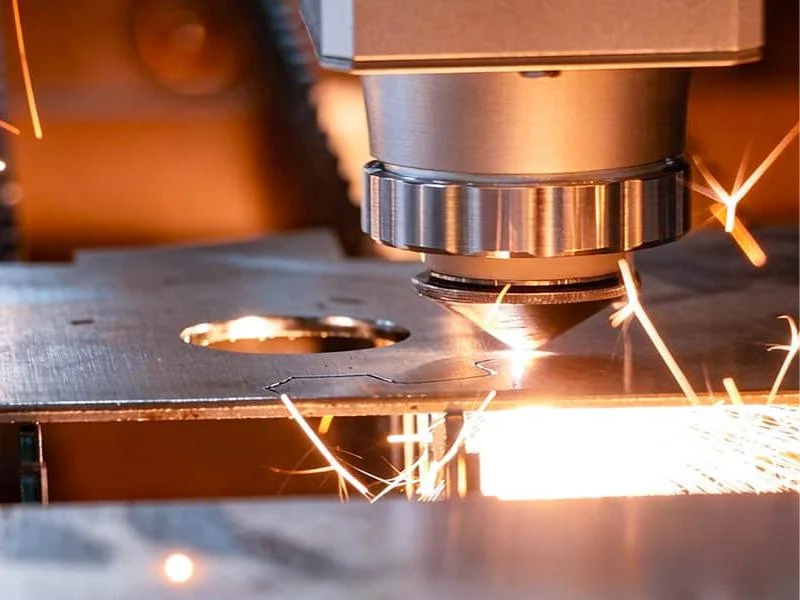
Oxygen assist gas reacts exothermically with heated carbon steel, adding thermal energy to the cut that lets the laser cut faster and thicker than the beam’s raw power alone would allow — this is why oxygen remains the standard choice for carbon steel despite leaving an oxidized edge.
The oxidized edge oxygen produces is often acceptable or even expected on carbon steel parts that will be painted, coated, or welded, where the oxide layer either gets removed in a later process or doesn’t affect the part’s function. For carbon steel work where speed and thickness capacity matter more than as-cut edge appearance, oxygen is usually the right default.
Nitrogen for Stainless Steel and Aluminum
Nitrogen assist gas is inert — it doesn’t react with the metal — producing a clean, bright, oxide-free edge on stainless steel and aluminum, which matters because an oxidized edge on these materials is often a real defect rather than a cosmetic non-issue.
The tradeoff is cost and speed: nitrogen doesn’t contribute thermal energy to the cut the way oxygen does, so cutting is generally slower for the same thickness, and nitrogen itself costs more than oxygen or compressed air, especially at the purity and pressure precision cutting requires. For stainless and aluminum parts that ship as-cut or need to weld cleanly without extra edge prep, nitrogen’s edge quality is usually worth the added cost. How much plate each gas lets you part at 3 kW and 6 kW is set out in our fiber laser cutting thickness chart.
Compressed Air for Thin-Sheet Jobs
Compressed air is the lowest-cost assist gas option, since it doesn’t require a dedicated gas supply the way nitrogen or oxygen do — it works reasonably well on thin sheet material where cut quality demands are lower and the cost savings across high volume outweigh the edge-quality compromise.
Compressed air’s edge quality sits between oxygen’s fully oxidized edge and nitrogen’s oxide-free result — some oxidation occurs from the oxygen content in ambient air, but less than pure oxygen assist produces. This makes it a reasonable middle-ground choice for cost-sensitive thin-sheet work where neither oxygen’s speed advantage nor nitrogen’s edge purity is the deciding factor.
Oxidation, Cost and Edge-Quality Tradeoffs
The three gases sit on a clear spectrum: oxygen is fastest and cheapest per cut but leaves the most oxidation; nitrogen is slowest and most expensive but leaves the cleanest edge; compressed air sits in between on both cost and edge quality — matching gas choice to what your downstream process actually requires avoids paying for gas capability the part doesn’t need.
| Oxygen | Nitrogen | Compressed air | |
|---|---|---|---|
| Best for | Carbon steel, speed/thickness priority | Stainless, aluminum, edge-quality priority | Thin sheet, cost-sensitive volume work |
| Edge finish | Oxidized | Clean, oxide-free | Light oxidation |
| Relative cutting speed | Fastest (exothermic assist) | Slower | Moderate |
| Relative gas cost | Low | High | Lowest |
Information Needed for Cutting Tests
Bring your material type, thickness, and downstream process requirement — will the part be welded, painted, or ship as-cut — to a cutting test, since gas choice should be driven by what happens to the part after cutting, not just what cuts fastest or cheapest in isolation.
Run a test cut with your actual material and thickness under each gas option you’re considering, and evaluate the edge against your real downstream requirement rather than a general quality impression. A part that will be welded doesn’t need nitrogen’s oxide-free edge the way a part shipping as-cut does — matching the test to the actual end use avoids over- or under-specifying gas requirements for production.
For tube-specific assist gas considerations, see our assist gas guide for fiber laser tube cutting. For the full buying decision on sheet metal cutting capability, see our sheet metal fiber laser cutter buying guide.
Frequently Asked Questions
Why does oxygen leave an oxidized edge but nitrogen doesn’t?
Oxygen reacts chemically with the heated metal during cutting, which is what produces the oxidation — nitrogen is inert and doesn’t react, leaving a clean, oxide-free edge instead.
Is nitrogen always better than oxygen for cut quality?
It produces a cleaner edge, but oxygen cuts faster and cheaper on carbon steel where the oxidized edge is acceptable — “better” depends on what your downstream process actually requires.
Can compressed air replace nitrogen for stainless steel?
It produces more oxidation than nitrogen, so it’s a reasonable compromise for cost-sensitive or lower-spec work, but not a direct substitute where an oxide-free edge is genuinely required.
Does assist gas choice affect cutting speed?
Yes — oxygen’s exothermic reaction with carbon steel adds thermal energy that increases cutting speed and thickness capacity, while nitrogen’s inert reaction means cutting relies purely on laser power, generally making it slower for the same thickness.
What should I test before choosing an assist gas for production?
Your actual material, thickness and downstream process requirement — whether the part will be welded, painted, or ship as-cut determines which edge quality level is actually necessary.
Is assist gas choice different for tube cutting than sheet cutting?
The same core gas principles apply, but tube geometry introduces some different practical tradeoffs — see our tube-specific assist gas guide for those details.