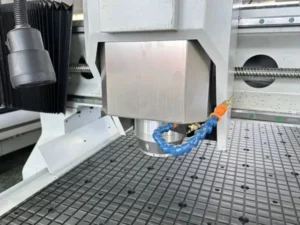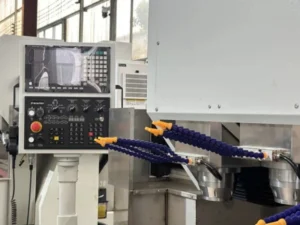
The T2 and T3 both read printed registration marks with the same imported CCD camera and cut to a printed graphic’s actual position. If you only looked at the vision workflow, you’d think they were the same machine at two prices. What actually separates them is duty cycle — how much continuous production each one is built to handle — and that difference matters more than most buyers expect going in.
The T2 pairs its camera with an air-cooled spindle and a hybrid stepper-servo drive: no chiller, simpler electronics, lower cost, and the lowest price point in the entire T line. The T3 pairs the same camera concept with a water-cooled spindle built specifically for continuous production. Same core vision capability, genuinely different production profile underneath it.
This comparison covers control systems, spindle configuration, speed, camera workflow and material fit, and which shop profile fits each machine.
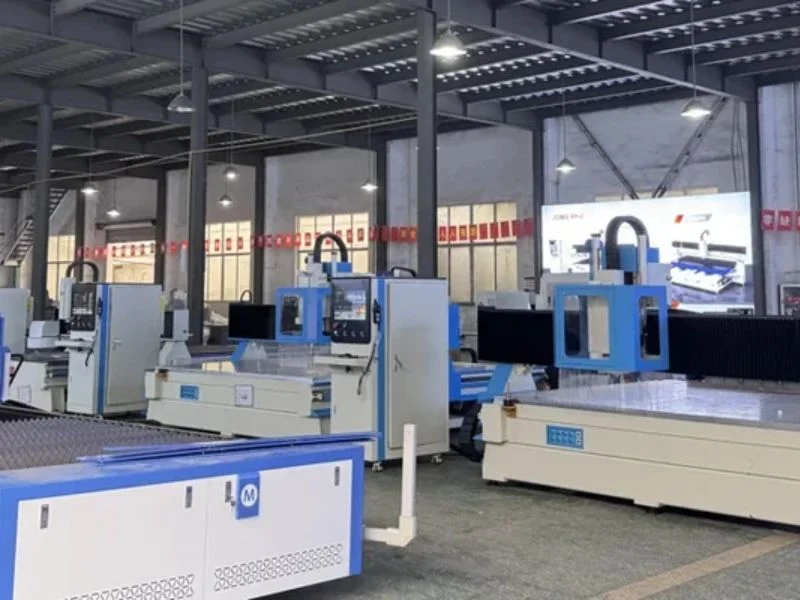
The Short Answer
Choose the T2 for a first vision machine or lower, intermittent production volume, where simplicity and lower cost matter more than sustained continuous throughput. Choose the T3 once production genuinely runs the machine for extended periods without significant idle time, where continuous-duty spindle cooling becomes a real reliability factor rather than an unused spec.
| T2 Vision CNC Router | T3 High-Speed Vision CNC Router | |
|---|---|---|
| Spindle | 3 kW air-cooled | 3 kW water-cooled |
| Drive system | Hybrid stepper-servo | Computer-controlled, built for continuous production |
| Camera | Imported CCD + proprietary edge detection | Same imported CCD + edge detection concept |
| Controller | NK105 | Computer-controlled |
| Optional tooling | — | Optional knife head for KT board, foam, hollow board |
| File formats | DXF / PLT / NC | DXF / PLT / NC |
| Best for | First vision machine, lower/intermittent volume | Continuous, high-volume print-to-cut production |
| Starting price | USD 5,200 | USD 8,900 |
Control Systems and Drive Configuration
The T2’s NK105 controller paired with a hybrid stepper-servo drive keeps the machine simpler and less expensive to own — fewer subsystems, no chiller — while the T3’s computer-controlled system and continuous-production drive configuration are built for sustained accuracy under longer duty cycles.
Neither drive system is inherently more accurate for a single job — the difference shows up over sustained production, where the T3’s configuration is specifically engineered to hold performance through longer runs without the periodic accuracy check a hybrid drive system benefits from.
Spindle: Air-Cooled Simplicity vs Water-Cooled Continuous Duty
Both machines run a 3 kW spindle, but the T2’s air-cooled configuration needs no chiller and is genuinely simpler to install and maintain, while the T3’s water-cooled spindle is specifically built to run continuously through a full production shift without the thermal limitations an air-cooled spindle faces under sustained heavy use.
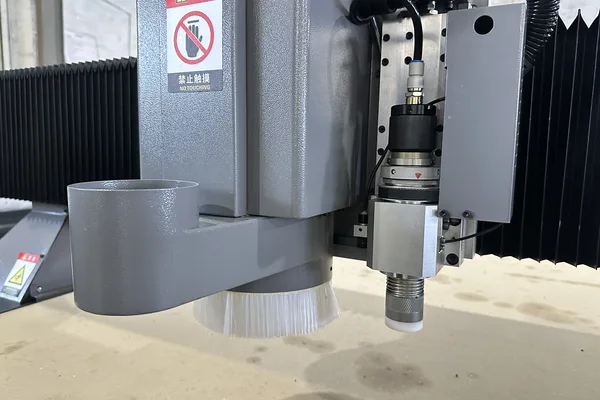
This is the core decision point between the two machines. A shop running the machine intermittently — several jobs a day with idle time between them — rarely stresses an air-cooled spindle’s limits. A shop running the machine near-continuously through a full shift benefits directly from the T3’s cooling capacity, which is the difference between a spindle rated for occasional heavy use and one built for sustained production.
Camera Workflow: Shared Foundation, Different Duty Cycle
Both machines use the same imported CCD camera and edge-detection concept, reading printed registration marks and aligning the cut path the same way — the camera workflow itself doesn’t change between models, which matters for shops planning to eventually upgrade from a T2 to a T3 without relearning the print-to-cut process.
This shared foundation is a deliberate product-line decision: an operator trained on T2 camera workflow needs no retraining on the T3’s vision system specifically, only on the differences in spindle behavior and any added knife-cutting capability. This makes a T2-to-T3 upgrade path lower-friction than switching to an entirely different vision system would be.

Material Fit and Optional Knife Cutting
The T3’s optional knife head extends its material range into foam board, KT board and hollow board that a spinning bit compresses or melts rather than cutting cleanly — the T2 has no equivalent option, so shops needing soft-material cutting alongside rigid board work should factor that into the comparison directly, not as an afterthought.
For shops running rigid signage substrate only — acrylic, PVC, rigid ACM board — this difference doesn’t matter. For shops whose material mix regularly includes soft or foam-core substrate, the T3’s optional knife capability is a meaningful practical advantage beyond the spindle cooling difference alone.
A Worked Example: Choosing Between Them
A sign shop just adding its first vision-guided machine, running a handful of print-to-cut jobs a day between other work, is well served by the T2’s lower cost and simpler maintenance. A shop that’s already running a vision router near-continuously and hitting its limits — or one whose material mix includes both rigid and soft substrate — has a clearer case for the T3.
Many shops reasonably start with a T2 and move to a T3 once volume grows to the point where continuous-duty capability pays back its added cost — the shared camera workflow makes this a low-friction upgrade rather than starting over with new equipment and retraining.
See the full T2 Vision CNC Router and T3 High-Speed Vision CNC Router product pages for complete specifications.
Frequently Asked Questions
Do the T2 and T3 use the same camera system?
Yes — both use the same imported CCD camera and proprietary edge-detection concept, reading and aligning to printed registration marks the same way. The difference between the machines is spindle cooling and drive configuration, not camera capability.
Why does the T3 cost more if the camera is the same?
The price difference reflects the T3’s water-cooled spindle built for continuous production and its more capable drive system, not additional camera capability — you’re paying for sustained duty cycle, not a better vision system.
Can the T2 handle continuous, high-volume production?
It’s built primarily for intermittent use — a shop running the machine near-continuously through full shifts will find the T3’s water-cooled spindle and continuous-production drive configuration a better match.
Is upgrading from a T2 to a T3 difficult?
It’s relatively low-friction — since both machines share the same camera workflow, operators don’t need to relearn the core print-to-cut process, only adapt to differences in spindle behavior and any added knife-cutting capability.
Does the T2 have an optional knife head like the T3?
No — the optional knife head for foam board, KT board and hollow board is a T3-specific option. Shops needing that soft-material capability should factor it into the comparison directly.
Which machine is the better starting point for a new sign shop?
The T2, in most cases — its lower cost and simpler air-cooled maintenance make it a reasonable first vision machine, with a straightforward upgrade path to the T3 if volume grows.