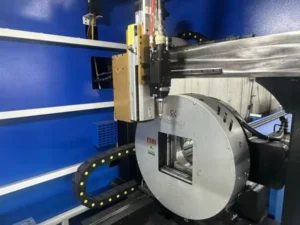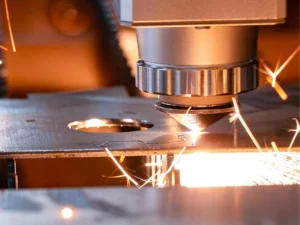
Machine loading, on the shop floor, is the work of getting raw sheet, board or roll onto a CNC machine’s bed and clearing finished parts off it — by hand, with a trolley or vacuum lifter, or with an automated loader. (In production planning the same phrase means assigning jobs to machines; this guide is about the physical kind.)
CNC machine loading is the part of the job nobody quotes for, and it is where most shops lose time and where people get hurt.
A 3 mm mild steel sheet at 1500 × 3000 mm weighs 106 kg. Two operators lift one onto the table several times a shift until somebody drops a corner, creases a sheet or catches a hand between the plate and the slats. The machine was chosen on cutting speed; the bottleneck turned out to be everything either side of the cut.
This guide covers what full sheets actually weigh, the four ways shops handle CNC machine loading, what the machine’s own design decides, and when automated handling is worth the money.
What CNC Machine Loading Actually Costs a Shop
CNC machine loading is unpaid cycle time, and on short nests it can take longer than the cutting. The arithmetic is easy to run on your own job sheets and it is usually uncomfortable.
Take a nest that cuts in four minutes. Clearing the finished parts, walking the next sheet over from the rack, lifting it on and squaring it against the stops takes three minutes with two people. That job spends 43% of its door-to-door time not cutting, and an eight-hour shift delivers roughly four and a half hours of spindle or beam time. CNC machine loading took the rest.
The second cost is material. A creased 3 mm aluminium sheet does not flatten out again, a scratched acrylic sheet has to be recut on the good face, and a laminated panel dropped on a corner loses the edge you were going to machine. Sheet stock is bought in packs, so a scrap rate of one sheet in fifty is a line item, not an accident.
The third cost is injury, and it is the one that ends up on paper. OSHA’s general materials handling rule, 29 CFR 1910.176, requires safe clearance, stable storage and clear aisles wherever mechanical handling equipment is used. The loading side of a cutting machine is exactly that area, and it is usually the least planned square metre in the building.
None of this appears in a machine quotation. It appears in the second year, when the shop realises the machine can cut faster than the shop can feed it.
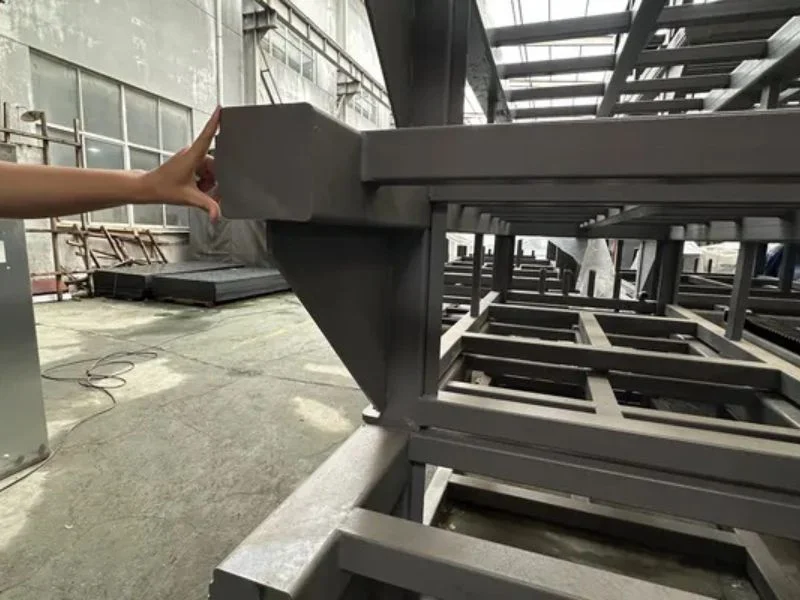
What a Full Sheet Weighs, and What One Person Can Lift
The number that decides your CNC machine loading method is the weight of the heaviest sheet you buy, not the average one. Work it out first, because the figures surprise people who have only handled wood-based panels.
The weights below are standard material densities multiplied by sheet volume, so you can check any of them against your own stock list.
| Material | Sheet size | Thickness | Weight per sheet |
|---|---|---|---|
| Birch plywood | 1220 × 2440 mm | 18 mm | ~32 kg (70 lb) |
| MDF | 1220 × 2440 mm | 18 mm | ~40 kg (88 lb) |
| Cast acrylic | 2050 × 3050 mm | 5 mm | ~37 kg (82 lb) |
| Aluminium composite panel | 1220 × 2440 mm | 3 mm | ~13 kg (29 lb) |
| Aluminium 5052 | 1500 × 3000 mm | 3 mm | ~36 kg (80 lb) |
| Mild steel | 1500 × 3000 mm | 3 mm | ~106 kg (234 lb) |
| Mild steel | 1500 × 3000 mm | 6 mm | ~212 kg (467 lb) |
| Stainless 304 | 1500 × 3000 mm | 10 mm | ~360 kg (794 lb) |
| Coated tarpaulin roll | 3.2 m × 50 m, 650 g/m² | roll | ~104 kg (229 lb) |
Set those against what a body can do. The NIOSH lifting equation puts the recommended weight limit at 23 kg (51 lb) for a compact load held close to the body at knuckle height in ideal conditions, and a 3 m sheet is the opposite of ideal. Reach, awkward grip, twisting and a two-person lift where the load is shared unevenly all cut that figure down, as OSHA’s ergonomics guidance sets out.
Read the two together and the conclusion is blunt. Wood-based panels and thin plastics are a two-person job that a lifting aid makes faster. Anything in steel above 3 mm, or any sheet longer than about 2.5 m, is mechanical handling work, and treating it as manual CNC machine loading is a decision to injure someone eventually.
The same applies to rolls. A coated fabric or membrane roll is heavier than most steel sheets a small shop handles, and it has no rigid edge to grip.
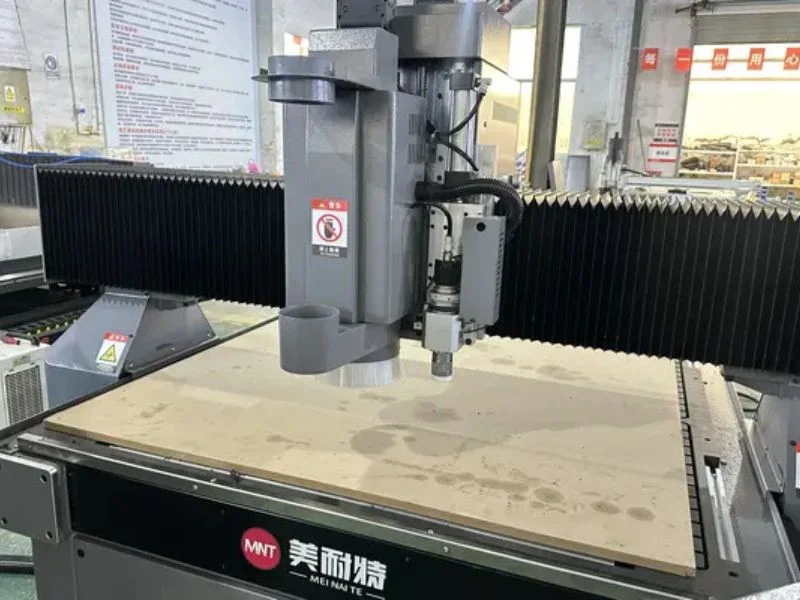
Four Ways to Load a CNC Machine, Compared
Four methods cover almost all CNC machine loading, and the right one follows from your heaviest sheet, your floor space and your loads per shift. Most shops move up this list one step at a time, usually one injury or one scrapped pack too late.
| Method | Practical ceiling | Floor space | Where it fails |
|---|---|---|---|
| Two-person manual lift | ~40 kg panels, up to 2.5 m | Loading corridor only | Steel, long sheets, high load frequency, thin material that bows |
| Sheet trolley or roller in-feed shelf | ~150 kg stack, single format | Trolley footprint plus turning room | Mixed sheet sizes; still a manual slide onto the bed |
| Vacuum lifter on a jib crane | 250 kg–2 t depending on crane | Column base plus boom swing radius | Porous, oily or perforated sheets that will not hold vacuum |
| Automated loader or shuttle table | Full pallet, unattended | Often doubles the machine footprint | Mixed materials and short runs; capital cost on low volume |
The two-person lift is less a method than the absence of one, but it is honest for a shop cutting foam board, ACP and 18 mm panels a few times a shift. Give it a clear corridor and a stop to square against.
A sheet trolley with a scissor lift is the cheapest genuine upgrade to manual CNC machine loading. It holds a pack, raises the top sheet to bed height, and turns a lift into a slide. Its limit is that it handles one format well and everything else badly.
A vacuum lifter hung from a jib crane is where most small metal shops land, because it solves grip and weight at once. The pads spread the hold across the sheet, so a thin plate arrives flat instead of bowed in the middle, and one person can do the job.
Sizing is the whole decision: a portable or column-mounted jib rated 250 kg to 2 tonnes with a 2–4 m boom covers a single-machine cell, and Voitto’s guide to portable jib cranes for small workshops is a reasonable starting point on capacity, boom length and mounting before you talk to a supplier. A jib crane also needs floor or wall structure to react the moment, which is a building question as much as an equipment one.
Automated CNC machine loading is the fourth step and earns its own section below. It is a handling system bolted to a cutting machine, bought from a handling supplier, not a feature of the cutter itself.
What the Machine’s Own Design Decides About CNC Machine Loading
Half of your CNC machine loading problem is settled before the machine arrives, by table height, how open the frame is, and where the gantry parks. Buyers rarely ask and regret it within a month.
Table height sets the lift geometry. Most flatbed cutters and routers sit with the bed around 850–950 mm off the floor, which is workable for a slide from a trolley at the same height and punishing for a lift from the floor. If you plan to feed from a pack on a pallet, the pallet needs a lift to bring it up, not operators who bend.
Frame openness decides whether you can slide at all. Open long sides let you feed a sheet across the bed from either side; a fully enclosed cabinet forces loading from one end, which doubles the corridor you need and rules out sliding a 3 m sheet in sideways. Ask where the electrical cabinet, dust hood and extraction ducting sit, because those are what usually close off the side you wanted.
Gantry park position matters more than the spec sheet suggests. If the gantry parks at one end and clears the full bed, you can load anywhere along the table; if it parks mid-travel or the head cannot rise clear, every load becomes a lift over an obstacle. Confirm the park position and the clearance under the gantry in millimetres before you sign.
Registration stops and pins turn a two-person eyeball alignment into a slide-until-it-touches. On a flatbed cutter handling mixed sheet sizes, fixed stops on two edges take more time out of the CNC machine loading cycle than any single accessory.
Zoned vacuum changes handling as well as hold-down. Switching off the zones you are sliding across, then bringing them on once the sheet is squared, means the sheet moves freely and then locks instead of grabbing halfway across. On our CNC router and digital cutting tables the zone valves sit on the operator side for exactly that reason, and it is worth checking on any machine you evaluate.
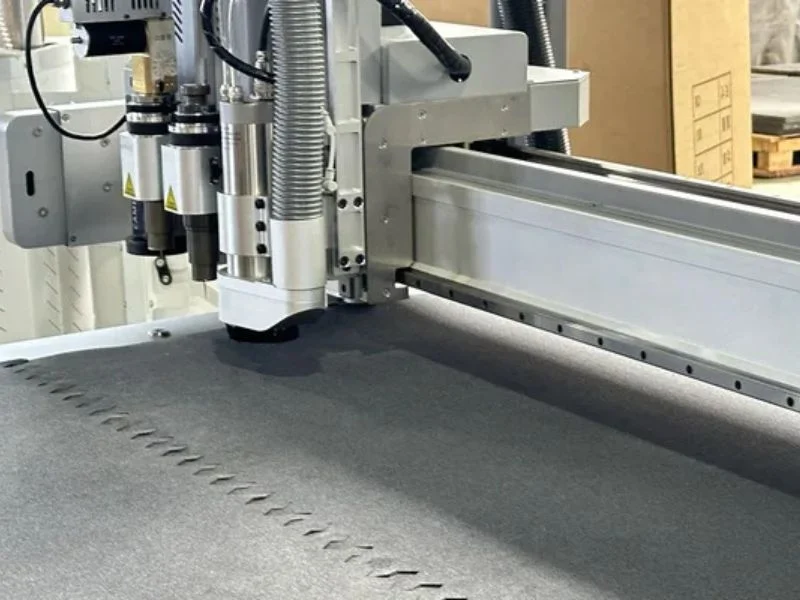
CNC Machine Loading and Unloading: Why Unloading Is the Half Nobody Plans
Unloading takes longer than loading on most jobs, because a full sheet is one object and a finished nest is fifty. Shops plan the lift and then find the real time sink is picking parts.
Programming decides most of it. Small tabs or bridges hold parts in the sheet so the whole nest lifts off as one piece and is broken out on a bench, rather than fished out of the slats one at a time. The trade is a deburring or sanding operation on every tab, so tab count and placement is a cost decision, not a default setting. Our guide to nesting software and panel yield covers where that sits against material utilisation.
Small parts falling through are the other half. On a slat bed in sheet metal, anything smaller than the slat pitch drops into the tray; on a vacuum table cutting soft materials, small parts stay put but lose hold-down as the surrounding skeleton is removed. Both are solved at the programme stage with common-line cutting, micro-joints, or a cut order that keeps the skeleton intact until last.
Then there is the skeleton itself. A steel skeleton from a 1500 × 3000 sheet is awkward, sharp and still heavy, and it needs the same lifter that put the sheet on. A shop with a crane for loading and nothing for the skeleton has solved half the problem.
Plan where parts go before they come off, because unloading is half of the CNC machine loading cycle. A cart at bed height beside the machine means finished parts are slid rather than carried, and the table is clear for the next load. It is a cheap fix that routinely returns more than a faster cutting head.
Laying Out the Loading Side of the Machine
Plan a clear corridor of at least 900 mm on the feed side, plus run-out equal to the sheet length at whichever end you load from. A layout that ignores this makes every other CNC machine loading decision worse.
Start from the sheet, not the machine. A 3 m sheet carried or swung on a crane needs 3 m of clear path plus turning room, so the distance from rack to table matters more than the distance from table to office. Storing sheets on the far side of a workshop is the most common reason a good lifter still produces a slow CNC machine loading cycle.
Put the rack inside one crane swing if you are using a jib. That single decision is what makes a jib crane pay: sheets go from rack to bed in one movement with no re-rigging. If the rack cannot be inside the swing, you are buying two handling operations, and the crane will get used less than you planned.
Floor loading is worth checking early. A free-standing jib column concentrates its load into a small base and needs a slab that can take the moment, and a pack of steel parked on the loading side is a point load on the same floor. Both are questions for whoever knows the slab, before the anchors are drilled.
Leave the service side alone. Loading corridors have a way of becoming storage, and the side you need for spare parts access, rail lubrication and the electrical cabinet is not a place to stack material. Mark the floor at commissioning and it usually stays marked.
Utilities follow the same logic. Compressed air for a vacuum lifter, a socket for the trolley charger and lighting over the loading zone are cheap during installation and disruptive afterwards.

When Automated Loading Pays, and When It Doesn’t
Automated CNC machine loading pays when the same material runs in volume on a predictable schedule, and disappoints when the job mix changes daily. The break-even is repeatability, not how busy the shop feels.
The case is strongest in sheet metal. A tower or pallet loader feeding a fiber laser lets the machine run through breaks and into an unattended shift, and when material is one alloy in two or three thicknesses, a suction loader separates and places sheets more consistently than a person. Shops running sheet metal laser cutting at volume are the classic buyers.
The case weakens fast with variety. A shop cutting acrylic, ACP, foam board and 18 mm panel in the same day spends the saving on format changeovers, and a loader reconfigured between jobs is slower than two people who can see what they are holding. Short runs make it worse, because the loader’s advantage is measured per sheet while the setup is per job.
Floor space is the constraint people underestimate. A shuttle table or tower can double the footprint of the cell, and where the loading corridor is already tight, that space usually delivers more as a properly organised manual loading area than as automation. The same judgement applies when sizing a CNC router cell: bed size buys you nothing if the material cannot reach the bed.
Being straight about the boundary: MNT builds cutting machines — routers, machining centres, fiber lasers and digital cutting tables — not material handling systems. When a project needs a tower loader, a vacuum lifter or a jib crane, that comes from a handling supplier, and our part is making sure the machine is specified to work with it: table height, frame openness, park position, interface signals and the clearances your integrator will ask for.
Get that specification right at quotation stage and the handling supplier’s job is straightforward. Get it wrong and you are modifying a machine already bolted to the floor. If you are still choosing between machine classes, our guide to choosing a digital cutting table works through the same trade-offs from the cutting side.
Frequently Asked Questions
How do you load sheets onto a CNC router by yourself?
Single-operator CNC machine loading works by sliding, not lifting: raise the material to bed height first. A scissor-lift sheet trolley parked against the table, or a roller in-feed shelf at the same height as the bed, lets one person move an 18 mm panel across without taking its weight. Above roughly 40 kg, or with sheets longer than 2.5 m, use a vacuum lifter on a jib crane instead.
How much does a 4×8 sheet weigh?
An 18 mm (3/4 in) MDF sheet at 1220 × 2440 mm weighs about 40 kg (88 lb); the same size in birch plywood is about 32 kg (70 lb), and in 3 mm aluminium composite panel about 13 kg (29 lb). Metal is a different order: 3 mm mild steel at 1500 × 3000 mm is about 106 kg.
What is a safe weight for two people to lift?
The NIOSH recommended weight limit is 23 kg (51 lb) for one person handling a compact load in ideal conditions, and a two-person lift does not simply double it: sharing an awkward load unevenly causes most back injuries. For full sheets, reach and grip reduce the safe figure further, which is why mechanical handling is the standard answer above about 40 kg.
Do I need a vacuum lifter or a jib crane for a laser cutting machine?
Usually both, working together: the jib crane carries the weight and the vacuum lifter provides the grip. A vacuum head alone still needs something to hang from, and a hook alone means slings or clamps that bow thin sheet. Perforated, oily or heavily scaled material is the exception, because the pads cannot hold a seal.
How much space do you need around a CNC machine for loading?
CNC machine loading needs at least a 900 mm clear corridor on the feed side, plus run-out equal to the sheet length at whichever end you load from, and keep the sheet rack inside one crane swing if you use a jib. Also protect the service side for spare parts access and the electrical cabinet, since loading corridors tend to become storage.
Is automatic loading and unloading worth it for a small shop?
It pays where one material runs in volume on a predictable schedule, particularly sheet metal on a fiber laser that can then run unattended. It rarely pays where the job mix changes daily, runs are short or floor space is tight, because changeovers consume the saving and the loader can double the cell footprint.
CNC machine loading is a specification question, not an accessory you add later. Send us your heaviest sheet size and material, how many loads per shift you expect, and a sketch of the floor space around the machine, and we will come back with the table height, frame layout and park position that suit your handling method, including the interface details your lifting or automation supplier will ask for.
Contact our engineering team with your material list and shift pattern, and we will specify the machine around how your material actually moves. If a trolley and a clear corridor solve your problem better than any option we sell, we will tell you that.