For thick PTFE plate, the cutting method you pick decides your edge quality, your feature options and your cost per part.
CNC routing and waterjet both cut PTFE cold enough to avoid the charring a laser leaves, but they are not interchangeable. One mills finished features dry in a single setup; the other blasts an outline through almost any thickness, wet and abrasive. Choosing wrong means rework, wet parts or a slow, costly job.
This guide compares how each method cuts PTFE — on edge finish, features, thickness, speed and cost — and shows which fits gaskets, seals and machined components.
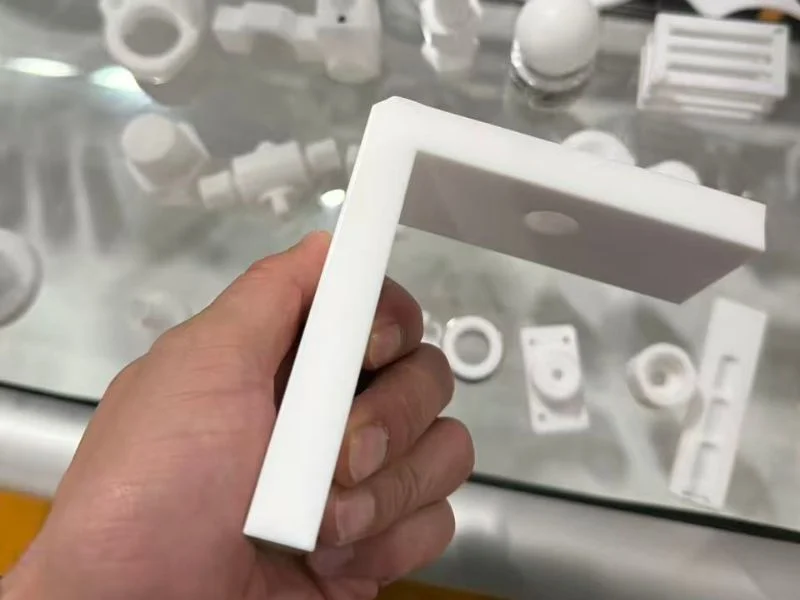
CNC Router vs Waterjet for PTFE: The Short Answer
Use a CNC router for finished PTFE components that need slots, holes, pockets or a smooth sealing face; use a waterjet for very thick, outline-only blanks where no internal features are required. Most PTFE parts fall in the router column.
The table below sums up the trade-offs. The sections after it explain each one so you can match the method to your part instead of your equipment.
| Factor | CNC router (spindle milling) | Waterjet (abrasive) |
|---|---|---|
| Best for | Profiles, slots, holes, pockets, 3D, batch parts | Very thick outline-only blanks |
| Edge and finish | Clean, dry, square, machined smooth | Colder cut, but abrasive-textured and wet |
| Internal features | Slots, blind holes, pockets, tapped, 3D | Through-cut outline only |
| Thickness | Limited by Z-travel and tool reach | Very thick in one pass |
| Process | Dry | Wet — moisture concern on modified PTFE |
| Fine detail | Fast and precise | Slower, coarser |
| Running cost | Low — mainly tooling | High — garnet, water, pump power |
How Each Method Cuts PTFE
A CNC router shears PTFE dry with a rotating spindle tool; a waterjet erodes it cold and wet with a high-pressure stream of water and abrasive garnet. The mechanics are completely different, and that difference drives every other trade-off.
On a router, a sharp, high-rake tool slices a clean chip from the plate while dust extraction pulls the fine PTFE away. It runs dry, cuts several features in one setup, and depends on correct feeds and speeds to avoid fuzz — the details are covered in our guide on cutting PTFE without fraying. Because there is no heat and no water, the part leaves the table finished and ready to measure.
A waterjet takes a different route. A pump drives water through a fine orifice at very high pressure, mixes in garnet abrasive, and that stream erodes a path straight through the material. There is no rotating tool and almost no heat, so it will cut PTFE — and nearly anything else — of great thickness. But the cut is wet, the stream is abrasive, and it only ever cuts all the way through.
So the choice is not really router versus waterjet in the abstract. It is: do you need machined features and a dry, finished part, or do you need to get an outline through a very thick blank?
Edge Quality and Finish on PTFE
A CNC router leaves a clean, dry, square edge; a waterjet leaves a colder but abrasive-textured, wet edge, and its high-pressure water raises a moisture concern in some modified PTFE grades. For any sealing surface, the router edge is the safer choice.
Routed PTFE comes off the machine with a smooth, milled edge and square walls, which matters on gasket and seal faces where the sealing surface has to be flat and clean. A light finishing pass and, for precision work, an anneal step take that edge down to tight tolerance without heat marks.
A waterjet edge is cold but different in character. The abrasive stream leaves a slightly frosted, textured surface and can taper on thicker sections, so a face that has to seal often needs a second operation. On soft virgin PTFE, embedded garnet is a minor concern, but the texture is still rougher than a machined face.
The wet process adds one more consideration. Parts come off the waterjet wet and need drying, and glass- or carbon-filled and other modified PTFE grades can absorb some moisture under high-pressure water — something a dry routing process avoids entirely.
Precision and Tolerance on Machined PTFE
A CNC router holds tighter, more repeatable tolerances on PTFE than a waterjet, especially once an anneal-and-finish step controls the material’s thermal expansion. For mating and sealing dimensions, milling is the more predictable process.
A router combines fine positioning accuracy with the option to rough close to size, anneal to relieve stress, then take a light finishing pass. That routine is how machined PTFE reaches tolerances down to about ±0.0005 in on precision work and repeats part to part, because the stress that would otherwise move the part later has already been released.
A waterjet is less predictable on tight-tolerance PTFE. The high-pressure stream tapers — the top of the cut is wider than the bottom — and the taper grows with thickness, while the stream lags on corners and fine detail. On soft PTFE those effects are enough that a dimension held to a few thousandths usually wants a machining pass anyway.
So when a print calls out a tight bore, a flat sealing face or a repeatable groove depth, the router reaches it directly; the waterjet gets close to an outline and hands the precision work to a second operation.
Features: Slots, Holes, Pockets and 3D Work
This is where a CNC router pulls clearly ahead — it cuts slots, blind holes, pockets, counterbores, tapped features and 3D contours that a waterjet, which only cuts all the way through, cannot make. Feature requirements alone decide many PTFE jobs.
A waterjet is a through-cutting tool. It produces an outline and any holes that go fully through the plate, but it cannot make a blind hole, a partial-depth pocket, an O-ring groove, a step or a thread. Anything that stops short of the back face is out of reach.
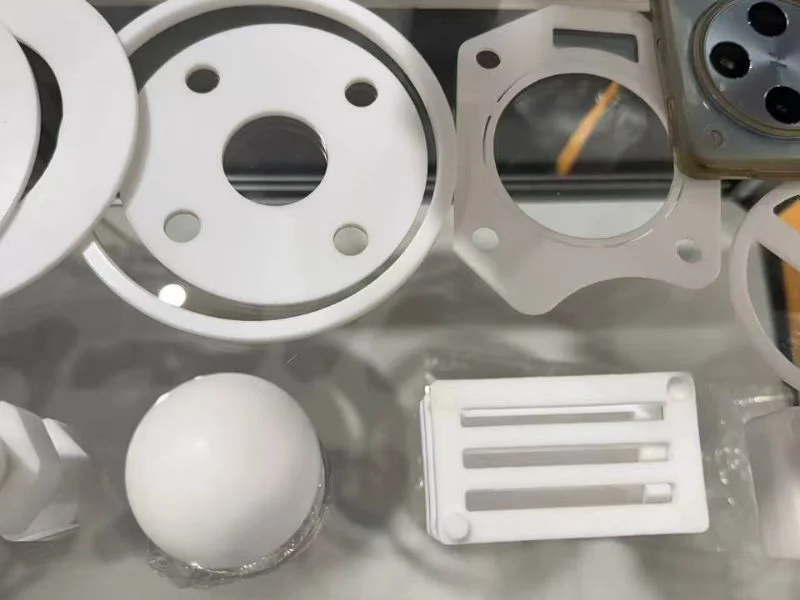
A router controls depth on every axis, so it machines all of those in a single setup. Real PTFE components rarely stop at an outline: valve seats need grooves, insulators need bolt holes and counterbores, seals need steps and chamfers. Those parts have to be milled, not blasted.
When a part is a simple flat outline with only through-holes, both methods can make it. The moment it needs a pocket, a groove or a tapped hole, the router is the only one of the two that finishes the job.
Thickness: How Thick Can Each Method Cut?
A waterjet wins on raw thickness — it cuts very thick PTFE blanks in one pass — while a CNC router is limited by spindle Z-travel and tool reach, though it covers the plate and block thicknesses most PTFE parts actually use. Thickness is the waterjet’s strongest argument.
Most finished PTFE components are made from plate, rod and block within a router’s Z range, and the router handles them while adding the features those parts need. Its ceiling is set by how far the spindle can plunge and how long a tool you can run without deflection.
Where a blank is exceptionally thick and you only need the outer shape — no pockets, no grooves — a waterjet cuts it in one pass without a heat-affected zone. That is the case that justifies the wet, slower, costlier process.
It helps to see all three PTFE methods together. Thin PTFE film and skived tape are cut on an oscillating knife; plate and block that need machined features go on a router; very thick outline-only blanks go on a waterjet. Match the thickness and the features, and the method chooses itself.
Speed, Cost and Running Costs
A CNC router has lower running costs — mainly tooling — while a waterjet carries higher operating cost from garnet abrasive, water, pump power and slower fine-detail cutting. Over a batch of finished parts, the router is usually the cheaper and faster route.
A router’s main consumable is the cutting tool. Filled PTFE dulls tools faster than virgin, but tooling is a modest, predictable cost, and once a program is set the machine repeats parts quickly in one setup.
A waterjet’s running cost is higher and more continuous: garnet abrasive is consumed every second the jet is on, the high-pressure pump draws significant power, and water use and disposal add up. Fine detail also cuts slowly, so intricate PTFE parts take longer than on a router.
The economics flip only at the extremes. For a one-off, ultra-thick outline blank, standing up a milling program makes little sense and the waterjet earns its cost. For repeatable finished components with features, the router wins on both speed and running cost.
Batch Production and Repeatability
For repeatable batches of PTFE parts, a CNC router shines — one program, one setup, part after part — while a waterjet can nest parts but pays garnet, water and time on every piece. Volume shifts the economics toward milling.
Once a router program is proven, the machine repeats the part with consistent features and dimensions, and a tool changer lets it drill, pocket and profile in a single setup without an operator re-fixturing between steps. For a run of gaskets, seals or insulators, that repeatability is where the cost per part drops.
A waterjet can nest several parts on one sheet, which helps material use, but every cut still consumes garnet and pump power, runs slowly on fine detail, and leaves wet parts to dry and often to finish. Across a batch of featured PTFE components, those per-piece costs and the extra operations add up faster than a router’s tooling wear.
When It Makes Sense to Use Both
On exceptionally thick PTFE parts that also need machined features, the two methods can work together — a waterjet roughs the thick outline, then a router adds the pockets, grooves and finished faces. It is a niche case, but a real one.
The logic follows each method’s strength. When a blank is too thick for a router to profile efficiently but the finished part still needs bores, steps or a sealing face, a waterjet can take the thick outline down to rough shape and hand it to a router for the feature and finishing work. Most PTFE parts never need this — one method covers them — but for very thick, feature-rich components it uses each tool where it is strongest.
Where Laser and Die Cutting Fit — and Where They Don’t
Two other methods come up for PTFE, and both are quickly ruled out for most jobs: a laser cannot cut PTFE safely, and die cutting only suits thin, high-volume, fixed shapes. Knowing why keeps the choice between router and waterjet clean.
A laser is a non-starter on PTFE. The material decomposes above about 260 °C and releases toxic fluoride fumes, leaving a charred edge, so PTFE plate should never go under a laser regardless of thickness. That removes the method that handles many other plastics.
Die cutting — a steel-rule die or punch — works only on thin PTFE sheet, film and tape. It is fast and cheap for very high volumes of one fixed shape, but every shape needs its own tooling, it cannot make slots, pockets, threads or any 3D feature, and a design change means a new die. For thick plate or anything with machined features, it is out.
That leaves the real choice for thick, featured PTFE parts where it started: a CNC router for finished components, and a waterjet for very thick outline-only blanks. Die cutting only re-enters the picture for thin, flat, high-volume gaskets, and the laser stays off PTFE entirely.
Which Should You Choose for Your PTFE Parts?
Match the method to the part: a router for finished components with features and sealing faces, a waterjet for very thick outline-only blanks, and an oscillating knife for thin film. Start from what the part needs, not from what machine is free.
| Your PTFE part | Best method |
|---|---|
| Gaskets, flat and ring seals, valve seats (smooth face plus features) | CNC router |
| Insulators, bushings, machined profiles (holes, steps, pockets) | CNC router |
| Very thick outline-only blanks, no internal features | Waterjet |
| Thin PTFE film, skived tape, thin sheet | Oscillating knife |
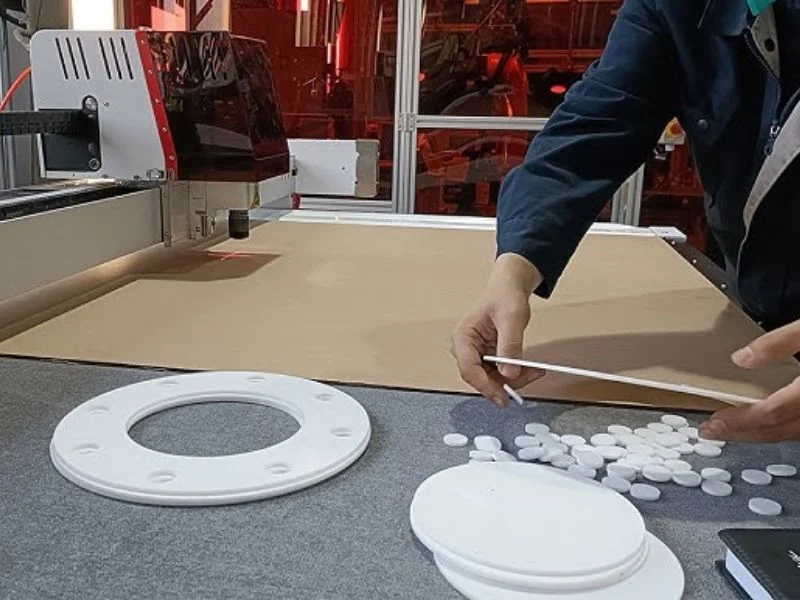
For most buyers sourcing finished PTFE gaskets, seals and insulators, a CNC router is the practical answer: dry, clean edges, machined features and a lower cost per part. You can see the machines, real specs and customer cutting footage on our PTFE and Teflon cutting machine page, or look at the T5 Precision CNC Router used in those clips.
Frequently Asked Questions
Can a waterjet cut PTFE without melting it?
Yes. A waterjet cuts cold with water and garnet, so there is no heat and no charring. The trade-offs are a wet, abrasive-textured edge and the inability to make blind holes, pockets or 3D features. It suits very thick outline-only blanks.
Is a CNC router or a waterjet better for PTFE gaskets?
A CNC router is usually better for gaskets. It leaves a smooth, dry sealing face and can add bolt holes, grooves and steps in one setup. A waterjet only cuts the outline and holes that pass fully through, and its edge is rougher and wet.
Does waterjet cutting make PTFE absorb water?
Virgin PTFE absorbs almost no water, but glass- and carbon-filled or other modified grades can take up some moisture under high-pressure water. A dry CNC routing process avoids this entirely, which matters for parts held to tight dimensional or electrical specs.
How thick a PTFE plate can a CNC router cut?
A router machines solid PTFE plate, rod and block; the ceiling depends on spindle Z-travel and tool reach. It covers the thicknesses most PTFE components use. For exceptionally thick outline-only blanks, a waterjet is the better fit. Send your drawing and we confirm the right machine.
Which is cheaper for PTFE parts, a router or a waterjet?
For repeatable finished parts, a CNC router is usually cheaper: its main cost is tooling, and it cuts features in one setup. A waterjet consumes garnet, water and pump power continuously and cuts fine detail slowly, so its running cost is higher except on one-off ultra-thick blanks.
Can a CNC router cut PTFE without leaving fuzz?
Yes. Sharp, uncoated, high-rake tooling, light passes, a steady feed and dust extraction give clean, fuzz-free edges. The full method is in our guide on cutting PTFE without fraying or powdering.
Router and waterjet both cut PTFE cold, but they answer different questions. If your part needs machined features, a smooth sealing face and a dry, low-cost result, mill it on a CNC router. If it is a very thick blank that only needs its outline, a waterjet earns its place. See the full method comparison and material data on our PTFE cutting machine page.
Background reading: water jet cutter and PTFE (polytetrafluoroethylene).