PTFE, POM, PEEK and nylon all machine well, but picking the wrong one means a part that swells, wears out or costs far more than it needed to.
These four cover most engineering-plastic jobs, yet they behave very differently on temperature, chemical resistance, strength, moisture and price. A low-friction seal, a precise gear, a high-heat bushing and a tough wear pad each point to a different material — and the machining approach shifts with them.
This guide compares PTFE, POM (acetal), PEEK and nylon on the properties that decide a part, and shows which plastic fits which job before you cut it.
PTFE vs POM vs PEEK vs Nylon: The Short Answer
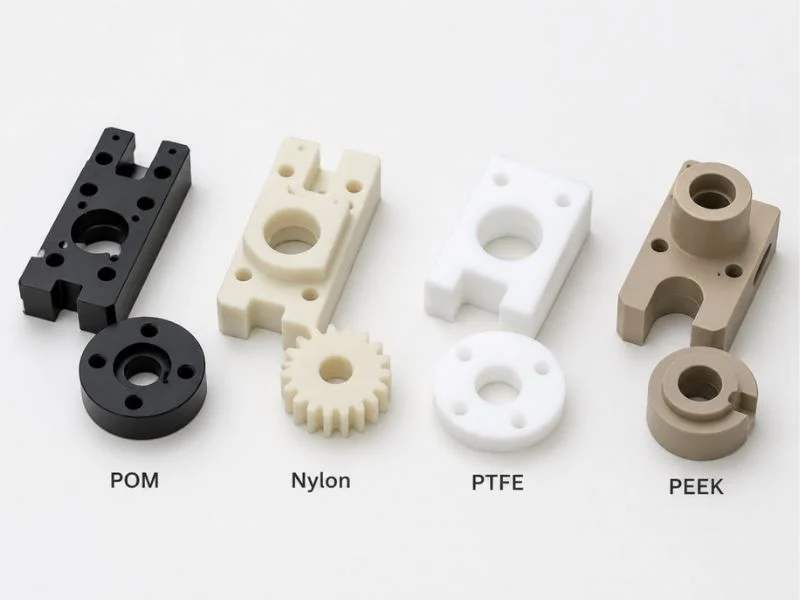
Choose PTFE for low friction and chemical or heat resistance, POM for stiff precision parts, PEEK for the highest temperature and load, and nylon for tough, low-cost wear parts. The table below lines up the trade-offs behind that summary.
| Property | PTFE | POM (Acetal) | PEEK | Nylon (PA) |
|---|---|---|---|---|
| Max service temp | ~260 °C | ~100 °C | ~250 °C | ~120 °C |
| Friction | Lowest (0.05–0.10) | Low | Low | Medium |
| Chemical resistance | Excellent | Good | Excellent | Fair |
| Strength / stiffness | Low, soft | High, rigid | Very high | Tough, moderate |
| Moisture absorption | Negligible | Very low | Very low | High |
| Machining | Soft; frays without sharp tools | Cuts crisp and easy | Hard; abrasive on tools | Gummy; moves with moisture |
| Relative cost | Mid | Low | High | Low |
Each row is a section below. Read them against your part’s real demands — temperature, load, chemicals, tolerance and budget — rather than reaching for the most capable material by default.
Temperature and Chemical Resistance
PTFE and PEEK lead on heat and chemicals; POM and nylon are limited to milder service. If a part sees hot fluids, aggressive chemicals or steam, the choice narrows to two materials fast.
PTFE handles continuous service to about 260 °C and resists almost every chemical, which is why it dominates seals, gaskets and linings in chemical, food and semiconductor work. PEEK matches it on temperature at about 250 °C and has excellent chemical resistance too, while adding strength PTFE lacks.
POM and nylon sit lower. POM is stable and machinable but tops out near 100 °C and offers only good — not excellent — chemical resistance, so it suits precision mechanical parts more than harsh environments. Nylon reaches about 120 °C but its fair chemical resistance and moisture pickup rule it out of many wet or aggressive applications.
So for a hot or chemically hostile part, the decision is usually PTFE versus PEEK, and it comes down to whether the part also needs mechanical strength.
Strength, Stiffness and Wear
PEEK is the strongest and stiffest of the four, POM is rigid and dimensionally stable, nylon is tough and wear-resistant, and PTFE is the softest and weakest. Load-bearing parts and low-friction parts pull in opposite directions here.
PTFE trades strength for its unmatched friction and chemistry — at Shore D 60 it deforms and creeps under load, so it is rarely a structural part on its own. PEEK is the opposite: very high strength and stiffness that hold up under mechanical and thermal load, which is what justifies its price on demanding parts.
POM fills the middle for mechanical work. It is rigid, dimensionally stable and low-friction, which makes it a default for gears, cams, bearings and precision components that must hold their shape. Nylon is tougher and more impact- and wear-resistant than POM, so it earns wear pads, bushings and rollers, as long as its moisture behavior is managed.
Moisture and Dimensional Stability
Nylon absorbs significant moisture and moves with it; PTFE, POM and PEEK are dimensionally stable by comparison. For a part held to a tight size, moisture behavior can matter as much as strength.
Nylon takes up water from humid air, and as it does it swells and its dimensions and properties shift. That is manageable with design allowances, but for a tight-tolerance part in a changing environment it is a real limitation — the part you machined dry is not the part you have a week later.
PTFE absorbs almost no water, and POM and PEEK take up very little, so all three hold size far better across humidity. This is one reason PTFE and POM are chosen for precision seals and mechanical parts where stability over time is not optional. When a print calls out a tight bore or sealing face that must stay put, nylon is usually the first material crossed off.
Machinability: How Each Plastic Cuts
POM is the easiest to machine, PTFE is soft and frays without sharp tooling, PEEK is hard and abrasive on tools, and nylon cuts gummy and moves with moisture. The same CNC router cuts all four, but the tooling and care change with each.
POM cuts crisp and clean with well-defined edges, which is part of why it is a machinist favorite for precision parts. PTFE is soft and heat-sensitive, so it needs sharp, uncoated, high-rake tools and light passes to avoid the white fuzz and powder covered in our guide on cutting PTFE without fraying.
PEEK machines to tight tolerance but is hard and abrasive, so it wears tooling faster and rewards sharp carbide and steady feeds. Nylon is tough and slightly gummy, and because it absorbs moisture, drying stock before machining helps it hold size. In every case the principles are the same as any clean plastic cut: sharp tools, controlled heat, firm workholding and chip clearance.
Filled and Reinforced Grades
Glass- and carbon-filled grades change the picture — they add strength, stiffness and stability, but wear tools faster and raise cost. A filled version of a cheaper plastic can sometimes do a job you would otherwise reach to a pricier material for.
Glass-filled PTFE, usually 15–25% glass, resists creep and wear far better than virgin PTFE and holds size under load, which is why filled grades go into bearings and wear parts. Carbon-filled PTFE adds wear resistance and some electrical conductivity. The trade-off is abrasion: fillers dull tools noticeably faster, so plan tool life around the grade.
The same idea helps the other plastics. Glass-filled nylon is much stiffer and far more dimensionally stable than unfilled nylon, narrowing its biggest weakness — moisture movement. Glass-filled POM stiffens an already rigid material, and carbon-fiber PEEK pushes strength and stiffness higher still for aerospace-grade parts.
The practical rule is to confirm the exact grade before machining. A virgin and a glass-filled version of the same plastic run on the same machine but demand different tooling and give very different tool life, and knowing which is on the table prevents a surprise mid-run.
Cost and When to Step Up to PEEK
Nylon and POM are the low-cost options, PTFE sits in the middle, and PEEK is the premium material you step up to only when temperature, strength or chemistry demand it. Paying for PEEK on a part that does not need it is the most common material mistake.
For a simple wear part or a mild-duty gear, nylon or POM does the job at the lowest cost, and there is no reason to reach higher. PTFE’s mid price is justified when a part needs its low friction, chemical resistance or heat tolerance — a seal, an insulator, a low-friction slide.
PEEK is the material you specify when the part must survive both high temperature and high load, or an aggressive chemical environment while carrying stress. It is the most expensive and the most abrasive to machine, so it earns its place on genuinely demanding parts, not as a default upgrade. When PTFE is strong enough or POM is hot enough, the cheaper material is the right one.
The Close Calls: PTFE vs PEEK and POM vs Nylon
Two comparisons cause most of the hesitation — PTFE versus PEEK for demanding parts, and POM versus nylon for mechanical parts. Settling each one comes down to a single deciding factor.
PTFE versus PEEK is a load question. Both resist high temperature and chemicals, so if the part carries little mechanical stress and needs low friction, chemical resistance or the lowest cost of the two, PTFE wins. The moment the part must also bear real load or stress at temperature, PEEK’s strength and stiffness justify its higher price.
POM versus nylon is a stability-versus-toughness question. POM is stiffer, machines crisper and holds size better, so it takes precision gears, cams and mechanical parts. Nylon is tougher and more impact- and wear-resistant, and usually cheaper, so it takes bushings, rollers and wear parts — as long as its moisture movement is acceptable or a glass-filled grade is used.
Framed this way, most “which plastic” debates resolve quickly: decide whether the governing need is load, friction, precision or toughness, and the pair collapses to one clear answer.
Typical Parts and Industries for Each Plastic
Each plastic clusters around a set of parts and industries that play to its strengths. Seeing where each one already dominates is often the fastest sanity check on a material choice.
PTFE goes into gaskets, flat and ring seals, valve seats, insulators, bushings and low-friction slides, and it is the default in chemical processing, food, semiconductor, oil and gas and electrical work where its chemistry and low friction are irreplaceable. POM takes gears, cams, bearings, fasteners and precision mechanical parts across automotive, consumer products and machinery, wherever stiffness and dimensional stability matter.
PEEK concentrates in high-temperature, high-load and aggressive-chemical parts — aerospace components, medical devices, and oil and gas hardware — where its cost is justified by conditions the others cannot survive. Nylon fills tough, cost-sensitive wear roles: bushings, wear pads, rollers, guides and gears in industrial and automotive machinery, where impact and abrasion resistance outweigh its moisture behavior.
If a part looks like an outlier for its material — a structural PTFE bracket, a hot-fluid nylon seal — that is usually a signal to re-check the choice against the property tables above before committing stock.
Which Plastic Should You Choose for Your Part?
Start from the part’s hardest requirement — friction, temperature, load, stability or budget — and the material usually chooses itself. The table maps common needs to the plastic that fits.
| Your part’s main need | Best fit |
|---|---|
| Lowest friction, seals, chemical or food contact | PTFE |
| Stiff, dimensionally stable precision parts, gears | POM (Acetal) |
| High temperature plus high mechanical load | PEEK |
| Tough, low-cost wear parts and bushings | Nylon |
| Precise part held to tight size in humid air | PTFE or POM (not nylon) |
All four machine cleanly on a CNC router with the right tooling, so the decision is about the material, not the method. If your parts are PTFE seals, insulators or low-friction components, see the machines and real cutting footage on our PTFE and Teflon cutting machine page, and for the tooling and feeds behind a clean plastic cut, read how to cut PTFE without fraying.
Frequently Asked Questions
Is PTFE or PEEK better for high-temperature parts?
Both handle roughly 250–260 °C, so the tie-breaker is strength. PTFE is soft and low-friction but weak; PEEK is very strong and stiff. For a hot part that also carries load, choose PEEK. For a hot, low-friction or chemical part with little load, PTFE is more economical.
Which is easier to machine, POM or PTFE?
POM is easier. It cuts crisp with clean, well-defined edges and holds tolerance readily. PTFE is soft and frays without sharp, high-rake tooling and light passes. Both cut on the same CNC router, but PTFE needs more care to avoid fuzz and dimensional drift.
Why does nylon change size after machining?
Nylon absorbs moisture from the air and swells as it does, so a part machined dry can grow over the following days. Drying the stock before cutting and allowing for movement helps. For parts that must hold a tight size in humid conditions, PTFE or POM is a safer choice.
When is PEEK worth its higher cost?
PEEK earns its price when a part must survive high temperature and high mechanical load together, or an aggressive chemical environment while under stress. If PTFE’s chemistry or POM’s heat range is already enough, the cheaper material is the better engineering and cost decision.
Can one CNC router cut PTFE, POM, PEEK and nylon?
Yes. A CNC router cuts all four; what changes is the tooling and care. PEEK is abrasive and wears tools faster, PTFE needs sharp high-rake tools, nylon benefits from dried stock, and POM cuts easily. Sharp tools, controlled heat and firm workholding apply to all of them.
PTFE, POM, PEEK and nylon each win a different job: PTFE for friction and chemistry, POM for stiff precision, PEEK for heat and load, nylon for tough low-cost wear. Match the material to the part’s hardest demand and machine it with the right tooling. To cut PTFE parts specifically, see our PTFE cutting machine page.
Material references: PEEK and POM (acetal).