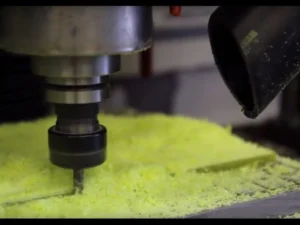
Rout PTFE at the wrong speed and you get white fuzz, powder and a furry edge instead of a clean part.
The problem is rarely the machine. PTFE is a unique engineering plastic with excellent chemical resistance, extremely low friction, and outstanding temperature stability. Understanding what PTFE is and its unique material properties helps explain why this material behaves differently during cutting. PTFE is soft, it expands with heat more than almost any other plastic, and it smears when a dull or fast-spinning tool drags across it instead of slicing. Fix the tool, the speed and the way you hold the part, and the fuzz disappears.
This guide explains why PTFE frays, which tooling and feeds cut it cleanly, and how fixturing and dust extraction keep edges sharp and parts on dimension.
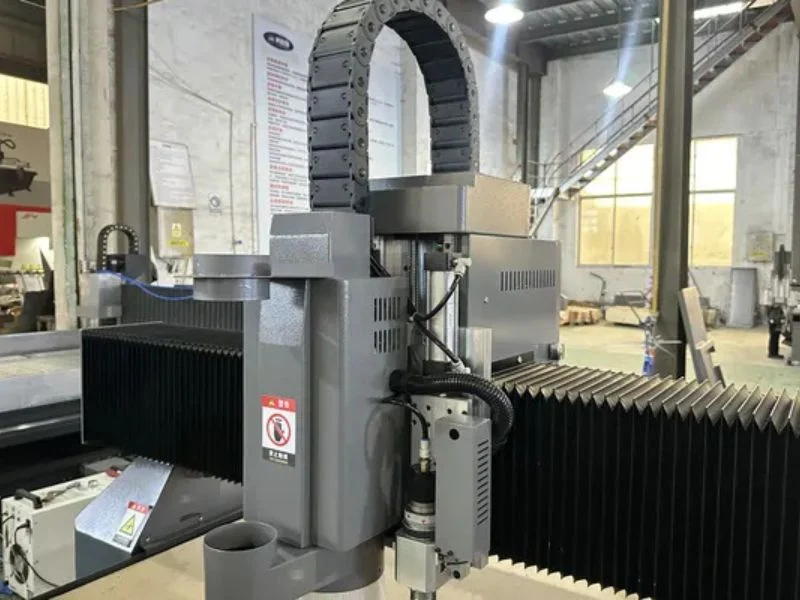
Why Does PTFE Fray and Powder When You Cut It?
PTFE frays and powders because it is soft and heat-sensitive, not because it is hard. A tool that rubs instead of slicing builds friction heat, the surface softens, and the edge tears into stringy fuzz and white dust rather than shearing away cleanly.
Two material properties drive this. PTFE has a hardness of only about Shore D 60, so a blunt edge pushes the material aside instead of cutting it. And PTFE has one of the highest thermal-expansion rates of any plastic — roughly ±1.3% over a 32–212 °F swing — so any heat you add makes the part grow, drift and grab the tool.
Heat is the enemy in another way too. PTFE starts to decompose above about 260 °C and melts near 327 °C. You will never reach those numbers in clean cutting, but local friction at a dull edge can soften the surface enough to leave a smeared, fuzzy finish.
So the white powder and stringy hairs are a symptom, and the usual causes are:
- A dull or coated tool that drags instead of shears
- Too much spindle dwell — high rpm with slow feed, so the bit rubs one spot
- No chip clearance, so cut material re-welds to the edge
- The part moving under the tool because PTFE is slippery and lightly held
Every one of these is fixable at the setup stage, which is why a clean PTFE cut is mostly about preparation, not brute force.
What Tools Cut PTFE Cleanly?
The cleanest PTFE cuts come from extremely sharp, uncoated carbide or HSS tools with polished flutes and a large positive rake angle. A sharp, high-rake edge slices the polymer away as a chip instead of tearing it into fuzz.
Rake angle matters more on PTFE than on most materials. A positive rake in the 0–15° range presents a keen slicing edge, lowers cutting friction, and stops material building up on the tool. Coatings, which help on metal, usually hurt here — an uncoated, polished edge stays sharper to the polymer and sheds chips better.
| Tool choice | Good for PTFE? | Why |
|---|---|---|
| Sharp uncoated carbide, polished flute, positive rake | Recommended | Shears cleanly, low friction, resists build-up |
| Single- or O-flute cutter | Recommended | Open flute clears soft chips before they re-weld |
| Dull or worn tool | Avoid | Drags and smears; leaves fuzz and powder |
| Coated / low-rake metal tooling | Avoid | Higher friction; material deposits on the edge |
Because PTFE is soft, cut material can deposit on the cutting edge and slowly dull it, so keeping tools clean and swapping them at the first sign of fuzz is part of the routine, not an afterthought.
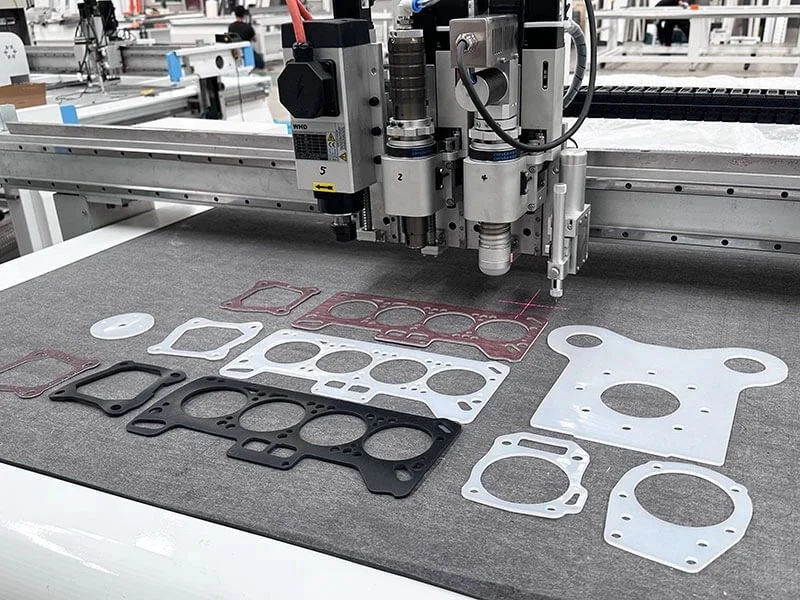
Best Feeds, Speeds and Depth of Cut for PTFE
Cut PTFE with light passes, a moderate spindle speed and a steady feed — enough feed to slice, not so much dwell that the bit whips soft material into powder. The goal is to remove a clean chip while adding as little heat as possible.
Exact numbers depend on your grade (virgin versus glass- or carbon-filled), tool diameter and machine, so treat the table below as starting points and confirm against a test cut, not as fixed values.
| Parameter | Starting guideline | Why it matters |
|---|---|---|
| Depth of cut per pass | Light — around 0.5–2 mm | Limits heat build-up and part growth |
| Spindle speed | Moderate, not maxed out | High rpm plus dwell softens and smears PTFE |
| Feed rate | Steady, enough to shear a chip | Too slow and the tool rubs; too fast and thin parts deflect |
| Finishing | Light final pass, anneal for tight work | Releases stress from PTFE’s high thermal expansion |
For precision parts, an anneal-and-finish step earns its time. Rough close to size, relieve the stress, then take a light finishing pass — this is how machined PTFE reaches tolerances down to about ±0.0005 in on the tightest work. Skip it and the part can move off dimension hours after it leaves the machine as internal stress relaxes.
How Fixturing and Dust Extraction Keep the Cut Clean
Because PTFE is slippery and expands with heat, hold it flat with vacuum or clamps and pull chips away with dust extraction — this stops drift, chatter and re-cut fuzz. Good workholding does as much for edge quality as the right tool.
PTFE’s coefficient of friction is only about 0.05–0.10, so a lightly clamped sheet slides, lifts and chatters, and every bit of movement shows up as a rough edge. A vacuum table — zoned for smaller parts — pulls the whole sheet down evenly, while mechanical clamps suit thick blocks that a vacuum alone will not hold.
Dust extraction handles the other half. A spindle shroud with vacuum pulls the fine PTFE chips out of the cut before they can pack into the flutes or re-weld to the edge. Keeping the cut clear also keeps it cool, which loops back to the core rule: less heat, less fuzz.
- Vacuum table for sheets and plate; zone it for small parts
- Clamps or fixtures for thick blocks and rod
- Spindle shroud plus extraction to clear chips and hold temperature down
- Shallow passes so the part never has time to heat and grow
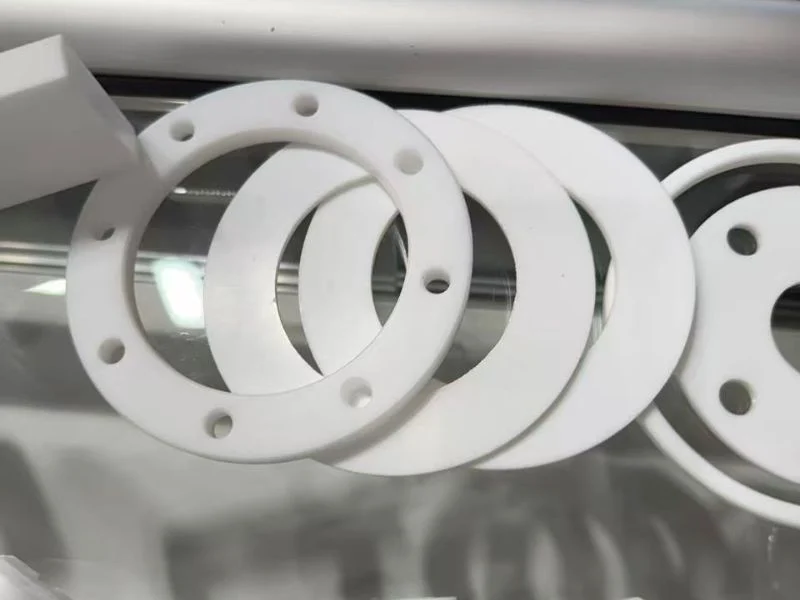
Does Filled PTFE Cut Differently From Virgin PTFE?
Yes — glass- and carbon-filled PTFE is harder and more abrasive than virgin PTFE, so it holds an edge better and frays less, but it wears tools faster. The cutting approach is the same; the trade-off shifts.
Virgin PTFE is the softest and the most prone to fuzz, which is why sharp tooling and light passes matter most on it. Filled grades — typically 15–25% glass or carbon — are stiffer, more dimensionally stable and resist creep, so they cut with a crisper chip and cleaner edge. The catch is abrasion: the filler dulls tools noticeably faster, so plan for more frequent tool changes and expect carbide to outlast HSS on filled stock.
Whichever grade you run, confirm the exact material before cutting. A virgin seal and a glass-filled bearing take the same machine but different tool life, and knowing which you have on the table saves a scrapped part and a ruined edge.
When a Router Is the Wrong Tool: Knife and Waterjet
A rotating spindle is the right tool for profiles, slots, holes and 3D features in solid PTFE plate and block; thin PTFE film and outline-only blanks are better handled elsewhere. Matching the method to the part avoids most edge-quality fights before they start.
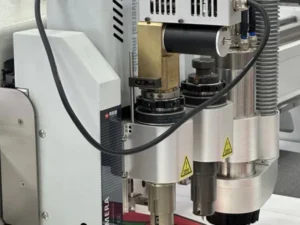
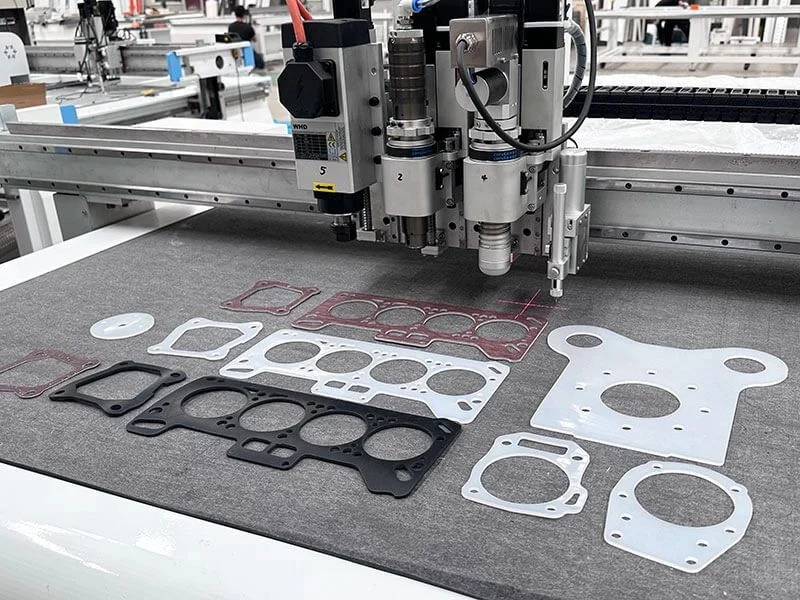
Thin PTFE film or skived tape moves and stretches under a spindle, so it is cut on an oscillating knife instead — a slicing blade with no rotation and no heat. Very thick blanks where you only need an outline can be waterjet cut cold, though the process is wet, slower for fine detail, and cannot produce slots, pockets or tapped features. For finished PTFE components — gaskets, seals, insulators, machined profiles — spindle milling on a CNC router remains the practical choice.
If you are weighing a router against a waterjet for thick plate, or comparing PTFE with other machinable plastics, the trade-offs are worth a closer look before you commit a job. You can also see the full method comparison and real customer cutting footage on our PTFE and Teflon cutting machine page.
Frequently Asked Questions
Why does my PTFE cut leave white fuzz and powder?
Fuzz and powder come from friction heat and a dull or fast-spinning tool that drags instead of slicing. Use a sharp, uncoated, high-rake tool, take light passes, keep the feed steady and add dust extraction. The fuzz is a setup symptom, not a material defect.
What rake angle and tooling should I use for PTFE?
Use extremely sharp, uncoated carbide or HSS with polished flutes and a positive rake around 0–15 degrees. A single- or O-flute cutter clears the soft chips before they re-weld. Swap the tool at the first sign of fuzz, because deposits dull the edge quickly.
What feeds and speeds work for machining PTFE?
Run a moderate spindle speed with a steady feed and light depth of cut, roughly 0.5–2 mm per pass. Enough feed to shear a clean chip, not so little that the tool dwells and melts the surface. Confirm exact numbers with a test cut on your grade.
Can I laser cut PTFE instead of machining it?
No. PTFE decomposes above about 260 °C and releases toxic fluoride fumes, leaving a charred edge. Thick PTFE should be machined with a rotating spindle, which cuts cold and clean. Thin PTFE film is handled on a digital knife cutter.
How do you hold tight tolerance on machined PTFE?
Rough close to size, anneal to relieve stress, then take a light finishing pass. This controls PTFE’s high thermal expansion and reaches tolerances down to about ±0.0005 in on precision work. Skipping the anneal lets parts drift off dimension as stress relaxes.
Can a CNC router cut PTFE gaskets, seals and insulators?
Yes. Spindle milling produces finished gaskets, flat and ring seals, valve seats, bushings and insulators from solid PTFE plate and block, including glass- and carbon-filled grades. It cuts profiles, slots and holes in one setup, dry and without the heat of a laser.
Cutting PTFE cleanly is mostly about respecting how soft and heat-sensitive it is: a sharp high-rake tool, light passes, steady feed, firm holding and good extraction. Dial those in and solid PTFE cuts with clean, square edges and full depth control. To see the machines and material data behind these methods, visit our PTFE cutting machine page or the T5 Precision CNC Router.
Further reading on the polymer itself: Polytetrafluoroethylene (PTFE) and the basics of cutting-tool rake angle.