G10 machining has a trap in it. Glass-epoxy laminate is one of the few materials that will let you get everything nearly right and still hand you a scrap part. It machines cleanly enough that a first test cut usually looks fine. The problems — a dulled cutter, a delaminated edge, an insulation part that no longer insulates — arrive on part number forty.
This guide covers what actually decides the outcome in G10 machining and FR-4 machining on a CNC router: tool choice, feed rate, why you must cut dry, and how to handle the dust. The same reasoning applies to G11/FR5 and 3240. If you are choosing the machine rather than tuning one, our CNC router for G10 and FR-4 page covers the machine-side requirements.
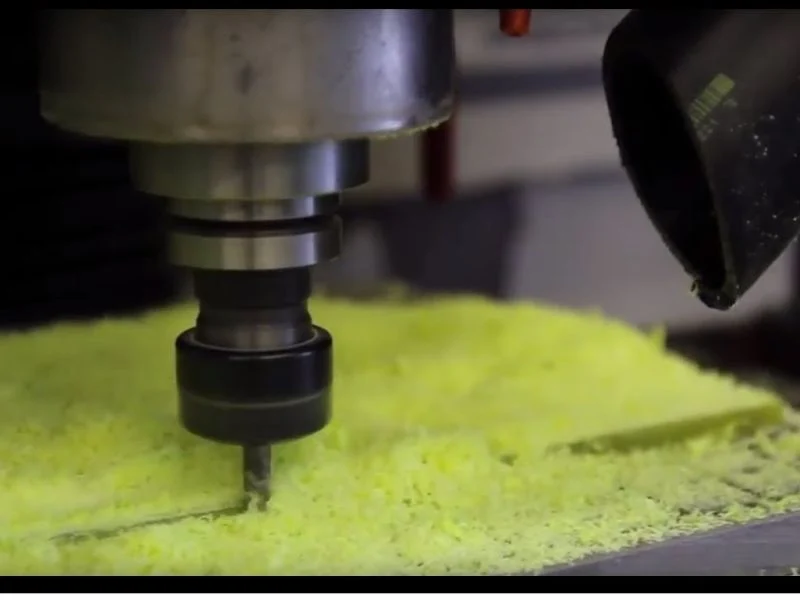
Why G10 Machining Punishes the Wrong Setup
These laminates are woven glass cloth impregnated with epoxy resin and pressed under heat and pressure, to grades defined under the NEMA LI 1 standard. That construction is exactly why they are useful — high dielectric strength, low moisture absorption under 0.3%, dimensional stability — and exactly why they are difficult.
The glass is the problem. It is abrasive in the literal sense: every pass takes material off your cutter as well as off the workpiece. The resin is the second problem, because it is thermally sensitive in a way that does not show on the surface.
So you are cutting to a tolerance with a tool that is continuously getting smaller, in a material where overheating causes damage you cannot see.
Tooling for G10 Machining: Carbide or Diamond-Coated
Both work in G10 machining. The decision is economic, not technical, and it comes down to cost per part rather than the price on the tool.
| Tooling | Cost | Typical life in glass-epoxy | Where it makes sense |
|---|---|---|---|
| Solid carbide | $5–15 | 2–5 hours | Prototypes, one-off fixtures, low volume |
| Diamond-coated | $25–60 | 15–30 hours | Any production run — roughly six times the life for five times the price, which is where cost per part turns in its favour |
Router bits designed for the PCB industry are worth seeking out. They were developed for this exact material and outlast general-purpose woodworking tooling by a wide margin. A standard two-flute wood spiral will cut G10 for about twenty minutes, and the danger is not that it stops — it is that it keeps going while producing oversize parts.
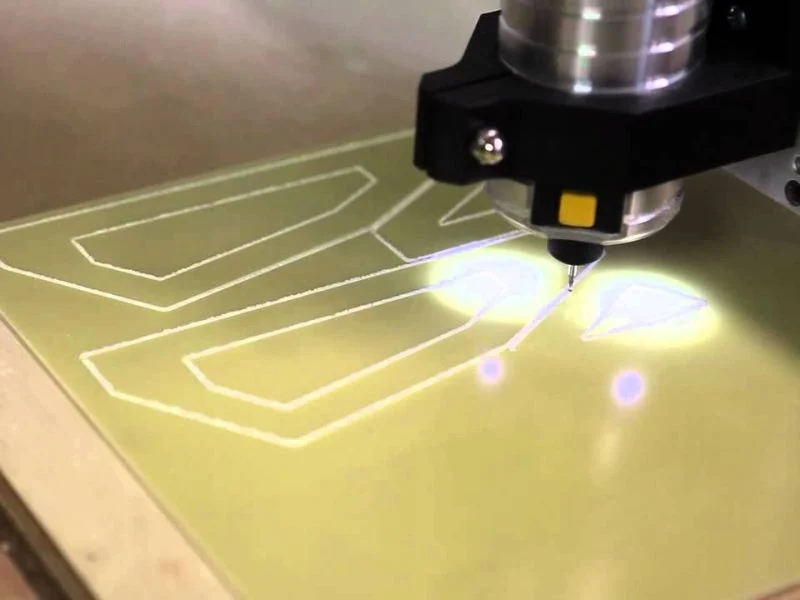
Feeds and Speeds for G10 and FR-4
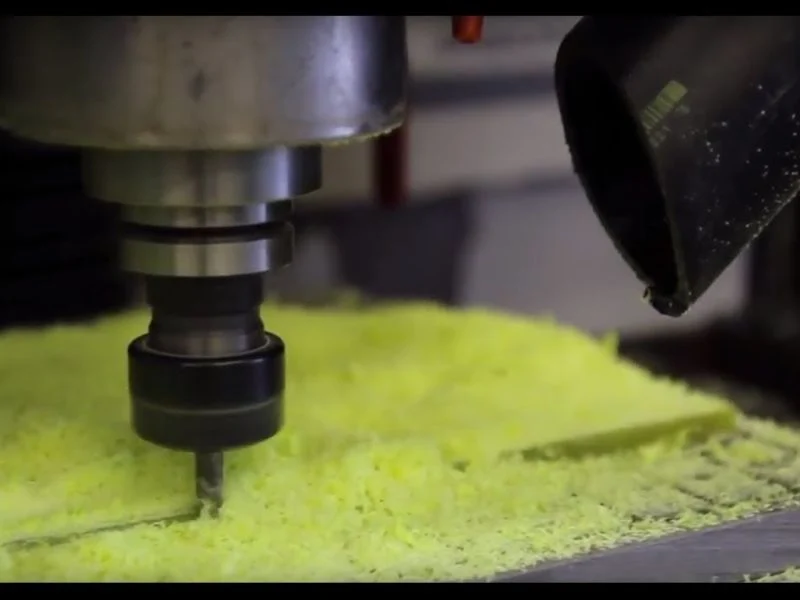
Feeds and speeds are where most G10 machining goes wrong. Start conservative, then increase the feed. The single most useful diagnostic on this material costs nothing: look at what is coming off the cut.
| Parameter | Starting point | What to adjust toward |
|---|---|---|
| Spindle speed | 12,000–18,000 RPM | Lower on thick plate, higher on thin sheet with small cutters |
| Feed rate | 60–120 IPM | Increase until chips form instead of powder |
| Depth of cut | Stepped, not full depth | Reduce further on brittle grades such as 3240 |
| Direction | Climb milling | Keeps the edge cleaner on brittle laminate |
Fine powder means your feed is too low. This is counter-intuitive, because a struggling tool feels like it needs an easier time. On glass-epoxy the opposite is true: a slow feed means the cutter rubs rather than shears, which generates heat, which dulls the edge, which makes it rub more. Feeding too slowly is the leading cause of premature tool death in this material.
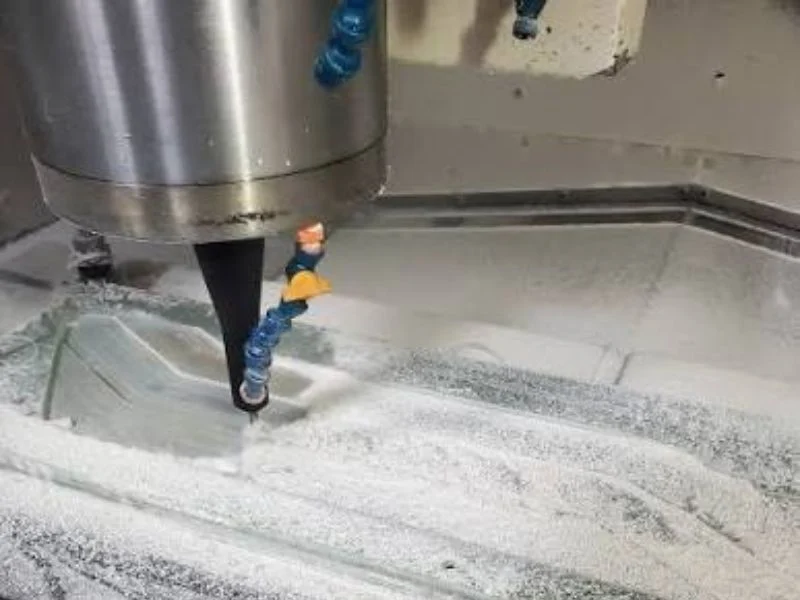
Why G10 Machining Has to Be Done Dry
This is the one rule in G10 machining with no exceptions worth discussing.
Do not use coolant. Cutting fluid changes the electrical properties of the laminate. If the part is destined for an insulation application — a terminal board, a transformer spacer, a switchgear barrier — a flooded part may no longer meet the dielectric specification it was ordered to, and nothing about its appearance will tell you. You have made scrap that passes visual inspection. Coolant also turns glass dust into a sludge that is harder to clear than the dust was.
Do not use compressed air either. The air line is the reflex in every workshop, and on this material it slowly destroys the machine. Glass particulate blown off the table travels into linear guides, ball screw nuts and the control cabinet. The consequence appears months later as accuracy nobody can account for.
The correct answer is dry cutting with extraction positioned at the cutter head, capturing dust where it is generated rather than after it has dispersed.
Dust Is a Safety Problem, Not a Housekeeping One
Respirable glass fibre is not sawdust. OSHA classifies it as a Particulate Not Otherwise Regulated, with a permissible exposure limit of 15 mg/m³ for total dust and 5 mg/m³ for the respirable fraction. A router cutting laminate dry in an unextracted enclosure will exceed that.
Treat extraction airflow and filtration rating as part of the machine specification when you buy, not as an accessory to add later. It is a reasonable question to put to any supplier: what is the airflow, and what is the filter rated to capture?
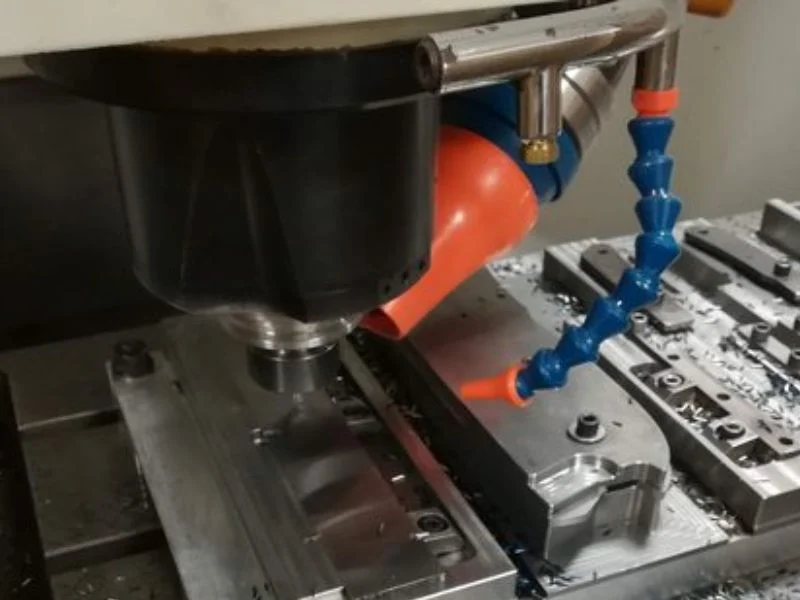
Tool Entry and Cutting Strategy in G10 Machining
Use helical or ramped entry for every pocket and every hole. A straight plunge at full feed delaminates the layers around the entry point, and on a finished insulation component that delamination is a rejection rather than a cosmetic issue.
When drilling, peck drill. The flutes pack with glass-loaded resin dust, and a packed flute stops evacuating chips and starts generating heat. The same reasoning applies to deep pockets: clear rather than push.
Delamination has its own set of causes and countermeasures across composite materials generally — we cover them in more depth in how to machine composites without delamination.
G10 vs FR-4, G11 and 3240: Which Grade You Are Actually Cutting
| Grade | What it is | At the machine |
|---|---|---|
| G10 | Epoxy glass cloth laminate, no flame retardant, halogen-free | Chips least, holds the tightest tolerance — the default for precision insulation parts |
| FR-4 | G10 with brominated flame retardant added | Near-identical mechanically and dielectrically; slightly more prone to chipping |
| G11 / FR5 | Higher-temperature epoxy glass, service to roughly 179 °C | Higher glass-transition temperature, so it tolerates heat that would delaminate FR-4 |
| 3240 / EPGC201 | Epoxy-phenolic glass cloth laminate, common in Europe and China | More brittle — reduce feed per tooth or the edge crumbles |
One practical warning about names. The same sheet is sold as Garolite in US machine shops, as TVE or Chapa TVE (Tecido de Vidro Epóxi) in Brazil, and as epoxy glass cloth laminate in engineering documentation. Trade names carry no grade guarantee. When buying across borders, order to the NEMA designation, because a shop expecting G10 behaviour from a sheet bought on trade name alone can end up re-proving its parameters.
When a Router Is the Wrong Answer
Two cases where G10 machining on a router is not the right process.
If the glass is still fabric, a spindle is the wrong tool entirely. Woven roving, chopped strand mat, prepreg and non-crimp fabric are cut before cure with an oscillating knife on a vacuum table. Different machine, different page.
If the plate is very thick and the volume is low, waterjet is a legitimate competitor. It introduces no thermal stress at all. The trade-offs are that the part comes out wet — awkward for a material specified partly on its sub-0.3% moisture absorption — and that per-part cost climbs with volume. We work through the same comparison on thick plate in CNC router vs waterjet for thick plate.
Laser is not on this list. It will cut thin laminate, but it chars the edge and the heat alters the resin chemistry at the cut line, degrading the dielectric performance that is the entire reason for specifying the material.
Frequently Asked Questions
What RPM should I use for G10?
Start at 12,000–18,000 RPM with a feed of 60–120 IPM, then raise the feed until the cut produces chips rather than powder. Powder means the cutter is rubbing.
Can I use coolant on FR-4?
No. Cutting fluid changes the electrical properties of the laminate and can render an insulation part unusable, with no visible sign. Cut dry with extraction at the cutter head.
Is G10 the same as FR-4?
FR-4 is G10 with brominated flame retardant added. Mechanical and dielectric properties are near-identical; G10 chips less and holds tighter tolerances, and is halogen-free.
What tooling lasts longest on glass-epoxy?
Diamond-coated cutters at $25–60 typically last 15–30 hours against 2–5 hours for $5–15 carbide, making them cheaper per part on any production run.
Is FR-4 machining different from G10 machining?
Only slightly. FR-4 machining uses the same tooling, feeds and dry-cutting rules as G10 machining; FR-4 is marginally more prone to chipping because of the flame-retardant additive, so precision work is usually specified in G10.
Is glass dust from machining G10 dangerous?
Yes. OSHA classifies it as a Particulate Not Otherwise Regulated with limits of 15 mg/m³ total dust and 5 mg/m³ respirable. Extraction at the head plus operator protection is required, and compressed air must not be used to clear it.
Thickness Changes the G10 Machining Strategy
Most published parameters assume sheet in the 1–6 mm range. They stop being right as the plate gets thicker, and the reason is chip evacuation rather than cutting force.
On thin sheet the chips leave the cut almost immediately. At 20 mm and above they have to travel up the full flute length, and glass-loaded resin dust packs rather than flows. A packed flute stops evacuating, starts rubbing, and the heat that follows is what delaminates the layers around the cut. This is why a parameter set proven on 3 mm FR-4 will burn a tool in 25 mm plate at the same feed and speed.
| Thickness | Strategy | What to watch |
|---|---|---|
| Under 3 mm | Single pass, backing board underneath | Breakout on the underside — support the sheet fully |
| 3–12 mm | Single or two-step depth, standard parameters | The comfortable range where published numbers hold |
| 12–25 mm | Stepped depth of cut, longer flute length | Chip packing — reduce depth per pass before reducing feed |
| Over 25 mm | Multiple passes, or reconsider waterjet | Tool deflection and heat build-up in the cut |
The instinct when a thick cut struggles is to slow the feed. In G10 machining that is the wrong lever: reduce the depth per pass and keep the feed up, because feed rate is what keeps the cutter shearing instead of rubbing.
How to Prove a G10 Machining Parameter Set
Test cuts on this material are worth doing properly, because the failure mode is gradual. A tool that has gone dull still produces parts — slightly oversize ones — and nobody notices until inspection.
Run a test batch of at least ten parts on the actual grade and thickness you will produce in. Measure the first part and the last part on the same feature, and note the difference. That number is your tool-wear allowance, and it tells you the change interval far more reliably than a tool-life figure from a catalogue.
Keep the used cutter. Comparing a worn edge against a new one is the quickest way to tell whether the wear is normal abrasion or something the parameters are causing — chipped flutes usually mean too much depth per pass, while a uniformly rounded edge is ordinary glass abrasion and simply means it is time for a change.
Getting a Machine Specified for G10 Machining
If you are specifying a machine rather than tuning one you already own, the requirements are rigidity, automatic tool change and extraction at the head. Those are set out on our CNC router for G10 and FR-4 laminate page, along with the three models we recommend for this material. Machines ship with a 12-month warranty and a lead time of around 20 days, and training and commissioning are included.
Send us a sample. Contact us with your grade, thickness and tolerance and we will machine a test part from your own sheet, then ship it back with the cutter we used so you can judge the finish and the tool wear together. Ask for a quote on the configuration rather than a list price — working area, spindle power and the extraction package are what move the number.