Automotive interiors and footwear are two of the most demanding leather-cutting jobs there are — high volume, tight tolerances, and parts judged on a visible edge. The method you cut with decides whether those parts assemble cleanly and how much expensive hide you waste. This guide covers how CNC oscillating knife cutting handles both sectors: the multi-layer speed, the nesting yield, and the cold-cut edge that keeps automotive and footwear production moving.
Why the Oscillating Knife Suits Both Sectors
For both automotive interiors and footwear, the oscillating knife wins because it cold-cuts multi-layer leather with a clean edge — improving material utilization 15–30% and cutting labor 20–35% versus manual methods. Those two numbers are why the technology has become the production standard in both industries.
Both sectors share the same three pressures: volume, precision and edge appearance. A method that burns the edge, cuts one layer at a time, or wastes irregular hide fails on at least one of them. The oscillating knife answers all three at once, which is why it replaces clicker presses and lasers on serious production lines.
There is also a workflow reason. Both automotive and footwear producers run many part shapes that change with each model or style, and a knife machine switches jobs by loading a new file rather than making a new die. That flexibility keeps a line productive as designs change season to season or model to model.
Downtime is expensive in both industries, so a method that is quick to set up and quick to change over protects output as much as raw cutting speed does. The knife’s file-based changeover keeps a high-volume line running with fewer stoppages between jobs.
Automotive Interiors
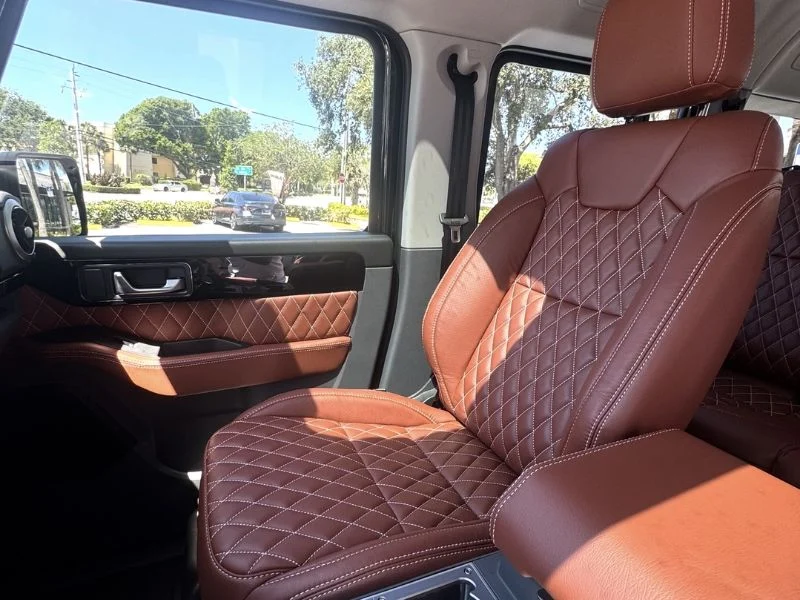
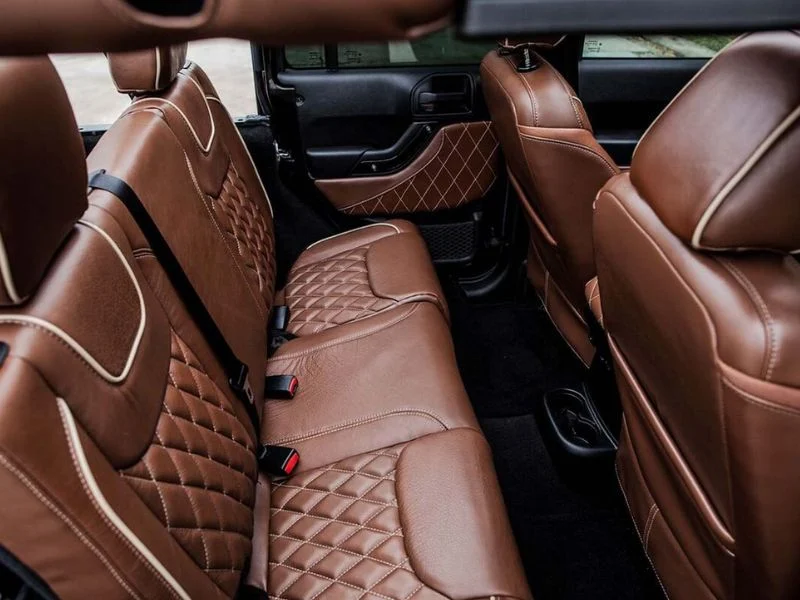
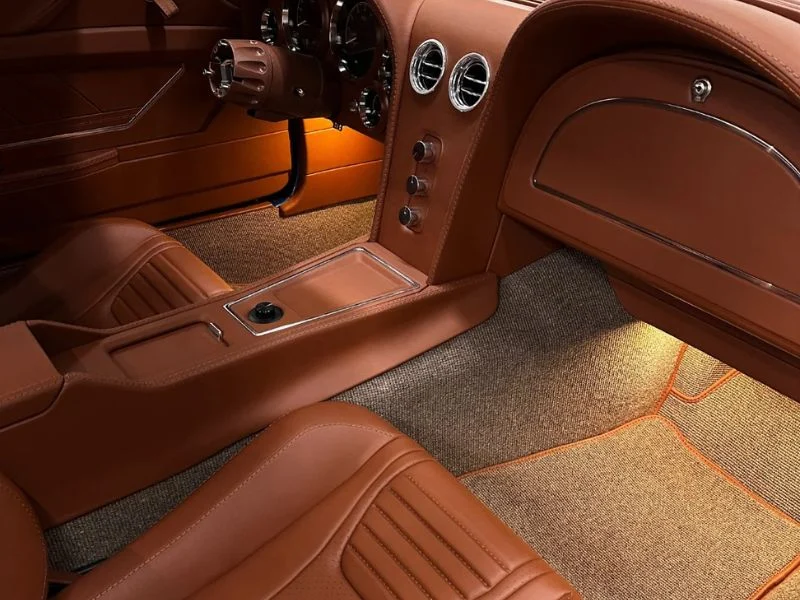
In automotive interiors, the knife cuts seat covers, door panels, dashboards and armrests from natural and synthetic leather while keeping stitch lines precise across every batch. Precision is not optional here — interior panels from many cut pieces have to align perfectly once stitched.
Automotive leather is expensive and every hide is irregular, so yield matters as much as speed. Vision nesting arranges parts to use more of each hide, and multi-layer cutting keeps dimensions identical across a batch, so a full set of seat panels stitches together without drift.
Edge appearance seals the case. A cold-cut edge keeps the leather’s grain and color, which a high-end interior demands, while a laser’s scorched edge would be a visible defect. For seats, steering-wheel wraps and trim, the knife delivers the finish the segment requires.
OEM and tier-one suppliers add their own demands on top. They expect traceable, repeatable quality across large orders and parts that meet the automaker’s fit and finish standards. A CNC knife machine gives that repeatability because every part follows the same programmed path, batch after batch, with no operator-to-operator variation.
Volume shapes the economics too. A single vehicle interior uses many leather parts, and a model runs for years, so a small per-part saving on material or labor multiplies across the whole program. That is why interior suppliers treat cutting yield as a line-item cost, not a detail.
Footwear
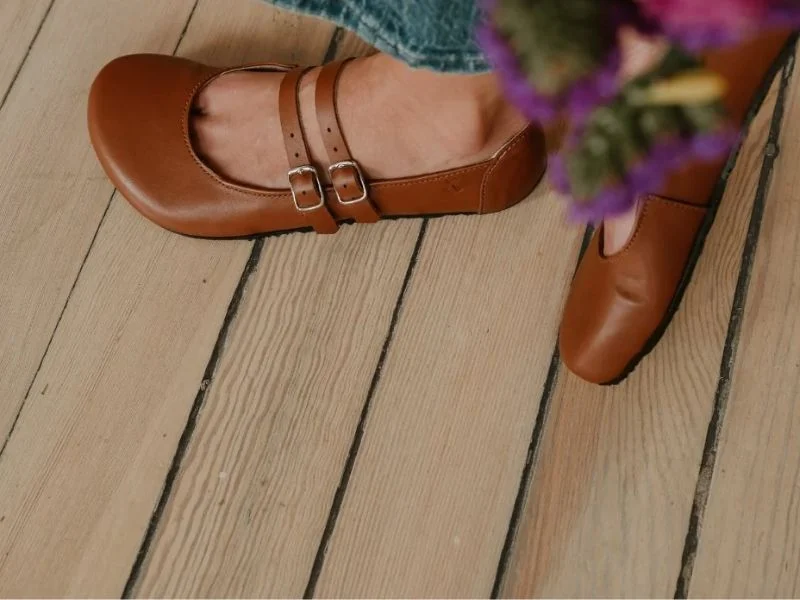
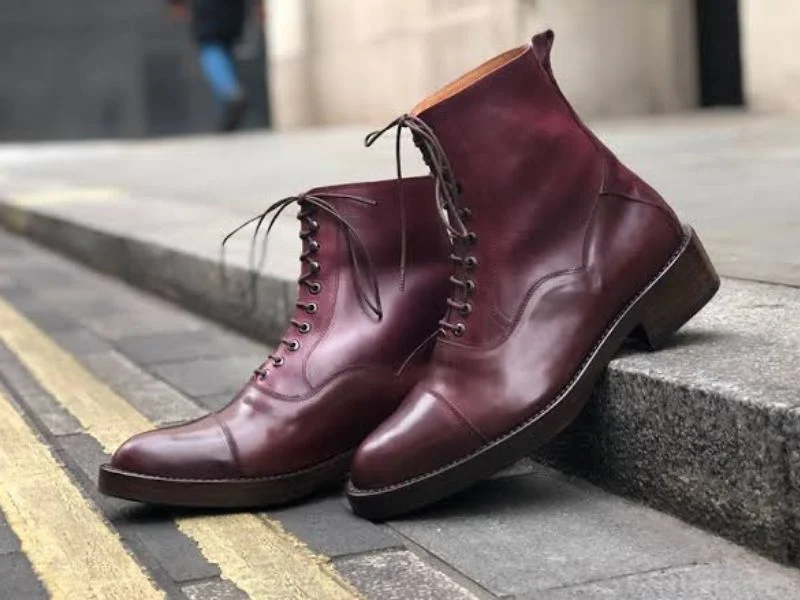
In footwear, the knife cuts uppers, linings, tongues and components in stacked layers, so one machine replaces several hand cutters on a production line. That throughput is what makes it viable for volume shoe manufacturing.
Shoe production runs genuine and PU leather in high volume, often in repeated shapes. Stacking several layers and cutting them in one pass multiplies output per operator, while the cold cut leaves edges clean enough to move straight to stitching with no trimming or sealing step.
Consistency across the stack is what protects fit. Because vacuum adsorption holds every layer flat and the servo head holds ±0.1 mm, the top and bottom pieces come out the same size — essential when uppers and linings from different layers assemble into one shoe.
Speed of changeover matters as much as speed of cut in footwear. A shoe factory may run dozens of sizes and styles, and because the machine changes patterns by file rather than by physical die, it moves between them in minutes. That agility suits the short, varied runs that modern footwear brands demand.
Material mix adds another reason. Footwear rarely uses one leather — an upper, a lining and a trim piece may each be a different grade or thickness. A single knife platform cuts them all by adjusting blade and depth, so a shoe line does not need separate machines for separate components.
Why Multi-Layer Cutting Matters Here
Multi-layer cutting is the single biggest reason both sectors move to a knife — stacking roughly 1–10 mm of leather and cutting it in one pass multiplies output without adding operators. It is the difference between a sampling tool and a production machine.
The setup is simple in principle. Vacuum adsorption holds the stack flat so nothing shifts, and the high-frequency oscillating blade cuts through every layer with smooth edges and no burning. The result is consistent dimensions from the top sheet to the bottom one.
A laser cannot do this reliably on leather — the lower layers char before the beam clears the top. So for any footwear or bag line cutting repeated parts in volume, multi-layer knife cutting is the capability that carries the economics.
How many layers you can stack depends on the leather. Thin, uniform synthetic stacks higher than thick, variable genuine hide, and blade choice and depth are set to match. The practical limit is found during a cutting test on your own material — one more reason sampling before purchase matters for a footwear line.
The gain is easiest to see against hand cutting. Where a manual cutter handles one part at a time, a stacked cut produces several identical pieces in the same pass, so throughput scales with layer count rather than with headcount. That is the economic engine behind volume footwear and bag production.
Material Utilization and Nesting
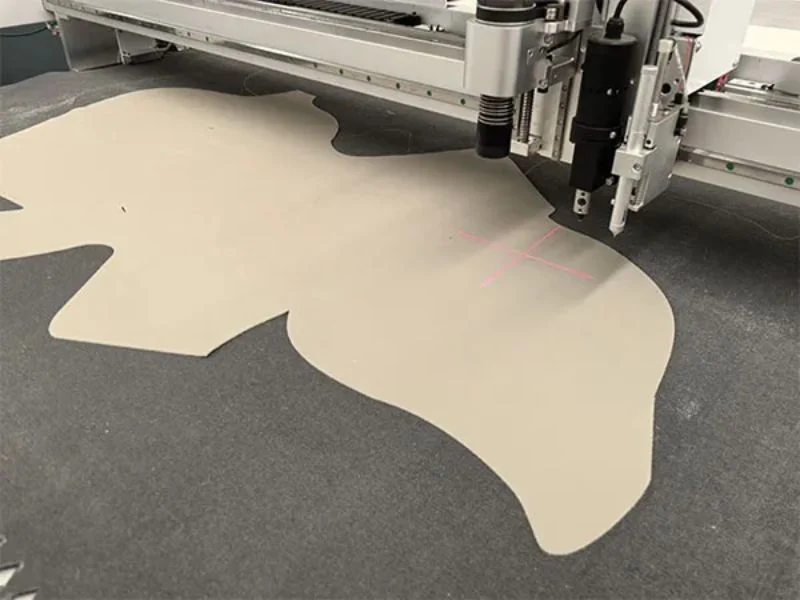
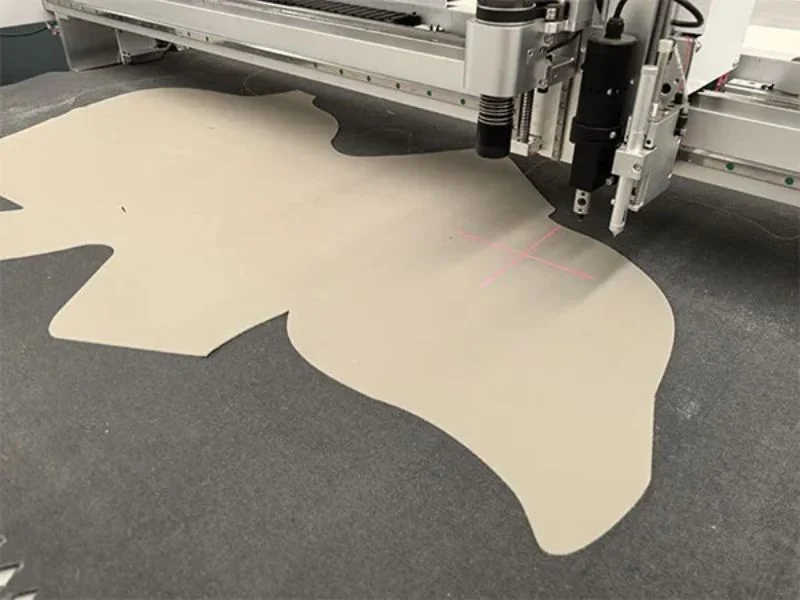
Nesting software is where the machine pays for itself: arranging parts across irregular hides lifts utilization 15–30%, and on automotive and footwear leather prices that is real money on every order. Yield, not speed, is often the bigger saving.
Leather is never a clean rectangle. Every hide has an irregular shape, thin spots and blemishes to avoid, so laying out parts by hand leaves usable material on the floor. Nesting software fits parts tightly around those constraints automatically.
Combined with reduced labor — typically 20–35% less than manual cutting — the utilization gain is what turns a faster machine into a lower cost per part. On expensive automotive hide, the material saving alone can justify the investment.
Good nesting does more than pack shapes tightly. It respects grain direction, avoids blemishes and thin areas, and balances parts across a hide so quality stays consistent — not just quantity. On automotive leather, where a visible flaw is a reject, that quality-aware nesting protects both yield and appearance.
Put in numbers, the effect compounds. If nesting saves even 15% of leather on a line that consumes hundreds of hides a month, and labor drops by a fifth, the combined saving on a single high-volume automotive or footwear program can return the machine cost within a year.
None of that requires a bigger crew. Because nesting and multi-layer cutting do the heavy lifting, the same output comes from fewer operators, which is where the labor saving of 20–35% actually shows up on the floor.
Print-and-Cut and Registration
A CCD vision camera lets the knife cut printed or pre-marked leather exactly to the design, which matters for branded and patterned automotive and footwear parts. Without it, printed work drifts out of register.
The camera follows printed edges or registration marks and adjusts the cut path to match, so logos, perforation patterns and decorative stitching guides line up with the cut. For any leather that carries a print or a pre-marked pattern, vision turns a manual alignment job into an automatic one.
This is increasingly common as brands add printed detail, perforation patterns and decorative elements to leather goods. Where those features once forced slow manual alignment, vision registration lets the machine cut them accurately at production speed, so decoration no longer bottlenecks the line.
It also reduces waste on printed leather. Because the cut follows the actual printed position rather than an assumed one, misaligned parts and the scrap they create largely disappear — which matters most on pre-printed hide that cannot simply be reprinted.
Bags and Accessories
The same machine and workflow extend to bags and accessories — panels, straps, wallets and small goods share the multi-layer, nesting and clean-edge advantages. One platform often covers a maker’s full leather-goods range.
Small leather goods involve many intricate parts cut in volume, which is exactly what multi-layer cutting and nesting handle well. Because the machine changes jobs by loading a new file rather than a new die, switching between bag, wallet and strap production is fast.
For a maker that produces bags, wallets and accessories alongside larger items, one knife platform consolidates the shop. Instead of separate tools for separate products, a single machine and workflow cover the range, which simplifies training, maintenance and floor space.
Small goods also benefit from the clean cold-cut edge. Wallet interiors, card slots and strap ends are handled and seen up close, so an edge that needs no sanding or sealing raises the perceived quality of the finished product.
Leather Cutting by Sector: At a Glance
The table summarizes what each sector cuts and why the oscillating knife fits.
| Sector | Typical parts | Why the knife wins |
|---|---|---|
| Automotive interiors | Seats, door panels, dashboards, armrests | Nesting yield + consistent stitch lines |
| Footwear | Uppers, linings, tongues, components | Multi-layer stacks, scorch-free edges |
| Bags & accessories | Panels, straps, wallets, small goods | Intricate contours, batch repeatability |
Bottom Line
For automotive interiors and footwear, an oscillating knife with multi-layer cutting and nesting is the production standard. It delivers the yield, the throughput and the clean edge that both sectors depend on.
The gains are concrete: 15–30% better material utilization, 20–35% less labor, ±0.1 mm precision across stacked layers, and a cold-cut edge ready to stitch. See the full specification, tooling and material range on our leather cutting machine.
The decision comes down to matching the machine to the demands of the sector. Both automotive and footwear reward the same capabilities — multi-layer throughput, high yield and a clean edge — so a specification that fits one usually fits the other, which is why a single knife platform serves diverse leather-goods production.
FAQ
How many layers of leather can it cut at once?
Roughly 1–10 mm of stacked leather in a single pass, depending on hardness and blade. Vacuum adsorption holds the stack flat so every layer keeps its dimensions — common in footwear and bag production.
Does multi-layer cutting stay accurate?
Yes. With vacuum hold-down and a servo-driven head, accuracy stays within ±0.1 mm across the whole stack, so the top and bottom pieces come out the same size with no shifting between layers.
How much material can nesting save?
Digital nesting typically lifts hide utilization 15–30% versus manual layout, with labor down 20–35%. On expensive automotive and footwear leather, that saving often justifies the machine on material cost alone.
Is it used for car seat leather?
Yes — automotive suppliers cut seats, door panels, dashboards, armrests and steering-wheel wraps from natural and synthetic leather on these machines, using vision nesting to maximize yield per hide.
Can it cut printed or patterned leather to register?
Yes. A CCD vision camera follows printed edges and registration marks, so logos, perforation and decorative patterns line up exactly with the cut path.
Does the same machine handle both automotive and footwear leather?
Yes. Both sectors need multi-layer cutting, high nesting yield and a clean cold-cut edge, so one oscillating knife platform serves both — you change jobs by loading a new file and adjusting blade and depth, not by swapping machines.