Delrin vs acetal is one of the most common questions on a plastics drawing — and one of the most misunderstood.
Delrin is acetal. Acetal is not always Delrin. The confusion comes from a brand name that became a generic word: engineers write “Delrin” when they mean any acetal, buyers substitute a cheaper acetal, and the part that comes back behaves slightly differently from the one that was designed.
This Delrin vs acetal guide explains what separates Delrin from other acetals, when the difference matters, and how each machines.
Delrin vs Acetal: The Short Answer
Delrin is DuPont’s brand of acetal homopolymer (POM-H); “acetal” usually means acetal copolymer (POM-C), sold under names such as Celcon, Hostaform, Ultraform and Tecaform. The homopolymer is stiffer and stronger; the copolymer has less centreline porosity and handles hot water and chlorine better.
| Factor | Delrin (POM-H, homopolymer) | Acetal copolymer (POM-C) |
|---|---|---|
| Tensile strength | About 11,000 psi — roughly 10–15 % higher | About 9,500 psi |
| Stiffness (modulus) | About 450,000 psi | About 400,000 psi |
| Heat deflection temperature | About 250 °F (121 °C) | About 220 °F (104 °C) |
| Centreline porosity in thick stock | Can be noticeable in large rod and thick plate | Minimal |
| Hot water, steam, chlorine | Less resistant | Better — resists hydrolysis |
| Machining | Excellent; better for thin walls and small diameters | Excellent; more forgiving on thick sections |
| Typical choice for | Small gears, thin-wall and highly loaded parts | Wet, washdown and food-plant parts; thick blanks |
Property values are from Boedeker Plastics’ comparison of acetal homopolymer and copolymer. Check the datasheet for the specific grade you buy, because both families include many variants.
The practical Delrin vs acetal rule is simple: if the part is small, thin or highly stressed, the homopolymer’s extra stiffness is worth having; if it is thick, wet or washed with chlorinated cleaners, the copolymer is usually the safer choice.
Is Delrin the Same as Acetal?
Delrin is a type of acetal, but not all acetal is Delrin: acetal is the family name for polyoxymethylene (POM), and Delrin is one brand of the homopolymer form.
Chemically, both are polyoxymethylene, a chain built from repeating formaldehyde units. The homopolymer is made of those units alone. The copolymer adds a small amount of a second monomer at intervals along the chain — Xometry describes one comonomer for roughly every 70–100 formaldehyde units — which interrupts the chain and changes how it behaves.
That small change is the whole Delrin vs acetal difference, and it has real effects. The regular homopolymer chain packs more tightly, so it is more crystalline, stiffer and stronger. The interrupted copolymer chain is more stable against heat, water and chemical attack, and it solidifies more evenly in thick sections, which is why it has less porosity at the centre of a large bar.
In everyday use, “Delrin” has become a generic word, much like brand names in other industries. A drawing that says “Delrin” may really mean “any acetal”, or it may mean the homopolymer specifically. When the difference matters, the drawing should say POM-H or POM-C, or name the exact grade.
The trade names are worth knowing because they appear on stock labels and certificates. Homopolymer: Delrin. Copolymer: Celcon, Hostaform, Ultraform, Tecaform, Ertacetal and others. All of them are acetal; only one is Delrin.
Strength, Stiffness and Heat: Where Delrin Leads
Delrin’s homopolymer structure gives it about 10–15 % more tensile strength and stiffness than acetal copolymer, and a higher heat deflection temperature — about 250 °F against 220 °F in Boedeker’s figures.
Those margins matter most in small, thin or highly loaded parts. A thin-walled bushing, a small gear tooth or a snap-fit that must spring back thousands of times gets measurable benefit from the extra stiffness and fatigue strength. Boedeker notes that Delrin is the better choice for small-diameter and thin-walled components for exactly this reason.
The higher heat deflection temperature helps with short-term heat — a part that sees a warm environment or friction heating under load. It does not turn acetal into a high-temperature plastic; both forms soften well below the temperatures that call for PEEK or other high-performance materials.
For most general parts, the Delrin vs acetal strength difference is small enough that design margin covers it. A drawing that simply calls for “acetal” on a bracket, spacer or guide will usually work in either form. The homopolymer earns its specification on the parts where every percent of stiffness counts.
Porosity, Hot Water and Chlorine: Where Acetal Copolymer Leads
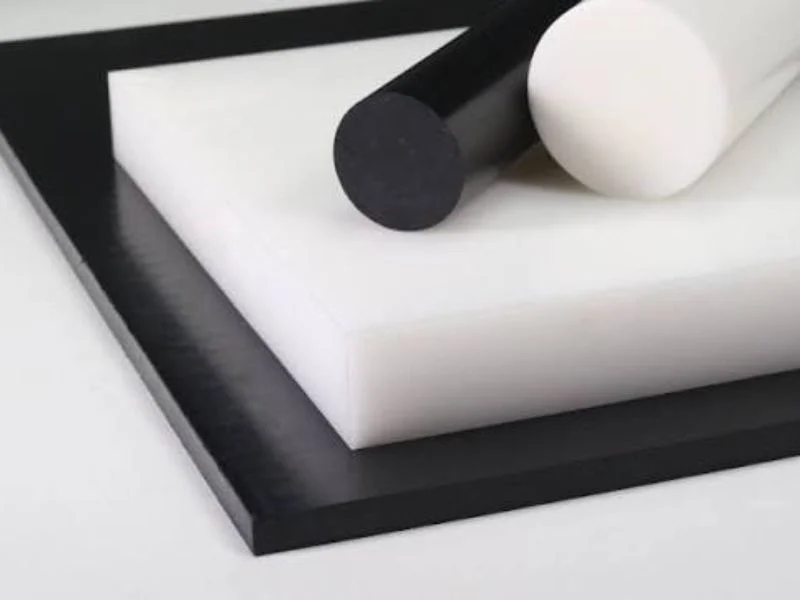
Acetal copolymer has much less centreline porosity in thick stock, resists hot water and steam better, and holds up better against chlorine — which makes it the safer choice for thick blanks and wet or washdown service.
Centreline porosity. Thick homopolymer rod and plate can carry porosity at the centre, where the material cools last. You often find it only when the cutter reaches the core, on the last and most expensive operation. For thick parts, fluid-handling parts or anything that must seal, copolymer avoids the problem.
Hot water and steam. Boedeker notes that copolymer resists hydrolysis better and keeps its dimensions through long exposure to hot water and steam. That matters for dishwasher, hot-fill and washdown components.
Chlorine. Copolymer also performs better in chlorinated water and cleaning solutions. For pool, water-treatment and food-plant parts that are cleaned with chlorine-based sanitisers, it is the more durable form.
Food and detectable grades. Both families are available in food-contact grades, and metal-detectable copolymer grades — often blue — are common in food processing, where a broken fragment must be caught by the line’s metal detector.
Delrin vs Acetal Cost and Availability
Acetal copolymer is generally the lower-cost and more widely stocked of the two, while branded Delrin carries a premium; for many parts, the price difference is smaller than the machining cost.
Xometry describes copolymer acetal as the more affordable option, and it is sold by more producers under more names. Delrin is a single brand, so it can carry a brand premium and fewer stock sizes at some distributors.
In Delrin vs acetal purchasing, the practical question is not which is cheaper per kilogram but which the drawing actually requires. If a drawing says “Delrin” but the part is a thick, wet-service manifold, copolymer may be both cheaper and better. If it says “acetal” but the part is a thin, highly loaded gear, the homopolymer may be worth the premium.
Substitution is where problems start. The two machine almost identically, but they do not shrink identically after machining, and their stiffness differs. Swapping one for the other on a tight-tolerance part can move dimensions and change performance. Agree the form — POM-H or POM-C — before the order, not after the first batch.
Machining Delrin vs Acetal on a CNC Router
Delrin and acetal copolymer both machine very well — dry, with sharp tooling and a steady feed — but they do not shrink identically, and each has one habit to plan for: homopolymer porosity and copolymer’s slightly lower stiffness on long features.
Speeds and feeds. A starting point on a router is around 12,000–18,000 RPM with a chip load of 0.10–0.25 mm, raising the feed until the tool makes clean, stringy chips rather than dust. Feeding too slowly makes the tool rub, heats the part and starts it moving.
Coolant. Cut dry with extraction. Flood coolant thermally shocks acetal and shifts dimensions, which defeats the reason most people chose it.
Stress and temperature. Extruded stock carries internal stress that relaxes after roughing, and acetal expands around 110 × 10⁻⁶ per kelvin — roughly ten times steel. Rough, rest, then finish tight parts, and measure at a known room temperature.
Porosity planning. On thick homopolymer, open the core early where the drawing allows, so a porous bar fails on part one rather than part forty.
Lasers. Acetal should not be laser cut: it decomposes rather than vaporising cleanly and releases formaldehyde. Machine choices for both forms are on our CNC router for Delrin, acetal and POM page.
Delrin vs Acetal for Gears, Bushings and Wear Parts
For gears and bushings, Delrin vs acetal comes down to size and load: small, fast, heavily loaded gears favour Delrin’s stiffness and fatigue strength, while larger, lightly loaded or wet-running parts work well — and often better — in copolymer.
Acetal is one of the most common gear plastics because it runs quietly against steel and itself, has low friction and holds its shape. In a small gear, the tooth root sees high, repeated stress, and the homopolymer’s extra stiffness and fatigue strength give a real margin. Many small precision gear trains specify Delrin for that reason.
Bushings and bearings follow the same pattern. A thin-walled bushing gains from homopolymer stiffness; a thick bearing block or a wear strip gains more from copolymer’s freedom from centreline porosity, because a void at the core becomes a weak point once the bore is machined into it.
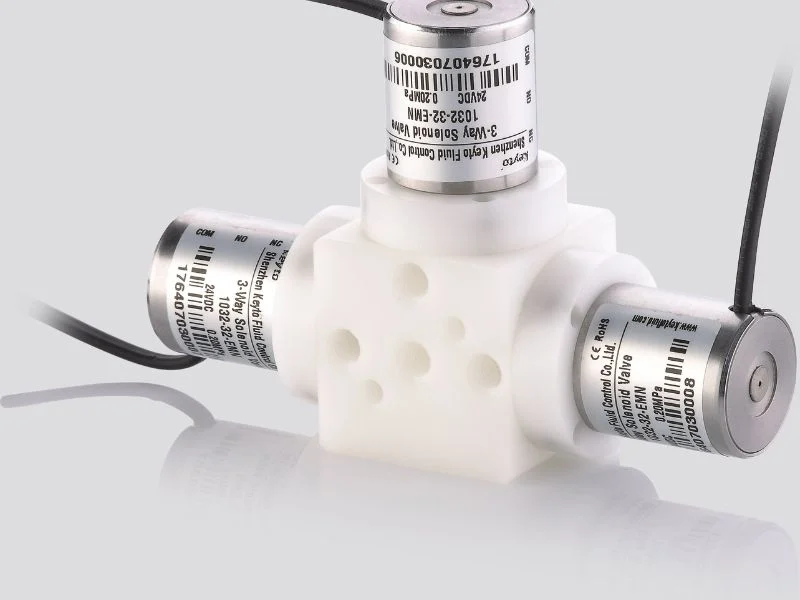
Wet-running parts tip the Delrin vs acetal balance toward copolymer. Pump components, valve seats and parts that run in hot water keep their dimensions better in copolymer, and in those parts dimensional stability matters more than a few percent of stiffness.
When in doubt, test both. A short run of each, assembled and run at real load and speed, answers the Delrin vs acetal question for that part far better than a datasheet.
Delrin vs Acetal in Food, Medical and Washdown Parts
In food, beverage and medical equipment, the Delrin vs acetal choice usually goes to copolymer, because washdown, hot water and chlorinated sanitisers are exactly where it outperforms the homopolymer.
Food-plant change parts — star wheels, timing screws, guides, portioning plates — are washed every shift, often with hot water and chlorine-based cleaners. A material that slowly hydrolyses or is attacked by chlorine loses its surface and its dimensions over months. Copolymer holds up better in that cycle, which is why it dominates washdown parts.
Metal-detectable grades add a second layer of protection. They are usually blue, so a fragment is easy to see, and filled so the line’s metal detector can catch it. Detectable acetal is more abrasive to tooling than natural grades, so plan for shorter tool life on long production runs.
Medical and laboratory parts follow the same logic, with extra attention to documentation. The grade, its compliance declarations and the lot number should travel with the part, because compliance belongs to the exact material, not to the words “Delrin” or “acetal” on a drawing.
Machining matters as much as material in these parts. Cut dry, with extraction rather than flood coolant, on a machine that has not run cutting fluid, and deburr as part of the cycle — a burr is a place for product to lodge and becomes an audit finding. The machine side is covered on our acetal CNC router page.
How to Specify Delrin vs Acetal on a Drawing
Write the polymer form and, where it matters, the grade: “POM-H (Delrin 150 or equal)” or “POM-C, natural, food-contact grade” removes the Delrin vs acetal ambiguity before it reaches purchasing.
A bare “Delrin” on a drawing is read three ways: as the brand, as any homopolymer, or as any acetal. Each reading can be defended, and each can produce a different part. Being explicit costs one line.
A useful callout covers four things. The form — POM-H or POM-C. The grade or an “or equal” clause, if a specific grade was tested. The colour, including whether a metal-detectable grade is required. And any compliance requirement, such as food contact.
When the drawing allows either form, say so: “POM-H or POM-C”. That lets purchasing buy what is in stock and tells the machine shop that the tolerances were set with both materials in mind. On a quotation, it also avoids the lead time of waiting for a specific brand when an equivalent is on the shelf.
Delrin or Acetal Copolymer: Which Should You Specify?
Specify Delrin (POM-H) for small, thin-walled or highly loaded parts where stiffness and strength matter; specify acetal copolymer (POM-C) for thick parts, wet or hot-water service, chlorine exposure and general parts where cost matters.
| Part or requirement | Better choice | Why |
|---|---|---|
| Small gears, thin-wall bushings, snap-fits | Delrin (POM-H) | Higher stiffness, strength and fatigue resistance |
| Parts with short-term heat exposure | Delrin (POM-H) | Higher heat deflection temperature |
| Thick blanks, manifolds, sealing parts | Acetal copolymer (POM-C) | Minimal centreline porosity |
| Hot water, steam, dishwasher service | Acetal copolymer (POM-C) | Better hydrolysis resistance and dimensional stability |
| Chlorinated water and sanitisers | Acetal copolymer (POM-C) | Better chlorine resistance |
| General brackets, guides, spacers | Either — usually copolymer | Performance difference is small; cost and availability decide |
If you are still deciding whether acetal is the right family at all, our comparison of POM vs nylon covers moisture and dimensional stability, and UHMW vs HDPE covers the cheaper polyethylenes used for wear strips and liners.
Whichever you choose, write it on the drawing as POM-H or POM-C, with the grade if it matters. That one line prevents most substitution problems between design, purchasing and the machine shop.
Frequently Asked Questions
Is acetal cheaper than Delrin?
Usually, yes. Acetal copolymer is made by several producers under many names and is generally the lower-cost, more widely stocked option, while Delrin is a single brand of homopolymer that can carry a premium. For most parts the machining cost outweighs the difference in stock price.
What is another name for Delrin?
Delrin is acetal homopolymer, also called POM-H or polyoxymethylene homopolymer. Generic names include acetal, polyacetal and POM. Copolymer acetal — POM-C — is sold as Celcon, Hostaform, Ultraform, Tecaform and Ertacetal, among others, but those are not Delrin.
What are the downsides of Delrin?
Delrin can show centreline porosity in thick rod and plate, is less resistant than copolymer to hot water, steam and chlorine, and is attacked by strong acids. Like all acetal, it cannot be laser cut safely and it expands far more than metal with temperature.
Which plastic is stronger than Delrin?
Among common machinable plastics, PEEK and glass-filled grades such as glass-filled nylon are stronger and stiffer than unfilled Delrin, and they tolerate much higher temperatures. They cost more and can be harder on tools. Acetal copolymer is slightly weaker than Delrin.
Can you substitute acetal copolymer for Delrin?
Often, but not blindly. On general parts the two are interchangeable. On tight-tolerance or highly loaded parts, copolymer is about 10–15 % less stiff and shrinks slightly differently after machining, so confirm fit and function on a sample first.
Is Delrin food safe?
Food-contact grades of both Delrin and acetal copolymer are available, including metal-detectable grades for food processing. Compliance belongs to the specific grade, not the family name, so ask for the supplier’s food-contact declaration for the exact material.
Delrin vs acetal is easiest to settle on a real part. Send us a drawing and the grade you are considering, and we will machine a free sample in POM-H, POM-C or both so you can check fit, finish, shrinkage and performance on your own part before a production run. Contact our engineering team to arrange it.