Laser cutting vs plasma cutting is mostly a question of plate thickness.
Both are thermal processes that cut metal from a file, and both are sold into the same fabrication shops. But a fiber laser and a plasma torch are built for different ends of the thickness range, with different edge quality, tolerances and running costs. Pick by the wrong measure and you pay for precision you do not need, or lose work to a shop that has the other machine.
This laser cutting vs plasma cutting guide compares the two on thickness, edge, tolerance and cost, and shows where the crossover sits.
Laser Cutting vs Plasma Cutting: The Short Answer
Choose a fiber laser for sheet and thinner plate where accuracy, small holes and a clean edge matter; choose plasma for thick plate, where it cuts faster and cheaper and a slightly rougher edge is acceptable. Hypertherm, which makes plasma systems, puts plasma’s advantage above about 16 mm (5/8 in).
| Factor | Fiber laser | Plasma |
|---|---|---|
| Sweet spot | Thin sheet to mid-thickness plate | Thick plate — above about 16–25 mm |
| Maximum practical thickness | About 16 mm mild steel at 3 kW, 22 mm at 6 kW | Up to about 150 mm steel on large CNC systems |
| Dimensional tolerance | Under about 0.25 mm | About 0.5 mm on high-definition systems |
| Small holes and fine detail | Excellent | Limited; holes below plate thickness are hard |
| Kerf | Narrow, near-parallel | Wider, with bevel on one side |
| Materials | Metals; reflective metals with care | Electrically conductive metals only |
| Machine investment | Higher | About 2–5 times lower than a fiber laser |
Sources: Hypertherm for the crossover, tolerance and investment figures; Wikipedia for plasma’s maximum thickness; the fiber laser thickness figures are from our fiber laser cutting thickness chart.
This guide is about metal fabrication. If you are comparing laser with waterjet — for heat-sensitive parts, composites or very thick stainless — that is a different trade-off, covered in our comparison of laser cutting vs waterjet.
How Laser and Plasma Cutting Work
A fiber laser melts a narrow line with a focused beam of light and blows the melt out with assist gas; plasma cutting drives an electric arc through a constricted gas jet, heating it into plasma that melts the metal and blows it clear.
A laser concentrates its energy in a spot a fraction of a millimetre across. That is why it cuts small holes, sharp corners and fine detail so well, and why its kerf is narrow and nearly parallel.
Plasma cutting needs the workpiece to complete the electrical circuit, so it cuts only electrically conductive metals — steel, stainless, aluminium, brass and copper. Its arc is broader than a laser beam, which gives a wider kerf; Wikipedia notes that plasma kerfs are wider at the top than the bottom and that the two sides of the cut are often asymmetrical.
The difference in energy density explains most of what follows. A laser’s concentrated beam is precise but has to work harder as plate gets thick. A plasma arc puts a great deal of power into a wider zone, which is less precise but keeps cutting quickly through heavy plate.
Both are thermal processes, so both leave a heat-affected edge. On thin sheet the laser’s smaller heat input distorts less; on thick plate the difference narrows.
Thickness: Where the Laser vs Plasma Crossover Sits
The crossover between laser cutting and plasma cutting sits roughly between 16 and 25 mm of mild steel: below it a fiber laser is usually faster and more accurate, above it plasma usually cuts faster and at lower cost per metre.
Hypertherm puts plasma’s advantage over fiber laser above 16 mm (5/8 in), on speed, edge finish and cost per metre. On our own sheet metal laser cutting machine page we put the economic turn nearer 25 mm, because a 6 kW fiber laser still cuts well up to about 22 mm. The exact point depends on laser power, plasma system, gas and the edge you need.
Below the crossover, a fiber laser’s speed on thin sheet is hard to match. On 1–6 mm material it cuts detailed parts quickly and holds small holes that plasma cannot. Most sheet-metal fabricators — enclosures, brackets, panels — live entirely in this range.
Above it, plasma pulls away. A laser slows sharply as plate gets thicker, and its running cost per metre climbs; a plasma system keeps cutting heavy plate at a steady pace. Wikipedia notes that large CNC plasma systems cut steel up to about 150 mm thick.
In laser cutting vs plasma cutting, the practical test is where your volume sits. List your last few months of work by thickness and cut length. If most of the metres are under 12 mm, a fiber laser serves you; if most are over 20 mm, plasma does; if the work straddles both, many shops run both machines.
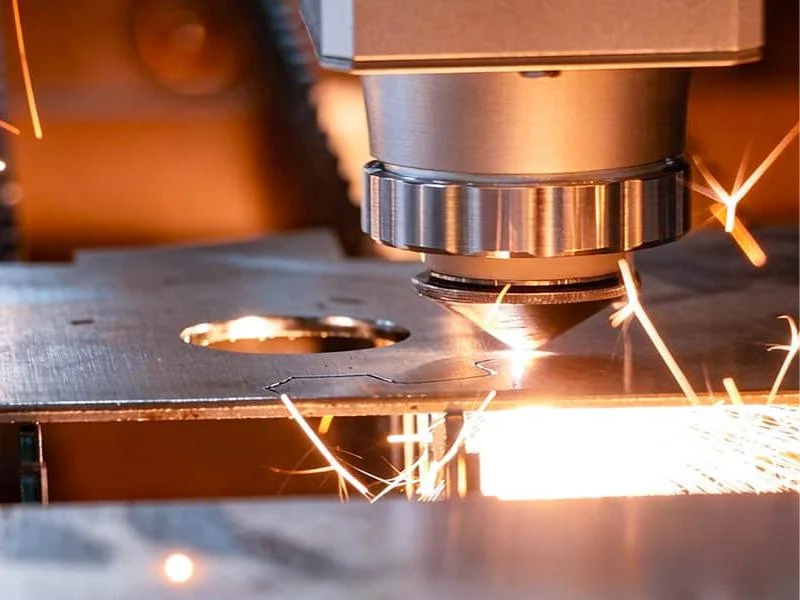
Edge Quality, Tolerance and Small Features
A fiber laser gives a narrower, squarer cut and tighter tolerances — under about 0.25 mm against about 0.5 mm for high-definition plasma — and holds holes and fine features that plasma cannot.
Tolerance. Hypertherm quotes laser cut-part tolerances under 0.25 mm (0.010 in) and high-definition plasma around 0.5 mm (0.020 in), and makes the point that the gap is roughly the thickness of a business card. For many structural parts, that difference does not matter at all.
Holes. This is where the two differ most. A laser cuts clean holes down to around the material thickness; plasma struggles with holes smaller than the plate is thick, and they often come out tapered or out of round. Wikipedia credits the laser’s hole-cutting ability as the main reason it has replaced plasma on thinner material.
Bevel and squareness. Plasma leaves a slight bevel, usually worse on one side of the cut, and a wider kerf. On thick plate going to welding, that bevel may be irrelevant or even useful; on parts that must fit squarely, it is a cost.
Dross and heat. Both can leave dross on the underside if settings are wrong. On thin sheet the laser’s smaller heat input distorts less; on thick plate, Hypertherm notes that plasma can give a smoother cut face than fiber laser.
For how tight a laser can realistically hold by thickness, and how to write that on a drawing, see our guide to laser cutting tolerances.
Cost per Part: Laser vs Plasma
Plasma costs far less to buy and less per metre on thick plate; a fiber laser costs more to buy but usually wins on cost per part for thin sheet, because it cuts faster and removes secondary operations.
Investment. Hypertherm puts a plasma system at about two to five times less than a fiber laser. For a shop that cuts mostly heavy plate, that difference is hard to justify spending.
Running cost. Plasma consumables — electrodes and nozzles — wear with every pierce and arc-hour. A fiber laser’s routine consumables are nozzles and protective lenses, and its main running costs are electricity and assist gas. On thick plate, Hypertherm notes plasma is usually cheaper per metre.
Secondary operations. This is where lasers often recover their cost on thin work. A part that comes off a laser with clean holes and a square edge may need no drilling or grinding; the same part off a plasma table may need holes drilled and edges cleaned. That labour is easy to leave out of a comparison and often decides it.
Throughput. On detailed thin parts, a laser nests tighter and cuts faster, so more parts come off each sheet per hour. On heavy plate the balance reverses.
The honest summary of laser cutting vs plasma cutting costs is that cost per part depends on your part mix, not on the machine. Run the comparison on your own parts, including secondary operations, rather than on a price list.
Laser vs Plasma: Materials and Applications
Both cut steel, stainless and aluminium; plasma needs a conductive metal, while a fiber laser also handles reflective copper and brass with the right protection. Typical applications split cleanly by thickness and detail.
| Application | Better fit | Why |
|---|---|---|
| Enclosures, brackets, panels, 1–6 mm | Fiber laser | Speed, small holes, clean square edge |
| Stainless food and medical equipment | Fiber laser | Bright nitrogen-cut edge, tight tolerance |
| Decorative panels and signage | Fiber laser | Fine detail and sharp corners |
| Structural steel, base plates, 20 mm+ | Plasma | Faster and cheaper on thick plate |
| Heavy equipment and shipbuilding plate | Plasma | Thickness range and cost per metre |
| Mixed 3–25 mm job shop | Both, or a higher-power fiber laser | Depends where most of the metres sit |
Tube and profile work adds another option. A tube laser cuts holes, miters and notches on round and square tube in one setup, which plasma tube systems do less precisely; see our tube laser cutting machine page.
Running Both: When a Shop Needs Laser and Plasma
Many fabrication shops end up running both a fiber laser and a plasma table, because their work spans thin detailed parts and heavy plate, and each machine is cheapest in its own range.
A typical mixed shop cuts enclosures, brackets and panels in 1–6 mm alongside base plates, gussets and structural parts in 20–40 mm. Forcing the thick work onto a laser slows it and raises cost per metre; forcing the thin work onto plasma adds drilling and edge clean-up. Two machines, each loaded with the work it suits, often cost less overall than one machine doing everything badly.
The order of purchase usually follows the money. If most revenue comes from thin detailed parts, the laser comes first and heavy plate is subcontracted until volume justifies a plasma table. If the shop is built on structural work, plasma comes first and precision sheet is bought in.
Floor layout matters when both run. Plasma produces more fume and noise and usually needs a water table or downdraft extraction; a fiber laser runs in an enclosed cabin with its own extraction. Keeping the two apart makes both easier to manage.
For the laser side of a mixed shop, our sheet metal laser cutting machine page compares bed sizes and power levels, and the tube laser covers profile work that neither flat table handles well.
How to Run a Fair Laser vs Plasma Test
Test laser cutting vs plasma cutting on the same real part, in the same material and thickness, and compare total cost per finished part — including drilling, grinding and handling — not just cutting time.
Choose two or three parts that represent your real work: one thin detailed part, one mid-thickness part and one thick part if you have them. Ask for each to be cut on both processes, and for the cycle time and consumable use to be recorded.
Then finish the parts as you would in production. Drill the holes plasma could not hold, grind the edges that need it, and measure the dimensions that matter. Add that labour to the cutting cost.
Finally, weight the result by your real volume. A laser that saves ten minutes of drilling on a part you make five hundred of a month pays back very differently from one that saves the same ten minutes on a part you make twice a year.
That arithmetic — cost per finished part multiplied by monthly volume — is the fairest way to decide laser vs plasma, and it usually settles the question faster than any specification sheet.
Laser or Plasma: Which Should You Buy?
Buy a fiber laser if most of your cut length is below about 12–16 mm and your parts have holes, detail or tight fits; buy plasma if most of it is heavy plate where speed and cost per metre matter more than edge finish.
A useful way to decide is to sort a representative month of work by thickness, weighted by cut length. The thickness band that holds most of the metres should choose the machine.
If the work is split, a single higher-power fiber laser can stretch further into thick plate than it used to, but it becomes expensive to run at the top of its range. Many fabricators find two machines cheaper overall: a laser for sheet and detail, and plasma for heavy plate.
Whichever you lean towards, test with your parts. A cut sample and a measured cycle time on your own drawing answer the question better than any general guide. MNT builds fiber lasers, not plasma systems, and if your work is mostly heavy plate we will tell you plasma is the better purchase. For sheet and tube, compare the X5, X6 and X6040 on our fiber laser cutting machine page.
Frequently Asked Questions
Which is better for cutting, plasma or laser?
It depends on thickness. A fiber laser is better on sheet and thinner plate, where it is faster, more accurate and cuts small holes cleanly. Plasma is better on thick plate — Hypertherm puts its advantage above about 16 mm — where it cuts faster and cheaper per metre with an acceptable edge.
What are the disadvantages of laser cutting?
A fiber laser costs more to buy than plasma, slows sharply and becomes expensive to run on thick plate, and cuts most non-metals poorly. Reflective metals such as copper need back-reflection protection. On thin and mid-gauge metal, those drawbacks rarely outweigh its speed and accuracy.
What can plasma not cut?
Plasma cannot cut non-conductive materials such as wood, plastics, glass, stone or composites, because the workpiece must complete the electrical circuit. It also struggles with small holes and fine detail, and holes smaller than the plate thickness often come out tapered or out of round.
What can a laser cutter not cut?
A fiber laser cannot economically cut very thick plate — beyond roughly 25 mm plasma or waterjet usually take over — and it cuts wood, acrylic and most plastics poorly. PVC should never be laser cut, because it releases harmful chlorine compounds.
Is plasma cutting more accurate than laser?
No. A fiber laser typically holds under about 0.25 mm, while high-definition plasma holds about 0.5 mm, according to Hypertherm. Laser also cuts smaller holes and sharper corners. For structural parts the difference often does not matter; for precision parts it does.
Is plasma cheaper than laser cutting?
To buy, yes — about two to five times cheaper. Per part, it depends on thickness: plasma is cheaper per metre on thick plate, while a fiber laser is often cheaper per part on thin sheet because it cuts faster and avoids drilling and edge clean-up.
Laser cutting vs plasma cutting is easiest to decide with your own parts. Send us drawings and your thickness mix, and we will cut a free sample on a fiber laser, measure the cycle time, and tell you honestly if plasma is the better fit for your work. Contact our engineering team to arrange it.