UHMW vs HDPE is a choice between two polyethylenes that look almost identical on the rack.
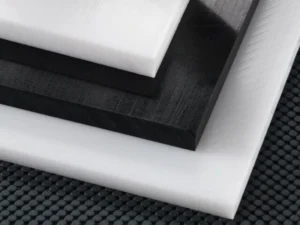
Both are white or black, waxy, light and cheap next to engineering plastics. Buyers swap one for the other to save money, and then find a chute liner wearing through in months or a machined part that will not weld. The chemistry is the same; the chain length is not, and that changes wear, impact, processing and price.
This UHMW vs HDPE guide compares the two on properties, cost and machining, and shows which one suits which part.
UHMW vs HDPE: The Short Answer
Choose UHMW when a part slides, wears or takes impact; choose HDPE when you need a cheaper, stiffer sheet that can be welded, thermoformed or fabricated. Both are polyethylene, but UHMW’s far longer molecular chains give it much better abrasion and impact resistance at a higher price.
| Factor | UHMW (PE-1000) | HDPE (PE-500 / PE-300) |
|---|---|---|
| Molecular weight | Millions of g/mol | Far lower |
| Abrasion and wear | Excellent — the reason to buy it | Good |
| Impact resistance | Very high, including in the cold | Good |
| Friction | Lower (about 0.14) | Higher (about 0.2) |
| Stiffness | Softer; creeps under sustained load | Stiffer at the same thickness |
| Welding and thermoforming | Not by normal melt methods | Yes — welds, thermoforms, fabricates |
| Cost | Higher | Lower |
| Typical parts | Chute liners, wear strips, slide plates, fenders | Tanks, cutting boards, marine panels, fabricated parts |
The rest of this UHMW vs HDPE comparison explains why those differences exist, because the reason behind them tells you when they matter and when they do not.
Most UHMW vs HDPE selection mistakes come from treating the two as interchangeable grades of the same sheet, and they show up as cost per part: a cheap liner replaced every season costs more than a UHMW liner that lasts for years. They share a chemical formula and a density band, but in service they behave like two different materials: one is a wear part, the other is a fabrication sheet.
What Makes UHMW Different From HDPE: Molecular Weight
UHMW and HDPE are both polyethylene; the difference is molecular weight — UHMW chains are many times longer, typically millions of grams per mole. Wikipedia’s entry on ultra-high-molecular-weight polyethylene puts it typically between 2 and 6 million daltons; Xometry quotes 5 to 9 million.
Longer chains tangle more and transfer load along more of their length. That is what gives UHMW its toughness and abrasion resistance: a surface under wear loses material far more slowly because each chain is anchored deep in the sheet.
The same long chains change how the material is made. UHMW is so viscous when melted that it does not flow like a normal thermoplastic, so it cannot be injection moulded or extruded in the usual way. Sheet is made by compression moulding or ram extrusion, which is part of why it costs more.
High-density polyethylene flows normally. It is extruded, injection moulded, blow moulded and rotomoulded, and fabricated sheet can be hot-air or extrusion welded and thermoformed. That processing freedom is one of HDPE’s biggest practical advantages, and it is something UHMW simply does not have.
In the stockist’s naming, UHMW is usually sold as PE-1000 and HDPE as PE-500 or PE-300, where the number loosely tracks molecular weight. Regrind and reprocessed UHMW grades sit between the two and behave between the two.
UHMW vs HDPE Properties Compared
On paper UHMW and HDPE sit close together — similar density, melting point and water absorption — while UHMW wins on friction and wear, and HDPE covers a wider range of stiffness and strength. The table below uses published values; ranges reflect the many HDPE grades on the market.
| Property | UHMW | HDPE |
|---|---|---|
| Density | 0.93–0.95 g/cm³ | 0.93–0.97 g/cm³ |
| Melting point | 133 °C | 118–137 °C |
| Tensile strength, yield | 20 MPa | 11–43 MPa |
| Elongation at 23 °C | 350 % | 600 % |
| Hardness | > 63 Shore D | 50–76 Shore D |
| Water absorption | 0.01 % | 0.01–0.10 % |
| Heat deflection at 0.46 MPa | 65 °C | 43–93 °C |
| Coefficient of friction | about 0.14 | about 0.2 |
Sources: Xometry’s HDPE vs UHMW comparison for mechanical and thermal values; Polymershapes for friction coefficients. Always check the datasheet of the actual sheet you buy, because grades vary.
Two things stand out in the UHMW vs HDPE numbers. First, neither material handles heat: both soften well below 100 °C under load, so neither belongs near a steam line or a hot conveyor. Second, the tensile figures do not show UHMW’s real advantage. Its strength is in abrasion and impact, which a tensile test does not capture.
Both absorb almost no water, so unlike nylon they do not swell in wet service. Both also resist most acids, alkalis and solvents, which is why polyethylene is the default in chemical handling.
Wear, Impact and Friction: Where UHMW Earns Its Price
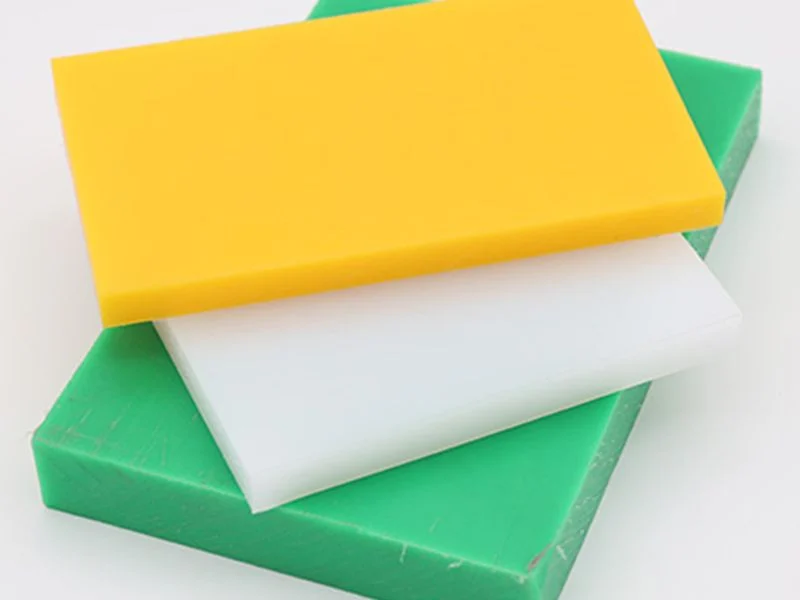
UHMW earns its higher price wherever material slides over a surface or hits it — bulk-handling liners, conveyor wear strips, guide rails and dock fenders. In those parts it outlasts HDPE, and often steel, by a wide margin.
Abrasion. Coal, grain, sand and aggregate sliding down a chute grind away a liner. UHMW’s long chains lose material far more slowly than HDPE’s, which is why hopper and chute liners are almost always UHMW.
Impact. UHMW absorbs repeated impact without cracking, and keeps that toughness at low temperatures where many plastics turn brittle. Marine fenders and truck-bed liners rely on it.
Friction and release. A coefficient of friction around 0.14 means bulk material slides instead of hanging up, and product releases from the surface. That low friction is also what makes UHMW a self-lubricating slide plate.
The UHMW vs HDPE trade-off is stiffness and creep. UHMW is soft, and under a sustained load it slowly deforms. A UHMW bracket carrying a static load, or a precision bushing that must hold its bore, will move over time. For those parts the answer is usually acetal rather than either polyethylene — a trade-off we cover on our CNC router for Delrin and acetal page.
Where HDPE Is the Better Choice
HDPE is the better choice when cost, stiffness or fabrication matters more than wear — tanks, cutting boards, marine panels, signage and anything welded or thermoformed.
Cost. HDPE is the cheaper sheet. Xometry puts HDPE at roughly $1.2 per kilogram against about $2–6 per kilogram for UHMW, depending on grade. On a large panel that is not subject to wear, paying for UHMW buys nothing.
Stiffness. At the same thickness HDPE is stiffer and creeps less, so it holds its shape better as a panel, a cover or a structural part.
Fabrication. HDPE can be welded into tanks and ductwork, thermoformed into trays and guards, and bent with heat. UHMW cannot be welded by the usual methods, so a UHMW assembly has to be bolted or mechanically fastened.
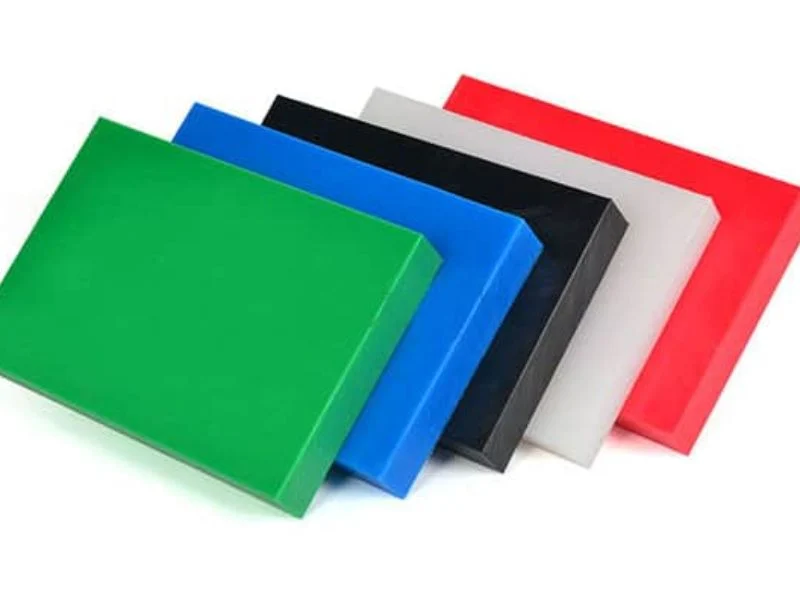
Surface and colour range. HDPE is sold in a wide range of colours, textures and food-contact grades for boards, marine outfitting and playground panels, and it machines slightly more easily than UHMW.
The honest summary of UHMW vs HDPE is that HDPE is the default sheet, and UHMW is what you upgrade to for the specific parts that wear. Many plants use both: HDPE for the guard and the tank, UHMW for the strip the product slides along. On a production run of mixed parts, the two sheets usually sit side by side on the same router table.
Machining UHMW vs HDPE on a CNC Router
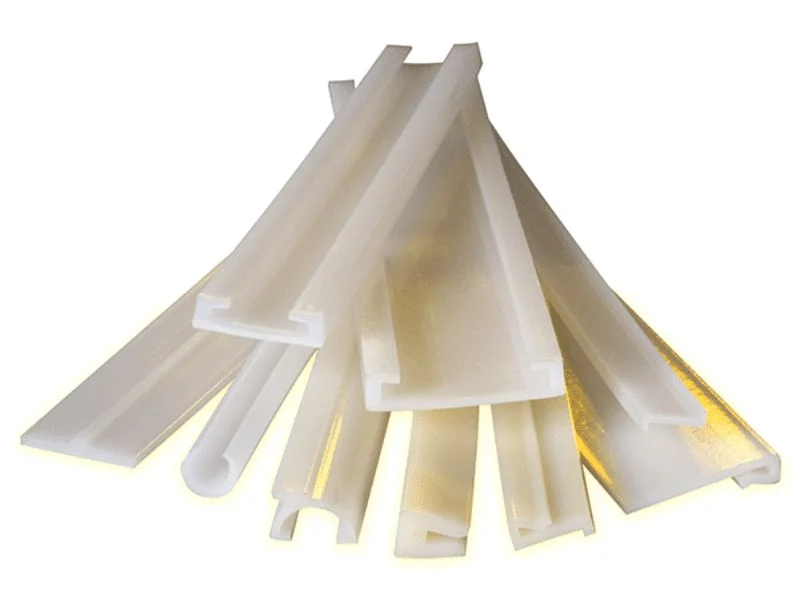
In UHMW vs HDPE machining, both polyethylenes machine the same way — sharp, positive-rake tooling, low spindle speed and a high feed — but UHMW is less forgiving: it gums tools faster and moves more after cutting.
Spindle speed. On a CNC router, start UHMW around 8,000–14,000 RPM and keep the feed up. That is lower than for acrylic or acetal, because polyethylene softens at a low temperature and conducts heat poorly. HDPE tolerates a little more speed, but nothing like acrylic.
Tool gumming. UHMW’s long chains soften and weld to a cutting edge rather than breaking away. A genuinely sharp tool with polished flutes and a single or two-flute geometry lets the chip release instead of packing.
Hold-down. In UHMW vs HDPE alike, hold the sheet over its whole area at the lowest pressure that works — a full-bed vacuum table on a CNC router for UHMW and HDPE is the usual answer. Clamping at the edges or pulling thin sheet hard into a spoilboard distorts it, and it springs back once released.
Thermal movement. Polyethylene expands by around 200 × 10⁻⁶ per kelvin — much more than metals. On a long liner or wear strip, agree the measuring temperature before you agree the tolerance. Regrind sheet is often not flat to begin with, which no amount of machining fixes.
Lasers. Neither material laser-cuts cleanly: polyethylene melts rather than vaporising and leaves a rounded, beaded edge. Parts are milled, or for thin flat parts, cut with an oscillating knife. Machine choices, table sizes and hold-down options for both materials are on our CNC router for UHMW and HDPE page.
UHMW vs HDPE vs Acetal: When to Step Up
When a part needs to hold a tight dimension or carry a sustained load, the answer to UHMW vs HDPE is often neither — acetal (POM, Delrin) is stiffer, creeps far less and holds a tolerance. Buyers searching for UHMW vs HDPE vs Delrin are usually at exactly this point.
Polyethylene is excellent at sliding, wearing and absorbing impact, and poor at staying the same size. It is soft, it creeps under load, and it expands by around 200 × 10⁻⁶ per kelvin. Acetal expands by roughly 110 × 10⁻⁶ per kelvin, is much stiffer, and machines to a precise, stable finish.
The practical split in a conveyor or packaging line is simple. Wear strips, guide rails and slide plates are UHMW; star wheels, timing screws, change parts and bushings that must fit a shaft are acetal; guards and covers are HDPE or polycarbonate. Each material does the job it is good at, and the drawing specifies which is which.
The cost step from UHMW to acetal is real, so reserve acetal for the parts where dimensions or load demand it. Where friction and wear are the whole requirement, UHMW is usually still the better and cheaper answer.
If acetal is on your shortlist, our comparison of POM vs nylon covers the next decision — which engineering plastic holds its size in your environment.
UHMW vs HDPE in Food Plants and Washdown Areas
Both UHMW and HDPE are available in food-contact grades, and both shrug off water and most cleaning chemicals; the choice between them in a food plant follows the same wear-versus-fabrication logic as anywhere else.
UHMW is the standard for parts that product slides across: guide rails, scraper blades, wear strips, star-wheel guides and cutting surfaces that see heavy use. Its low friction and wear resistance keep product moving and the surface intact through daily washdown.
HDPE is the standard for boards, trays, panels and fabricated covers, where cost and a wide colour range matter more than wear. Colour-coded HDPE boards are common for separating raw and cooked product.
Metal-detectable grades of both exist, usually in blue, so a fragment that breaks off can be caught by the line’s metal detector. For audit purposes, deburring matters as much as the material: a burr is a place for product to lodge, so food-contact parts should be deburred as part of the machining cycle, not afterwards.
Compliance belongs to the grade, not to “UHMW” or “HDPE” as a family name. Ask for the supplier’s food-contact declaration for the exact sheet, and keep it with the part’s production records — the lead time on paperwork is often longer than the lead time on the parts.
UHMW or HDPE: Which Should You Choose for Your Part?
For UHMW vs HDPE, match the material to what the part does in service: anything that slides, wears or is hit is UHMW; anything that is fabricated, welded or simply needs to be a cheap stiff panel is HDPE.
| Part or requirement | Better choice | Why |
|---|---|---|
| Hopper, chute and silo liners | UHMW | Abrasion resistance and material release |
| Conveyor wear strips, guide rails, slide plates | UHMW | Low friction and wear life |
| Dock fenders and impact pads | UHMW | Impact toughness, including in cold weather |
| Welded tanks, ducts and fabricated covers | HDPE | Weldable and thermoformable |
| Cutting boards and food-prep surfaces | HDPE | Cost, colour range, food-contact grades |
| Marine panels, signage and general sheet parts | HDPE | Stiffer and cheaper where wear is not the issue |
| Precision bushings and load-bearing parts | Neither — consider acetal | Both polyethylenes creep and move with temperature |
If you are comparing polyethylene with other engineering plastics as well, our guide to machinable plastics — PTFE, POM, PEEK and nylon covers the step up from polyethylene when temperature or tolerance becomes the limit.
Frequently Asked Questions
Which is stronger, HDPE or UHMW?
It depends on what “stronger” means. HDPE grades can have a higher tensile yield strength (11–43 MPa against about 20 MPa for UHMW) and HDPE is stiffer, but UHMW is far tougher: it resists abrasion and impact much better. For wear and impact parts UHMW is the stronger choice; for stiff panels HDPE often is.
Is UHMW cheaper than HDPE?
No, UHMW costs more. Published figures put HDPE at roughly $1.2 per kilogram and UHMW at about $2–6 per kilogram, depending on grade. UHMW is harder to process — it has to be compression moulded or ram extruded — which is part of the price difference.
What is the disadvantage of HDPE?
HDPE wears faster than UHMW, has a higher friction coefficient (about 0.2 against 0.14) and is less impact-resistant, so it fails early as a liner or slide surface. Like all polyethylene it also softens at low temperatures, with heat deflection starting somewhere between about 43 and 93 °C depending on grade.
How can you tell UHMW from HDPE?
Not reliably by eye — both are waxy, similar in density and sold in the same colours. The stockist’s label (PE-1000 for UHMW, PE-500 or PE-300 for HDPE) is the dependable guide. In practice, UHMW feels slicker and is harder to scratch, and HDPE can be welded while UHMW cannot.
Can UHMW be welded like HDPE?
Not with the usual hot-air or extrusion welding used on HDPE, because UHMW does not flow when melted. UHMW parts are joined mechanically — bolted, screwed or with countersunk fasteners — which is why liners are machined with a bolt pattern rather than welded in place.
Can UHMWPE stop a bullet?
UHMWPE fibre — sold as Dyneema and Spectra — is used in body armour, where the fibres are woven or laminated into dense panels. The UHMW sheet used for liners and wear strips is the same polymer but not an armour product, and it should never be treated as ballistic protection.
UHMW vs HDPE is easier to settle with a part in hand. Send us a drawing and the sheet grade you plan to use, and we will machine a free sample so you can check the finish, flatness and fit on your own material. Contact our engineering team to arrange it.