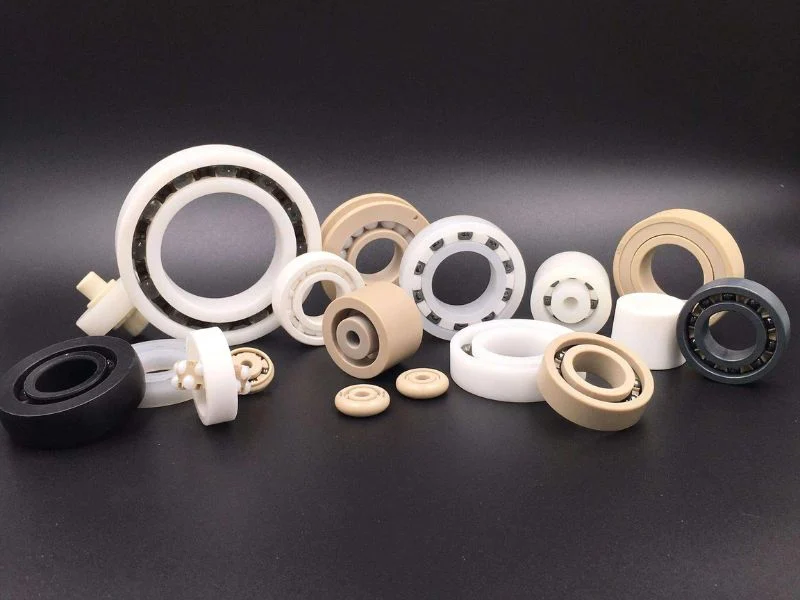
POM vs nylon is the most common engineering-plastic decision in machined parts.
Both are stiff, tough, low-friction and easy to machine, and both turn up as gears, bushings, rollers and wear parts. On a drawing they often look interchangeable. In service they are not: one holds its size in water and the other grows, and that single difference decides a large share of real-world failures.
This guide compares POM (acetal, Delrin) and nylon on moisture, strength, friction, temperature and machining, and shows which to choose for which part.
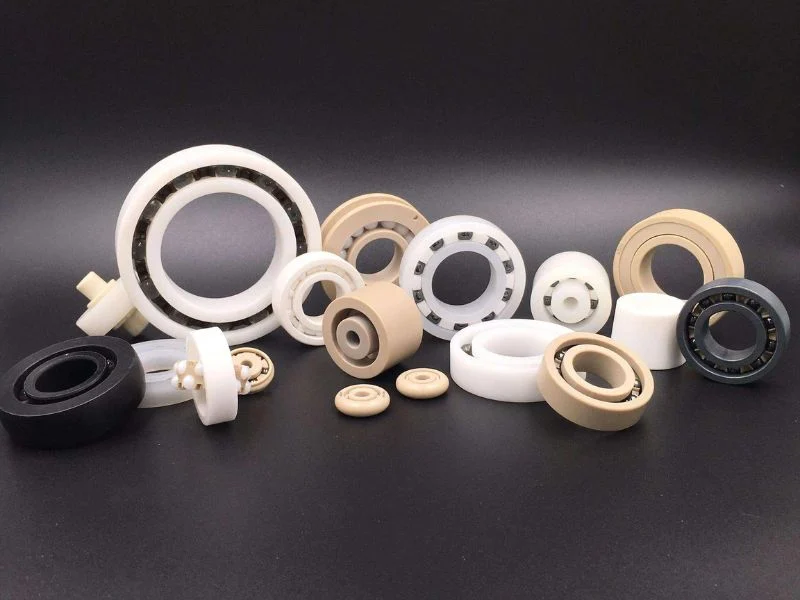
POM vs Nylon: The Short Answer
Choose POM for precision parts that must hold their dimensions, especially in wet or humid service; choose nylon for parts that need toughness under shock and abrasion, where a little dimensional change does not matter. The biggest difference in POM vs nylon is moisture: nylon absorbs roughly ten times more water than POM.
| Factor | POM (acetal, Delrin) | Nylon (PA6, PA66) |
|---|---|---|
| Moisture absorption | About 0.2 % | About 3 % — swells and softens |
| Dimensional stability | Excellent | Changes with humidity |
| Friction | Lower | Higher, especially dry |
| Heat resistance | Melts around 165–175 °C; long-term use to about 100 °C | Melts around 215–220 °C (PA6); long-term use to about 85 °C, higher for heat-stabilised PA66 |
| Toughness under shock | Good; notch-sensitive | Very good once conditioned |
| Chemical weak point | Strong acids, chlorine | Acids; absorbs water |
| Machining | Free-cutting, holds size | Machines well, burrs more, moves with moisture |
| Typical parts | Precision gears, valve parts, change parts, food components | Heavy-duty rollers, sheaves, wear pads, bushings under shock |
Read this POM vs nylon table as a first filter, not a verdict. The sections below explain where each difference comes from and when it actually changes the choice.
The quickest test is to ask whether the part must hold a tolerance in changing humidity. If it must, POM usually wins before any other property is considered.
Moisture: The Difference That Decides Most POM vs Nylon Choices
Nylon absorbs water from the air and from liquids, and as it does it swells, gets softer and loses stiffness; POM absorbs almost none and holds its size. Snijlab’s test values (DIN EN ISO 62) put moisture absorption at about 0.2 % for POM against about 3 % for PA6.
Wikipedia’s entry on nylon 6 describes the material as hygroscopic, absorbing up to 2.4 % of its weight in water, and notes that the absorbed water sharply lowers modulus and yield stress while increasing ductility. The exact figure depends on grade and humidity; the direction never changes.
For a machined part, this POM vs nylon difference has three consequences. A nylon bushing machined dry can tighten on its shaft after a humid week. A nylon gear loses stiffness and runs differently wet than dry. And a nylon part measured on the day it was cut may not pass inspection a month later.
None of this makes nylon a bad material. Designers who know it allow extra clearance, specify conditioned dimensions, or choose a lower-absorption grade. But where a drawing carries tight tolerances and the part lives in a wet, humid or washdown environment, POM removes the problem at the material level.
This is also why POM dominates food-processing change parts and fluid-handling components: they are washed daily, and a part that grows with water is a part that jams.
Strength, Stiffness and Impact Compared
Dry, the two are close: nylon PA6 is slightly stronger and stiffer in tensile tests, while POM is harder-wearing in sliding contact and keeps its properties in humid air — nylon’s strength drops as it absorbs water.
| Property (dry) | POM | PA6 nylon | Test method |
|---|---|---|---|
| Density | 1.41 g/cm³ | 1.14 g/cm³ | DIN EN ISO 1183-1 |
| Tensile strength | 67 N/mm² | 80 N/mm² | DIN EN ISO 527 |
| Elongation at break | 40 % | 50 % | DIN EN ISO 527 |
| Modulus of elasticity | 2,800 N/mm² | 3,200 N/mm² | DIN EN ISO 527 |
| Impact strength | 6 kJ/m² | 3 kJ/m² | DIN EN ISO 179 |
| Hardness | 81 Shore D | 82 Shore D | — |
| Coefficient of friction | 0.36 | 0.5 | — |
| Moisture absorption | 0.2 % | 3 % | DIN EN ISO 62 |
Source: Snijlab’s POM vs PA6 comparison, with the test standards it cites. Values are for dry material; nylon’s figures change as it absorbs moisture, and every supplier’s grade differs slightly, so use the datasheet for the sheet or rod you actually buy.
Two points are easy to misread. First, nylon’s tensile advantage is a dry-state number; conditioned in normal air, its strength and stiffness fall while its toughness rises. Second, POM is notch-sensitive: a sharp internal corner concentrates stress, so machined POM parts should carry a radius wherever the drawing allows.
The practical reading of POM vs nylon on strength is that neither wins on strength alone. Choose on moisture, friction and temperature first, and check that the stiffness of the chosen material in its service condition meets the load.
Friction, Wear and Noise
POM has the lower friction coefficient — about 0.36 against 0.5 for PA6 in Snijlab’s figures — and runs smoothly against steel without lubrication, which is why it is the default for small precision gears and sliding parts.
Low friction and a hard, slippery surface make POM a natural bearing and gear material, and the main reason POM vs nylon usually goes POM’s way for small mechanisms. It runs quietly against metal and against itself, resists stick-slip, and keeps a consistent feel over a long life. Snap-fits, latches and clips also favour POM because it springs back reliably.
Nylon wears well too, and in heavy, shock-loaded or abrasive service it is often preferred: sheaves, crane pads, rollers and heavy bushings are commonly cast nylon. Its higher friction can be brought down with oil-filled or molybdenum-disulphide-filled grades.
For gears specifically, POM vs nylon usually comes down to size and environment. Small, precise, fast gears in dry or wet conditions lean to POM; large, heavily loaded gears that see shock and warmth lean to nylon, with clearances designed for moisture growth.
If friction is the main requirement and load is light, compare both against UHMW, which slides even more easily — see our comparison of UHMW vs HDPE.
Temperature and Chemical Resistance
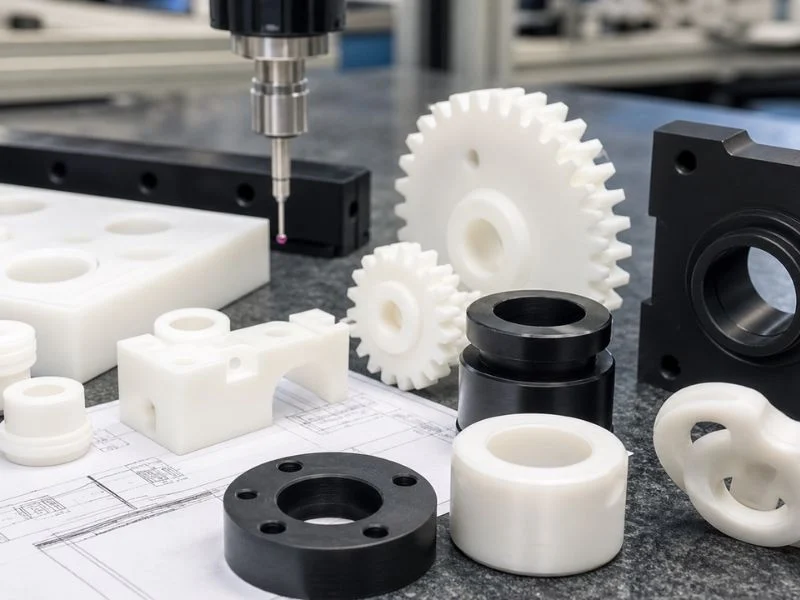
In POM vs nylon on temperature, nylon melts higher — PA6 around 215–220 °C against roughly 165–175 °C for POM — but in continuous service the two are close, and standard POM is rated slightly higher than PA6. POM is the more stable of the two in water; it is attacked by strong acids and chlorine.
Snijlab lists long-term service temperatures of about −50 to 100 °C for POM and −40 to 85 °C for PA6, with heat deflection at 110 °C and 95 °C respectively. So the higher melting point does not make unfilled PA6 the better hot-service material. Where nylon pulls ahead is in heat-stabilised and glass-filled PA66 grades, which is why engine-bay parts are commonly nylon rather than acetal.
On chemicals, both handle oils, greases and fuels well. POM is sensitive to strong acids and to chlorine, which matters for pool, water-treatment and some cleaning-chemical applications. Nylon is attacked by acids and, as covered above, by water itself.
Wikipedia’s entry on polyoxymethylene notes that thick homopolymer sections can carry pronounced centreline porosity. In practice the homopolymer (Delrin) is slightly stiffer, while the copolymer avoids that porosity and is generally the more stable choice in hot water and alkalis.
Neither material belongs in continuous high-temperature service or aggressive chemical duty. When temperature climbs past what nylon can take, the step up is usually PEEK, which we compare in our guide to machinable plastics — PTFE, POM, PEEK and nylon.
Delrin vs Nylon: Grades and Trade Names
Delrin is DuPont’s trade name for acetal homopolymer (POM-H); nylon covers several polyamides, of which PA6 and PA66 are the common machined grades, supplied extruded or cast. Knowing the grade matters as much as knowing the family.
POM grades. Acetal homopolymer (POM-H, sold as Delrin) and acetal copolymer (POM-C, sold as Celcon, Hostaform, Ultraform, Tecaform and Ertacetal) machine almost identically but do not shrink identically. Filled grades add PTFE for lower friction or glass for stiffness.
Nylon grades. PA6 and PA66 are the workhorses. Cast nylon (often PA6 made by casting large blocks and rods) is common for heavy wear parts and large sizes. Glass-filled nylon is much stiffer and more stable but far more abrasive to cutting tools. Oil-filled and MoS₂-filled grades lower friction.
When a drawing says just “nylon” or “acetal”, ask which grade. The homopolymer-versus-copolymer choice is covered in our guide to Delrin vs acetal. A glass-filled nylon and an unfilled cast nylon are different materials to machine and to use, and POM-H and POM-C are not a drop-in swap on a tight-tolerance part.
Machining POM vs Nylon on a CNC Router
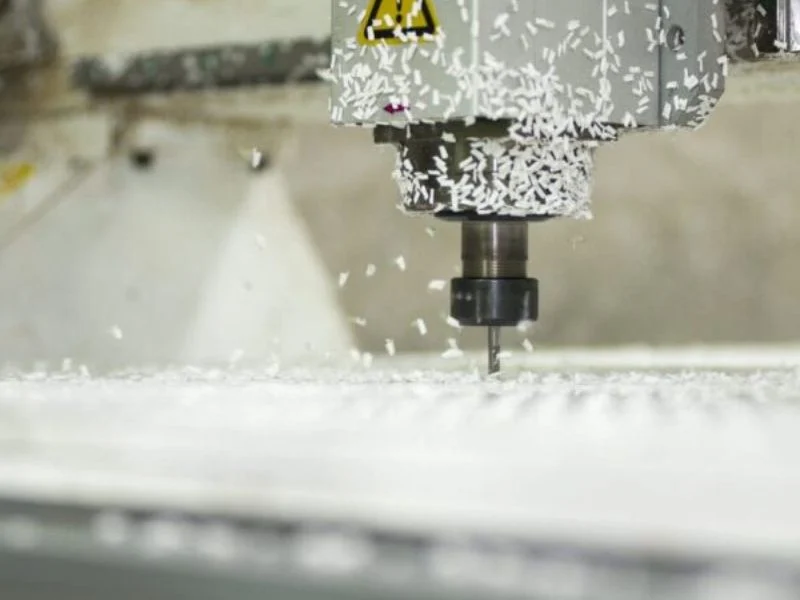
In POM vs nylon machining, POM is one of the easiest plastics to machine to size — free-cutting, dry, with clean chips — while nylon machines readily but leaves more burrs and keeps moving with moisture after it leaves the machine.
POM. Cut dry with extraction; flood coolant thermally shocks acetal and shifts dimensions. A starting point on a router is around 12,000–18,000 RPM with a chip load of 0.10–0.25 mm, raising the feed until the tool makes clean, stringy chips rather than dust. Extruded stock carries internal stress that relaxes after roughing, so rough, rest and then finish tight parts. Machine choices are on our CNC router for Delrin, acetal and POM page.
Nylon. Nylon cuts easily with the same sharp, polished carbide tooling but is gummier and tends to raise burrs, so a finishing pass and deburring step are normal.
In POM vs nylon machining, nylon’s bigger problem is moisture: a part cut from dry stock grows in humid air, and a part cut from conditioned stock shrinks if it dries out. Measure at a stated condition and allow for the service environment — on a production run, that means agreeing the measuring condition with your customer before the first batch ships, not after a rejection. Our acetal router page covers the machines we use when the same shop cuts both.
Thermal movement. Both expand far more than metals — acetal around 110 × 10⁻⁶ per kelvin — so gauge finished parts at a known room temperature.
Lasers. POM should not be laser cut: it decomposes rather than vaporising cleanly and releases formaldehyde. Thin nylon film and fabric can be laser cut, but machined nylon parts are milled.
POM or Nylon: Which Should You Choose for Your Part?
In POM vs nylon, pick POM when the part must hold size, run with low friction or live in water; pick nylon when it must take more heat, heavy shock or abrasion and its dimensions can move a little.
| Part or requirement | Better choice | Why |
|---|---|---|
| Small precision gears and cams | POM | Dimensional stability, low friction, quiet running |
| Parts in water, washdown or high humidity | POM | About 0.2 % moisture absorption against about 3 % |
| Food-processing change parts and guides | POM | Holds size through daily washing; food-contact grades available |
| Snap-fits, clips and springs | POM | Springs back reliably |
| Heavy rollers, sheaves and crane pads | Nylon | Toughness under shock, large cast sizes |
| Hot service above about 100 °C | Heat-stabilised or glass-filled PA66 | Standard POM and PA6 both run out of headroom there |
| Chlorinated water or strong acids | Neither — check PVDF or PEEK | POM is attacked by chlorine and acids; nylon by acids |
When the drawing and the environment both point the same way, POM vs nylon is an easy choice. When they conflict — a precision part in a warm, wet environment — test a sample in both materials rather than choosing from a datasheet.
How to Test POM vs Nylon Before a Production Run
Test POM vs nylon on the real part, in the real environment, before committing a production run — a datasheet cannot tell you how a specific shape, fit and load will behave. A short, structured test costs far less than a batch that swells or wears out in the field.
Machine both from the same drawing. Cut a small batch in each material on the same machine and program. This separates material behaviour from machining variation, and gives you a like-for-like cost per part for each option.
Condition the nylon. Leave nylon samples in the humidity they will see in service — or soak them if they will run wet — for long enough to reach equilibrium, then re-measure. A nylon part that only passes inspection straight off the machine has not passed.
Run the fit and the load. Assemble the parts with their mating shafts, housings or gears and run them at the real speed and load. Check running clearance, noise and temperature, and inspect for wear after a set number of cycles.
Check the chemicals. If the part meets cleaning agents, chlorinated water or process fluids, expose samples to them. POM’s weakness to chlorine and strong acids and nylon’s weakness to acids show up quickly in a simple soak test.
Record the conditions. Write down the temperature and humidity at which each dimension was measured. That record is what lets you and your customer agree a tolerance that means the same thing on both sides.
For food, medical or regulated parts, confirm the exact grade’s compliance documents at the same time; compliance belongs to the grade, not to the family name on the drawing.
Frequently Asked Questions
Is POM plastic the same as Delrin?
Delrin is one brand of POM. It is DuPont’s trade name for acetal homopolymer (POM-H). Acetal copolymer (POM-C) is sold under other names, such as Celcon, Hostaform and Tecaform. Both are POM and machine almost identically, but they differ slightly in stiffness, porosity and shrinkage.
Which is harder, nylon or Delrin?
Their surface hardness is almost the same — about 81 Shore D for POM against 82 for PA6 in Snijlab’s figures. In service Delrin feels harder and stiffer because it does not soften with moisture, while nylon becomes softer and more flexible as it absorbs water.
Is POM or nylon better for gears?
POM is usually better for small, precise, fast gears because it holds its size and has lower friction (about 0.36 against 0.5). Nylon suits larger, heavily loaded gears that see shock and heat, as long as the design allows clearance for moisture growth.
Does nylon absorb water?
Yes. Nylon is hygroscopic: PA6 absorbs about 3 % moisture in Snijlab’s test data, and Wikipedia describes nylon 6 absorbing up to 2.4 % of its weight. The water lowers stiffness and changes dimensions, while POM absorbs only about 0.2 %.
Is POM plastic expensive?
No — POM and nylon both sit in the mid-price band of engineering plastics, far below high-performance materials such as PEEK. The machining cost of a precision part usually outweighs the difference in stock price between POM and nylon.
Can you laser cut POM or nylon?
POM should not be laser cut, because it decomposes and releases formaldehyde. Thin nylon film and fabric can be laser cut, but thick nylon parts are milled for a clean edge. Machined POM and nylon parts are normally cut on a CNC router or machining centre.
POM vs nylon is easiest to settle with a sample. Send us a drawing and the grade you are considering, and we will machine a free sample part in POM, nylon or both so you can test fit and performance in your own conditions. Contact our engineering team to arrange it.