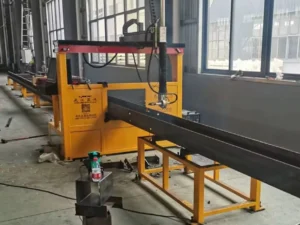
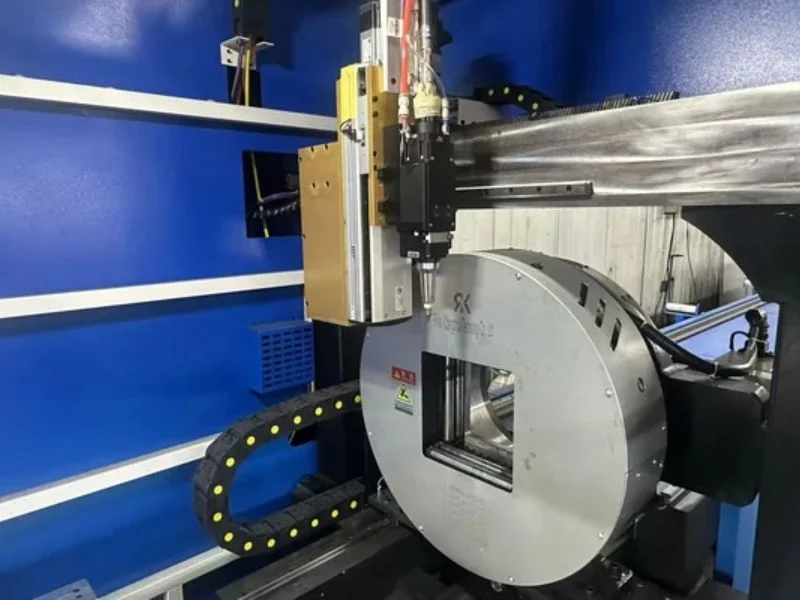
A fiber laser tube cutter combines three separate hazard categories in one machine — beam radiation, fume and gas exposure, and mechanical hazards from a rotating chuck and moving tube — which means a safety plan borrowed from a general CNC router or a woodworking shop misses real, specific risks this equipment introduces.
This is general planning guidance, not a substitute for a site-specific risk assessment, your local regulatory requirements, or your machine manufacturer’s documentation — laser safety classification, exhaust ventilation requirements and electrical code compliance vary by jurisdiction and installation, and should be verified with qualified local resources before installation.
This guide covers laser enclosure and access control, fume extraction and assist gas safety, operator PPE and training, electrical and site preparation, and where to find authoritative compliance references.
Laser Enclosure and Access Control
Confirm the machine’s enclosure and interlock system prevents beam exposure during operation, and that interlocks reliably cut laser power — not just pause the program — when an access point is opened during a cut. A guard that’s been removed for maintenance and not fully reinstalled, or an interlock that’s been bypassed for convenience, is one of the most common ways beam exposure protection ends up defeated without anyone deliberately deciding to defeat it.
Establish clear access control procedures for anyone entering the cutting area during operation, and train every operator — not just the maintenance lead — to recognize a guard or interlock that isn’t functioning correctly. See OSHA’s laser hazard guidance for the general regulatory framework most US shops are working against.
Fume Extraction and Assist Gas Safety
Size fume extraction for continuous laser cutting operation and confirm it captures fumes at the source, near the cutting head, rather than relying on general shop ventilation — metal cutting fumes contain particulates and compounds that vary by material, and extraction inadequate for your specific material mix is a real exposure risk, not just a housekeeping issue.
Assist gas systems carry their own hazards: nitrogen and other inert gases can create an oxygen-displacement risk in enclosed spaces if a line leaks, and compressed gas cylinders or bulk supply systems need proper storage, securing and regulation regardless of which gas type your process uses. Check gas line fittings and connections regularly as part of standard safety maintenance, not just cut-quality maintenance.
Operator PPE and Training
Require laser safety eyewear rated for your specific machine’s wavelength when there’s any potential for beam exposure, along with standard metal-fabrication PPE — hearing protection, eye protection from spatter, and appropriate clothing for a metal cutting environment — and don’t treat PPE as a substitute for engineering controls like enclosures and interlocks.
Train every operator on emergency stop locations and procedures, what to do in the event of a suspected beam exposure or gas leak, and how to recognize equipment malfunction before it becomes hazardous. Refresher training on a regular schedule matters as much as initial training, since safety habits can drift over months of routine operation.
Electrical and Site Preparation
Confirm your facility’s electrical supply matches the machine’s power requirements before installation, and verify grounding, circuit protection and any required electrical work meets your local electrical code — this is a site-specific engineering question that needs qualified local verification, not a generic checklist item.
Plan for gas supply infrastructure, exhaust ventilation routing, and floor space clearance around the machine for both operation and maintenance access as part of the same site preparation process. Coordinate these requirements with your machine supplier and a qualified local electrician or facilities engineer before the machine arrives, not after.
Compliance References and Local Verification
Laser classification standards, exhaust and ventilation requirements, and electrical code all vary by country and jurisdiction — verify your specific requirements with local regulatory bodies and qualified professionals rather than assuming a general guide covers your specific installation.
In the US, university EHS programs publish detailed, publicly available laser cutting safety guidance that’s a useful general reference point, alongside OSHA’s laser hazard guidance for the regulatory framework. Your machine manufacturer’s documentation and your local authority having jurisdiction remain the definitive sources for your specific installation.
See our tube laser cutting machine category page and our tube laser cutting machine buying guide for the broader equipment decision this safety planning supports.
Frequently Asked Questions
Does laser safety eyewear replace the need for machine enclosures?
No — PPE is a supplement to engineering controls like enclosures and interlocks, not a substitute for them. A properly functioning enclosure and interlock system is the primary protection against beam exposure.
Can nitrogen assist gas be a safety hazard?
Yes — a leak in an enclosed space can create an oxygen-displacement risk, since nitrogen and other inert gases aren’t toxic but can reduce available oxygen. Proper gas line maintenance and space ventilation planning matter accordingly.
Do laser cutting safety requirements vary by location?
Yes significantly — laser classification standards, ventilation requirements and electrical code vary by country and jurisdiction, which is why local regulatory verification is necessary rather than relying on a general guide alone.
What should fume extraction be sized for?
Continuous operation with source capture near the cutting head, sized for your specific material mix — general shop ventilation alone is typically inadequate for the particulates and compounds metal cutting fumes contain.
How often should operators receive safety training?
Initial training plus regular refreshers — safety habits and awareness can drift over months of routine operation, so a one-time training isn’t sufficient on its own.
Who should verify electrical and installation requirements?
A qualified local electrician or facilities engineer, coordinated with your machine supplier — this is a site-specific engineering question that needs professional verification, not a generic checklist answer.