Buyers evaluating five axis machining usually spend the most time comparing sticker prices and skip past the four specifications that actually determine whether the machine fits their parts: working envelope, head configuration, RTCP accuracy and fixturing.
A five axis router that’s undersized for your largest part, built around the wrong swivel head type for your material, or paired with a fixturing approach designed for flat sheet goods rather than formed parts will underperform its spec sheet the day it starts running real production. These four decisions matter more than raw spindle power or rapid traverse speed for most shops moving into contoured or compound-angle work.
This guide covers each of the four in the order they should be decided — working envelope first, since it constrains everything else, down to fixturing, which is where a lot of five axis buyers get surprised after the machine is already installed.
The Four Decisions at a Glance
| Decision | Key question |
|---|---|
| Working envelope | Does travel cover your largest part in every axis, including rotational clearance? |
| Head configuration | AC head or BC head — which fits your part geometry and spindle needs? |
| RTCP accuracy | Is the machine’s rotation-around-tool-center-point calibration accurate and stable? |
| Fixturing | Can it hold formed, non-flat parts securely — not just flat sheet on a vacuum bed? |
Working Envelope: Match Travel to Your Largest Part
Confirm the machine’s actual working envelope — not just table size — covers your largest part in X, Y and Z, with enough clearance for the rotational head to swing through its full range without colliding with the part or fixture. This is easy to underestimate on five axis machines specifically, because the swiveling head needs physical clearance around the part that a three axis spindle never requires.
Ask for the machine’s usable envelope at maximum head tilt angle, not just its envelope with the head at zero degrees. A machine that comfortably fits your part with the head straight down can lose meaningful clearance once the head tilts to reach an angled feature, and that lost clearance is exactly what determines whether your actual parts fit.
Head Configuration: AC Head vs BC Head
AC head configurations tilt around two axes both mounted on the spindle head itself, while BC head configurations split rotation between the head and the table — AC heads are generally more common on router-style five axis machines and offer a larger working envelope relative to machine footprint, which is why most composite and formed-part trimming applications use them.
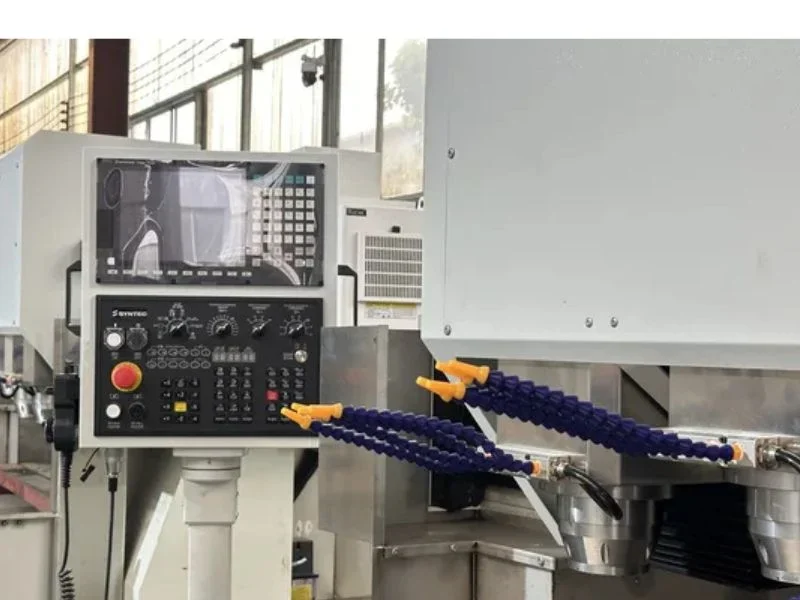
BC configurations, which rotate the table (or a rotary table holding the part) around one axis while the head rotates around another, can offer different rigidity and reach tradeoffs depending on part size and the specific work being done. For most panel-processing and trim work — automotive interior parts, thermoformed covers, composite panels — a one-piece cast AC swivel head gives simpler kinematics and is the more common choice; confirm which configuration a given supplier’s machine actually uses, since the terminology isn’t always used consistently across manufacturers.
RTCP Accuracy: The Spec That’s Hard to Verify From a Data Sheet
RTCP (rotation around the tool center point) keeps the tool tip at its programmed position as the rotational axes move — a machine with imprecise or poorly calibrated RTCP produces parts that are dimensionally accurate at some tool angles and off at others, which is a difficult defect to diagnose without understanding RTCP is the cause.
RTCP accuracy isn’t something you can fully evaluate from a spec sheet number — ask for a demonstration cut on a part with features approached at varying tool angles, and measure the result rather than taking a stated accuracy figure at face value. Also ask how RTCP calibration is performed and how often it needs to be re-verified in production use, since a system that drifts and needs frequent recalibration adds ongoing maintenance burden a stable one doesn’t.
Fixturing for Formed Parts: Jigs, Not Vacuum
Flat sheet goods hold down with a vacuum table; formed, contoured or compound-angle parts generally need dedicated jigs or fixtures shaped to the part’s geometry — confirm your supplier addresses this explicitly, because a machine sold primarily for flat-panel work may not include fixturing guidance for the formed parts you actually intend to run.
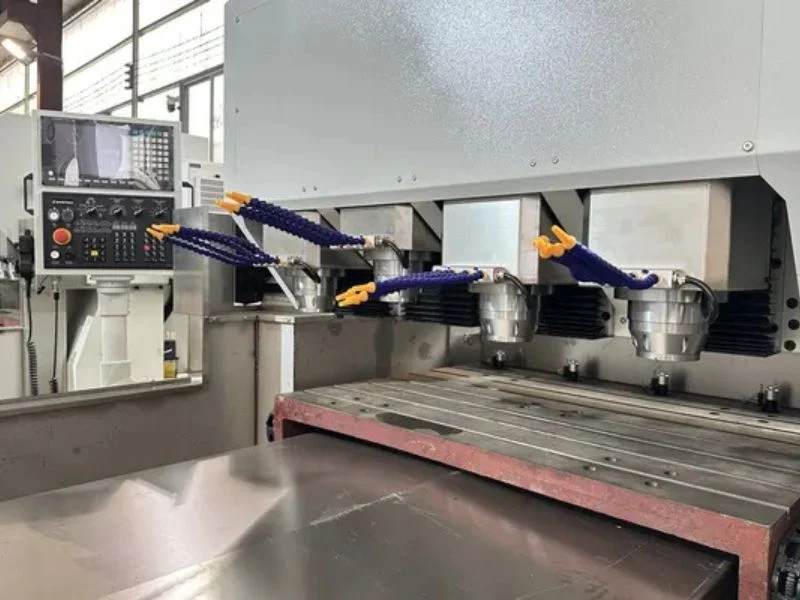
Custom fixturing is often the buyer’s own responsibility to design and build, or an added-cost item from the machine supplier — ask specifically what’s included versus what you’ll need to source or fabricate separately. A machine with excellent working envelope, head configuration and RTCP accuracy still can’t produce accurate parts if the fixture holding the part shifts, flexes, or doesn’t reference the part the same way twice between setups.
Post-Processor and CAM Compatibility
Confirm the machine’s controller has a proven post-processor for the CAM software your shop already uses — a mismatch here means either switching CAM systems or running with an unsupported or custom post-processor, both of which add cost and risk beyond the machine purchase itself. This is easy to overlook during a machine demo, where the supplier typically runs their own well-tested post-processor on their own sample parts.
Ask for a reference shop running the same CAM software you use on the same machine controller, and if possible get a sample toolpath verified on your own part geometry before committing. A five axis machine with excellent hardware specifications is only as good as the toolpath the post-processor actually generates — errors here show up as collisions, gouges or inaccurate cuts that have nothing to do with the machine’s mechanical accuracy.
For the setup-count and cost comparison against three axis routing, see our five axis vs three axis CNC router guide. For cured composite trimming specifics once the machine is running, see how to machine composites without delamination. For the full range of five axis applications, visit our five axis CNC router page.
Frequently Asked Questions
What working envelope do I need for a five axis router?
Confirm the usable envelope at maximum head tilt angle covers your largest part, not just the envelope with the head at zero degrees — clearance shrinks as the head tilts, and that’s the number that determines whether real parts actually fit.
What’s the difference between an AC head and a BC head?
AC heads tilt around two axes both mounted on the spindle head, generally offering a larger working envelope relative to footprint — common on router-style machines for panel and trim work. BC configurations split rotation between the head and table, with different rigidity and reach tradeoffs depending on part size.
How do I evaluate RTCP accuracy before buying?
Ask for a demonstration cut on a part with features approached at varying tool angles and measure the result yourself, rather than relying solely on a stated accuracy figure — RTCP performance is difficult to judge from a spec sheet alone.
Can I use a vacuum table for five axis work?
Vacuum tables work well for flat sheet goods, but formed or contoured parts generally need dedicated jigs or fixtures shaped to the part geometry. Confirm your supplier addresses fixturing for your actual part types, not just flat-panel work.
Is fixturing included when buying a five axis router?
Not always — ask specifically what fixturing is included versus what you’ll need to design, source or fabricate separately, since this is a common gap between a machine sold for flat-panel work and one intended for formed parts.
Do I need five axis capability, or would 3+2 positioning be enough?
If your parts have several flat or near-flat faces at different fixed angles rather than continuously curved surfaces, 3+2 indexed positioning can capture much of the setup-count benefit with simpler programming than full simultaneous five-axis toolpaths.