
Five Axis CNC Router
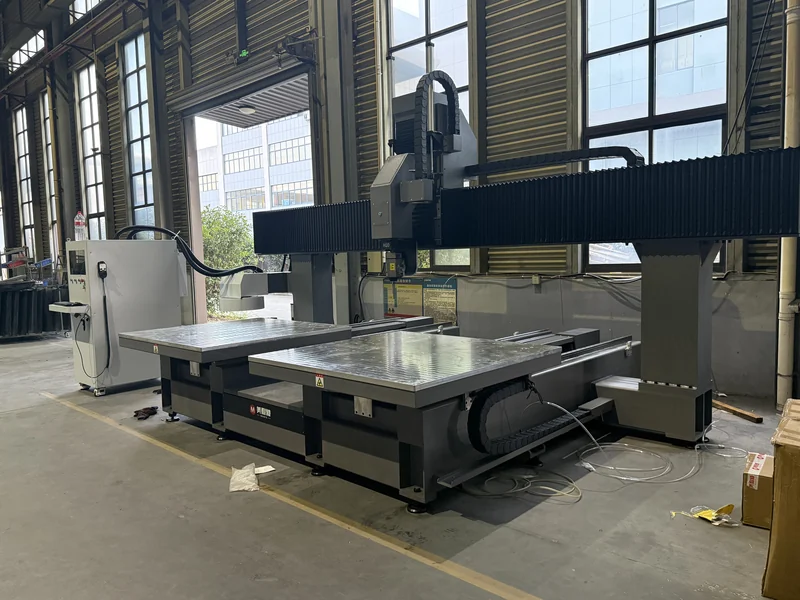
The MNT (MEINAITE) M1515-2 is a fixed-gantry five axis CNC router built for composites, thermoformed parts, automotive interior trim and engineering plastics — not for metal cutting.
- AC swivel head with RTCP — the tool tip follows the programmed path when the head tilts, so contoured trimming holds tolerance
- Two tables, two fixture sets — load one while the other cuts; the spindle stops only for tool changes
- 12-tool ATC + saw-blade holder — mill, drill, chamfer and saw-cut (≥ 50 mm) in one setup
Two Different Machines Are Called "Five Axis"
Search for a five axis machine and you get two unrelated categories. A five axis machining centre — a trunnion or swivel-table mill — is built to cut metal: heavy castings, high torque, modest working envelope. A five axis CNC router is a gantry: a large flat envelope, a high-rpm electrospindle, and a swivel head that reaches over a fixtured part.
The M1515-2 is the second kind. It exists to trim, drill and contour parts that are already formed — a moulded interior panel, a thermoformed cover, a composite skin, a machined plastic block. If your job is cutting steel or titanium, a machining centre is the right purchase and we will say so rather than sell you a gantry.
Why five axes instead of three
A three axis router can only approach the part from straight above. Every hole on a curved surface comes out elliptical, every trimmed edge is bevelled by however much the surface tilts, and anything undercut is simply unreachable — so the part gets re-fixtured, and each re-fixture costs both time and accuracy.
With an AC swivel head the tool stands normal to the surface wherever it lands. One fixture, one program, all five sides that matter. That is why moulded and thermoformed parts moved to five axis trimming and never moved back.
RTCP is the feature that makes it usable
Tilting the head moves the tool tip away from the programmed point — unless the control compensates in real time. RTCP (rotational tool centre point) does exactly that: you program the surface, the control solves the kinematics. Without it, five axis work becomes a post-processor problem and every tool-length change re-opens it. The Weihong control on this machine ships with RTCP as standard.
Machine specification
| Item | MNT-M1515-2 |
|---|---|
| Travel X / Y / Z | 1500 × 1500 × 400 mm |
| Worktable size | 1600 × 1600 mm — steel structure with aluminium extrusion top |
| Max table load | 800 kg |
| Rotary axes | AC swivel head, one-piece cast five-axis head |
| Spindle | HQD 12 kW water-cooled electrospindle, 24,000 rpm, HSK63F, max tool Ø 30 mm |
| Tool changer | 12-position disc ATC, plus a saw-blade holder (saw cutting ≥ 50 mm) |
| Control | Weihong CNC bus system with RTCP tool-centre-point following |
| Rapid traverse | X/Y 30 m/min · Z 15 m/min · A/C 15 rpm |
| Cutting feed | X/Y 1–15,000 mm/min · Z 1–10,000 mm/min |
| Repeat positioning | ±0.05 mm linear · ±1.5′ on A/C |
| Positioning accuracy | ±0.05 mm/m linear · ±1.5′ on A/C |
| Drives | Weihong bus servos with absolute encoders · TBI ball screws (X/Y 4040, Z 3210) · ground linear guides · Motovario gearboxes |
| Frame | 10 mm wall steel tube, stress-relieved after welding; 200 × 300 × 10 mm gantry beam; 20 mm plate uprights |
| Workholding | Fixture and jig clamping (not vacuum) — two tables, two fixture sets |
| Dust extraction | 5.5 kW bag collector with hood, included |
| Power | AC 380 V / 50 Hz / 3-phase, 80 kVA · air ≥ 0.65 MPa |
| Lead time | 45–50 working days |
Working envelope, table configuration and spindle package are all built to order. Send the part envelope and the material and we confirm the configuration before quoting.
Aluminium that is flat, or 2.5D? Then five axes are cost you do not need. Plate, panel, profile and pocketed parts are a three-axis job, and the real decision there is router versus machining centre — that gradient is walked on our CNC router for aluminum page. Five axes earn their keep only when the surface itself is contoured, or when reaching the feature means tilting the tool rather than re-fixturing the part.
Materials a Five Axis Router Is Built For
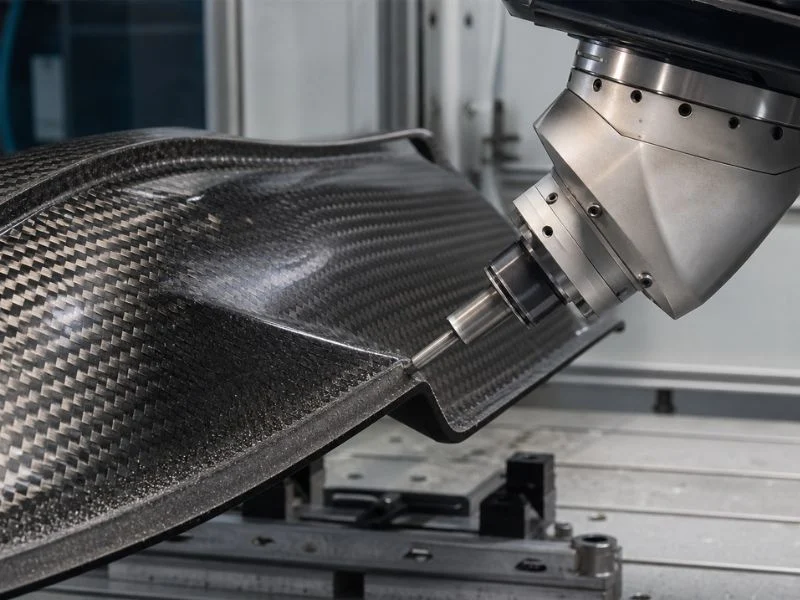
Composites & Cured Laminate
- Formats: Cured CFRP and GRP parts, envelope to 1500 × 1500 × 400 mm
- Watch out: Cured laminate is abrasive and delaminates at the exit side if the cutter pushes rather than shears — a delaminated edge on a structural part is a reject, not a rework
- How we cut it: Diamond-coated or PCD tooling, climb cutting with the head normal to the surface, and extraction sized for conductive dust
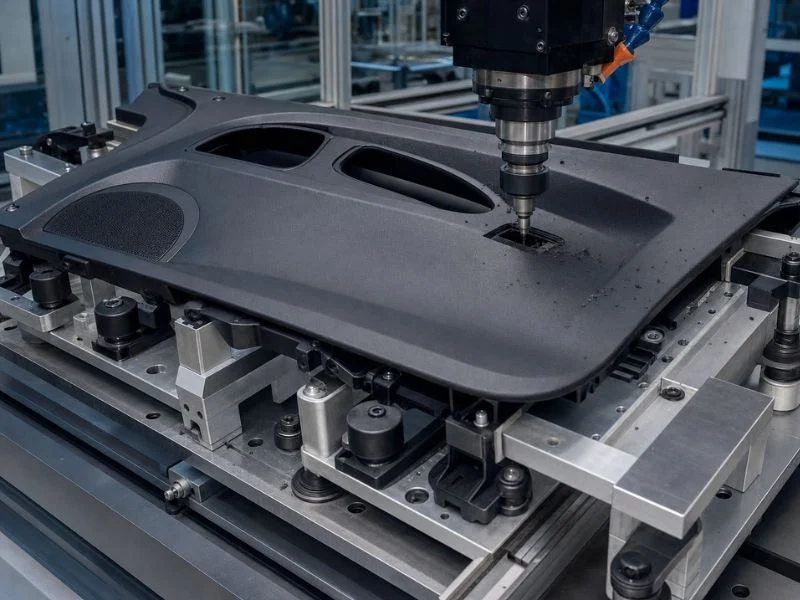
Automotive Interior Trim
- Formats: Moulded door cards, pillar trim, headliners and load-floor panels, batches in the hundreds
- Watch out: Every trim line and clip hole sits on a curve, so a three axis machine either bevels the edge or needs a second fixture — and each re-fixture is another 0.1 mm of stack-up
- How we cut it: The AC head holds the cutter perpendicular to the surface everywhere, in one fixture and one program
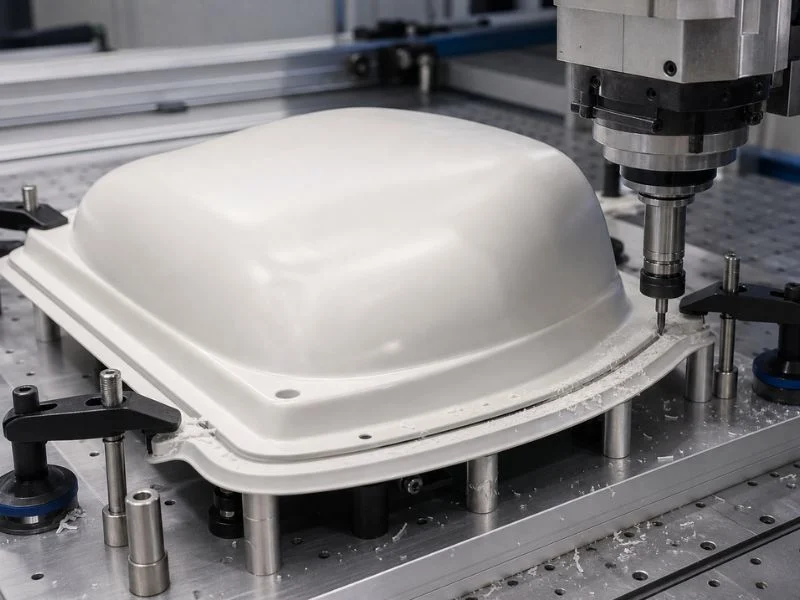
Thermoformed & Injection-Moulded Parts
- Formats: Vacuum-formed covers, housings, guards and ducting in ABS, PC, PP and PMMA
- Watch out: The flange stops being flat the moment the part has any draw depth — exactly where hand trimming stops being repeatable and a router table stops reaching
- How we cut it: Five axis follows the flange line wherever it goes, and the 12-tool changer drills the fixing holes in the same cycle
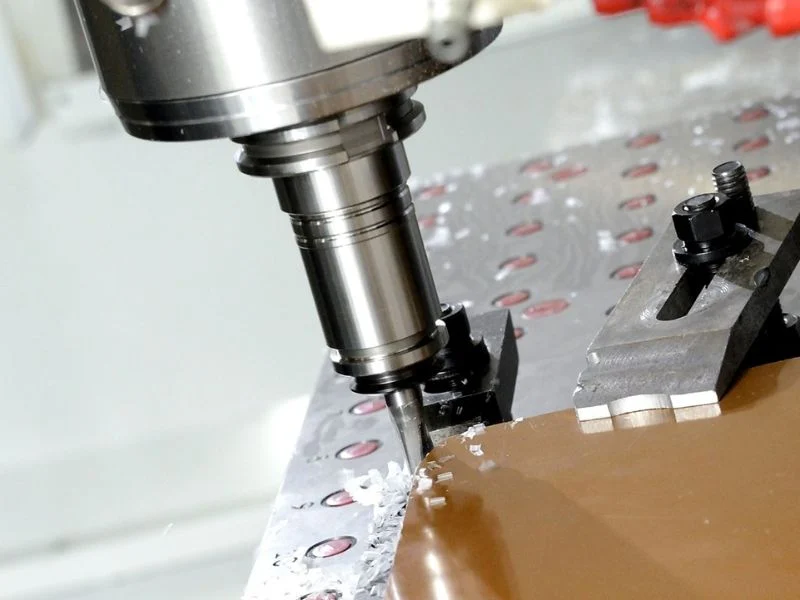
Engineering Plastics & Tooling Board
- Formats: ABS, PC, acrylic, POM, nylon and PU modelling board in blocks to 400 mm thick
- Watch out: Thick plastic is a heat problem before it is a cutting problem: too slow and the chip welds back into the cut, too fast and the tool deflects
- How we cut it: 24,000 rpm with the right chip load clears material instead of melting it; the saw blade cuts blanks down first
Trimming, Drilling and Sawing in One Setup
Contour Trimming
- Parts: 3D trim lines at up to 15,000 mm/min with the cutter normal to the surface throughout
- The hard part: Approach a curved edge from straight above and you get a bevel equal to the surface angle — on a 45° sidewall that is a part that will not fit its neighbour
- What you get: RTCP keeps the tool tip on the programmed line while the head tilts, so the edge is square to the surface everywhere
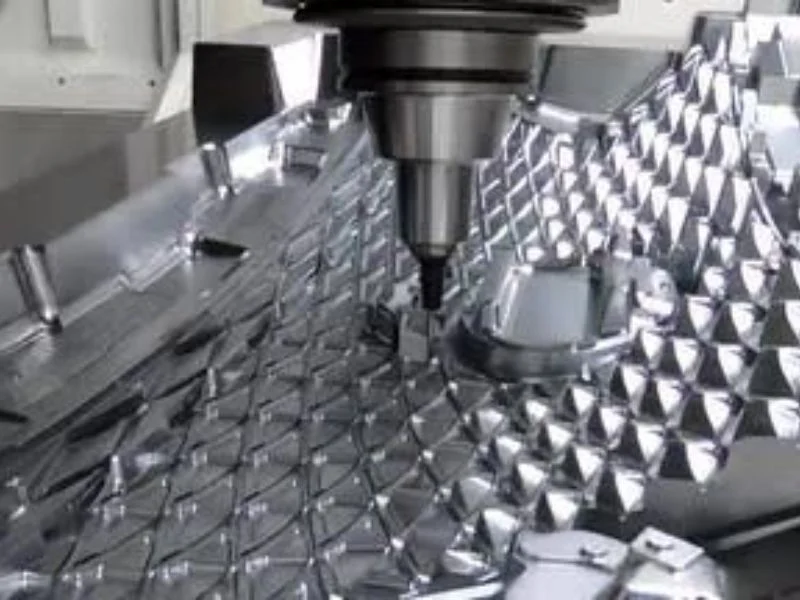
Drilling on Curved Surfaces
- Parts: Clip holes, fastener holes and locating features, ±0.05 mm repeatable
- The hard part: A hole drilled at an angle to the surface comes out elliptical and the fastener binds or sits proud — the assembly line finds it, not the machine shop
- What you get: The head tilts to meet each hole square, which is the single most common reason trim work moves to five axis
Milling, Chamfering & Engraving
- Parts: Roughing, finishing, chamfering and marking from a 12-position HSK63F magazine, tools to Ø 30 mm
- The hard part: Split those operations across three machines and you pay for three setups, three datums and three chances to lose alignment on an already expensive part
- What you get: The ATC swaps tools without an operator, so the whole sequence runs inside one program on one fixture
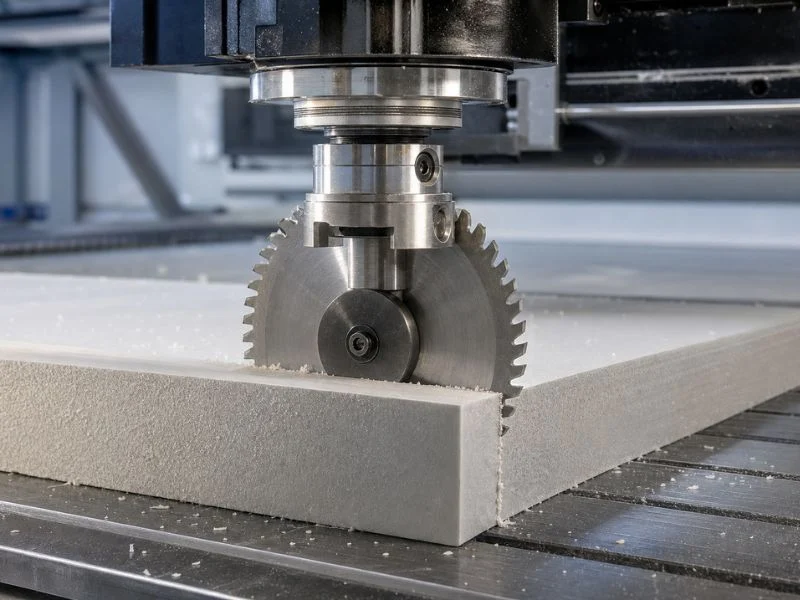
Saw Cutting to 50 Mm
- Parts: A saw-blade holder in the same magazine, cutting stock over 50 mm thick
- The hard part: Most shops cut blanks on a separate saw, which means handling the part twice — and re-locating a formed part is exactly where accuracy goes
- What you get: The blank is sawn, then trimmed and drilled, without ever leaving the fixture
Recommended MNT Machines
Five axis is the right answer only when the part is contoured. For flat sheet and plate, a three axis router or a knife cutter costs far less and runs faster.
MNT-M1515-2 Five Axis CNC Router
- Cuts: Composites, automotive interior trim, thermoformed and injection-moulded parts, engineering plastics
- Specs: 1500 × 1500 × 400 mm · AC swivel head with RTCP · 12 kW / 24,000 rpm HSK63F · 12-tool ATC + saw blade · dual worktable
- Best for: Contoured parts that a three axis machine has to re-fixture — the machine on this page
T-Series CNC Routers (3 Axis)
- Cuts: Flat panel — acrylic, ACP, MDF, plywood, plastics
- Specs: Vacuum table · ATC and vision options · a fraction of the five axis price
- Best for: Flat work, where a fifth axis buys you nothing
M-Series CNC Machining Centres
- Cuts: Acrylic, aluminium and heavier milling work
- Specs: Rigid frame · ATC · three axis milling platform
- Best for: Aluminium and rigid-material milling rather than contoured trimming
When Five Axis Pays Back — and When It Doesn't
A five axis router costs several times what a three axis machine costs. It earns that back in exactly one situation: when the part is contoured and a three axis machine would need more than one fixture. Outside that situation it is an expensive way to do work a cheaper machine does better.
| Your part | Right machine |
|---|---|
| Flat sheet, cut through, 2D profiles | 3 axis router, or a knife cutter for soft material |
| Formed part, trim line on a curve | Five axis router — this machine |
| Holes perpendicular to a curved surface | Five axis router |
| Uncured fabric, prepreg, foam, rubber | Digital knife cutter — zero kerf, no dust |
| Steel, titanium, hard metal | A metal machining centre, not a gantry router |
| Sheet metal and tube | Fiber laser |
Three things buyers underestimate
- Fixtures, not the machine, decide your cycle time. This machine clamps with jigs, not vacuum — formed parts have no flat face to pull down on. Budget fixture design into the project; a good fixture is what makes the second table worth having.
- CAM capability is the real prerequisite. Five axis toolpaths need software and a programmer who can post them. The control handles RTCP; it cannot invent the toolpath. Five axis posts exist for the mainstream packages — Mastercam is the one most trim shops already run — but budget the programming time honestly, not just the machine.
- Composite and plastic dust is the hidden cost. Machining cured laminate produces abrasive, and in the case of carbon, conductive dust. The 5.5 kW bag collector is included for that reason, not as an accessory. Tooling is the other half: cured laminate needs diamond-coated or PCD cutters rather than standard carbide, and the tooling suppliers publish the geometry data — Sandvik Coromant and Kennametal both do.
How the MNT Five Axis Router Is Built
On a gantry five axis, rigidity and the head decide accuracy — everything else is specification you can buy. About MNT (MEINAITE) — who builds it and where.
Distributor or OEM partner? Territory, spare-parts commitment and technical training are what decide whether a machine is worth carrying. Talk to us about partnership.
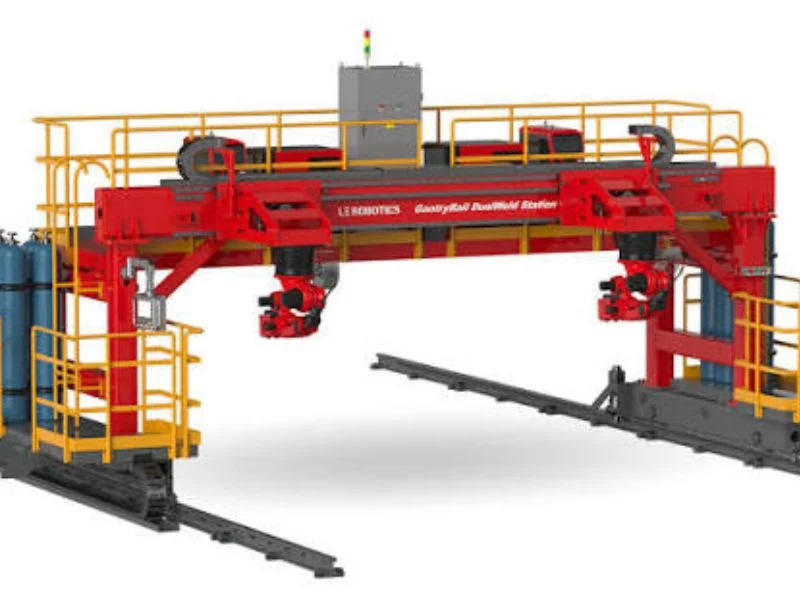
Frame Built to Stay Straight
- 10 mm wall steel tube frame, stress-relieved after welding so accuracy holds over years
- 200 × 300 × 10 mm gantry beam with ribs on the load axis; 20 mm plate uprights
- Whole frame machined on a large gantry mill after annealing, so assembly starts from a true datum
- For distributors: a single five axis sale is worth ten knife-table sales at USD 39,000–133,000 — but it needs someone on your side who can demonstrate a five axis toolpath, not just quote a spec sheet
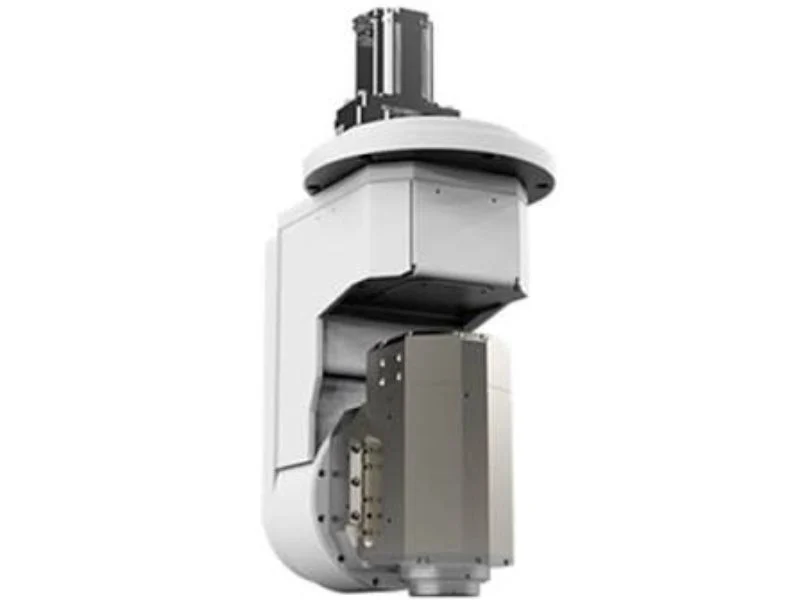
Head, Control and Drives
- One-piece cast AC swivel head — rigidity where a bolted head loses it
- Weihong bus control with RTCP; absolute-encoder servos, no homing after power-up
- TBI ball screws, ground guides, Motovario gearboxes, Schneider electrics, Airtac pneumatics
- For distributors: spare-parts commitment, territory and technical training are the three things that decide whether a machine is worth carrying — all three are set out on our partnership page
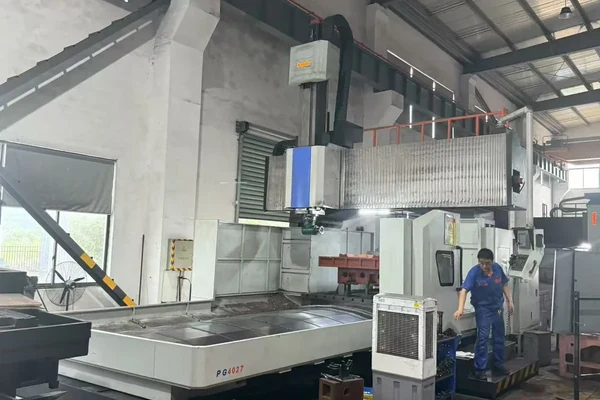
The Factory That Builds Your Five Axis Router
- Frames welded, annealed and machined in-house by Hangzhou Chaohan
- Every machine assembled and run-tested before shipping
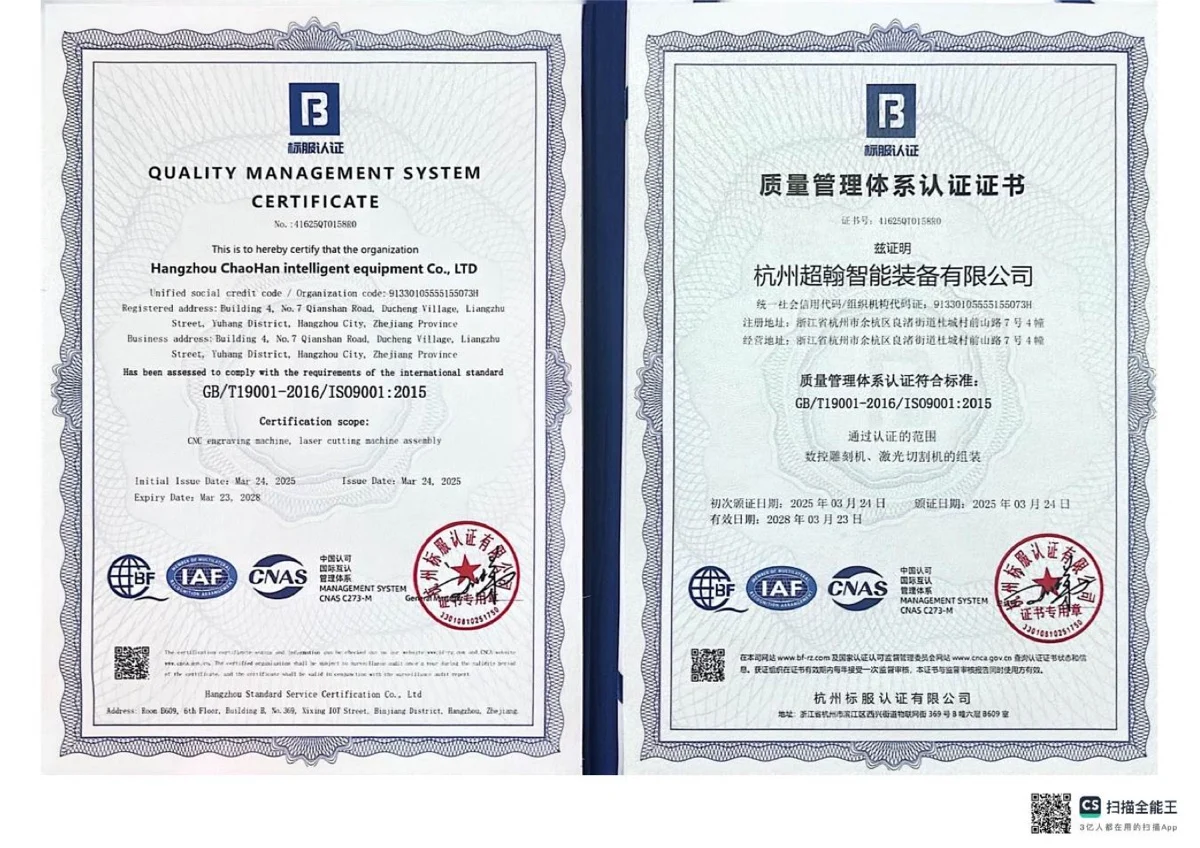
Commissioning, Training and 12-Month Warranty
- CE-marked and ISO 9001:2015 certified, built by Hangzhou Chaohan
- On-site installation, then 3–5 days of operator training until your team runs it unaided
- 12-month warranty with lifetime support and free software updates
Specs are from the MNT-M1515-2 build sheet: 1500×1500×400 mm, HQD 12 kW HSK63F, Weihong RTCP control, 80 kVA. Lead time 45–50 working days.
Frequently Asked Questions
How much does a five axis CNC router cost?
The MNT-M1515-2 runs roughly USD 39,000 to 133,000 depending on working envelope, spindle package, tool changer, table configuration and whether dust extraction and fixturing are included. The wide span is real — a single-table machine with a basic spindle and a twin-table machine with a full ATC and fixture sets are different purchases. Send your part envelope, material and monthly volume for a firm factory-direct quote.
What is the difference between a five axis CNC router and a five axis machining centre?
They are different machines for different materials. A machining centre is a heavy casting built to cut metal, with a modest envelope and high torque at low rpm. A five axis router is a gantry with a large flat envelope and a high-rpm electrospindle, built for composites, plastics and formed parts. The M1515-2 is a router. If you need to cut steel or titanium, buy a machining centre — we will tell you that rather than sell you a gantry.
What is RTCP and do I need it?
RTCP (rotational tool centre point) keeps the tool tip on the programmed path while the head tilts. Without it, every tilt shifts the tip away from where you programmed it, and every change in tool length re-opens the problem in the post-processor. On a five axis machine RTCP is not optional in practice — it is what makes the machine programmable by a normal CAM workflow. The Weihong control here has it as standard.
Can it cut metal?
Aluminium and non-ferrous, within reason — it is a 12 kW 24,000 rpm spindle, which favours high-speed cutting in soft material rather than heavy metal removal. Steel and titanium are outside what a gantry router should be asked to do. For sheet metal and tube, a fiber laser is the right tool; for heavier milling, see our machining centres.
Why does it use fixtures instead of a vacuum table?
Because the parts are already formed. A vacuum table pulls down on a flat face, and a moulded interior panel or thermoformed cover does not have one. Jigs locate the part the same way every cycle, which matters more than clamping force when the trim line has to repeat to ±0.05 mm. Fixture design is the part of a five axis project that most often gets underestimated — we help specify it during the sample trial.
What does the dual worktable actually save?
Load and unload time, which on trimming work is often larger than cut time. With two tables and two fixture sets, the operator strips and reloads one table while the spindle runs on the other, so the machine stops only for tool changes. On short-cycle interior-trim parts this is typically where the throughput gain comes from — not from cutting faster.
Can it saw-cut as well as mill?
Yes. A saw-blade holder sits in the same 12-position magazine, so the machine can saw stock over 50 mm thick and then trim and drill the same part without moving it. That is the reason for the ATC magazine rather than a fixed spindle — one machine covers blank cut-down and finish machining.
What do I need on site before it arrives?
AC 380 V / 50 Hz three-phase at 80 kVA, compressed air at 0.65 MPa or better, a dust-extraction run for the 5.5 kW collector, and floor space beyond the 1600 × 1600 mm tables for loading both sides. Ambient humidity 30–75%, earth resistance under 10 Ω. Ask for the installation drawing when enquiring — power and extraction are far easier to plan before the machine ships. Lead time is 45–50 working days.
Do you provide training and support?
Yes. Engineers install and commission on site, then run 3–5 days of operator training until your team can use the machine unaided. Warranty is 12 months on the whole machine with lifetime maintenance support and free software updates. Send us a part and we cut a sample before you commit — on five axis work a sample trial tells you more than any spec sheet.
Five Axis & Machining — Technical Guides
Process choice, machine selection and what a fifth axis actually buys you.
How to Choose a Five Axis CNC Router
Envelope, head type, RTCP and fixturing — how to size a five axis CNC router against the parts you actually run.
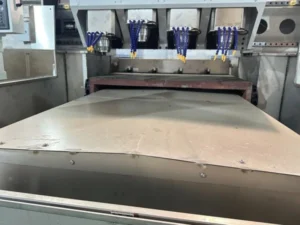
Five Axis vs Three Axis CNC Router: When the Fifth Axis Pays Back
When the fifth axis pays back and when it does not, worked through on real contoured parts rather than in the abstract.
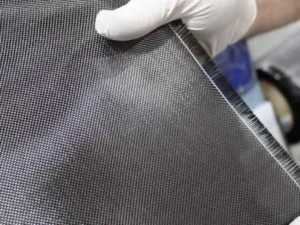
How to Machine Composites Without Delamination: CNC Milling, PCD Tooling & Five-Axis
Tooling, feeds and dust control for trimming cured composite — the post-mould side of composite machining.
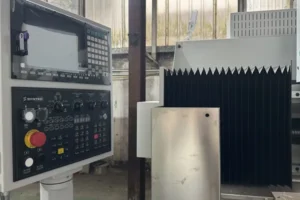
How to Choose a CNC Machining Center for Acrylic and Aluminum
Machining centre selection for acrylic and aluminium — the three axis alternative when the part is not contoured.
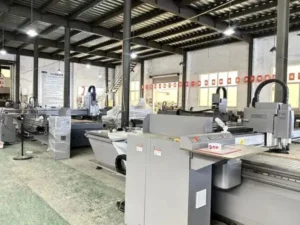
Direct Drive vs Rack and Pinion CNC Machines
Drive types and where each belongs, including why ball screws are used on this machine’s axes.
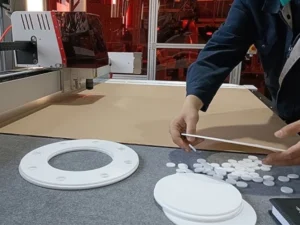
CNC Router vs Waterjet for Thick PTFE Plate
How cutting-process choice shifts with material and thickness — the same reasoning applied to thick plastics.
Send Us a Part for a Five Axis Sample Trial
Send the part envelope, material and monthly volume. We confirm the configuration, quote factory-direct, and cut a sample before you commit — on five axis work a trial tells you more than any spec sheet.