Moving a 4×8 ft panel around a machine sounds simpler than moving a machine around a fixed panel — until the panel weighs enough or measures large enough that repositioning it accurately between passes becomes the harder engineering problem. That’s the design logic behind a moving-gantry large-format machining center: keep the material still, move the cutting head instead.
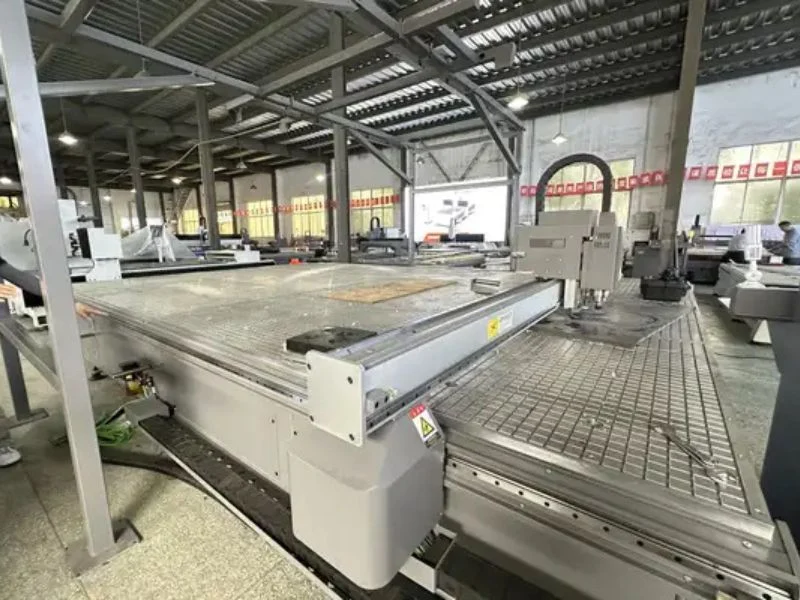
Large-format machines like the M4020 use a moving gantry — the entire cutting structure travels over a stationary bed — rather than a moving table that shifts material under a fixed gantry. This isn’t an arbitrary design choice; it’s a direct response to what happens to accuracy and practicality once panel size and weight cross a certain threshold.
This guide explains why moving-gantry design is standard on large-format machining centers, how gantry synchronization actually works, and when a large-format moving-gantry machine like the M4020 is the right choice over a precision-focused machine like the M3015.
Why Moving Gantry Instead of Moving Table for Large Panels
A moving-table design has to accelerate and reposition the entire workpiece between passes, which gets progressively harder to do accurately as panel size and weight increase — a moving-gantry design instead keeps the panel stationary and moves a lighter cutting structure over it, which scales better as bed size grows.
At smaller working envelopes, either approach can work well. Once bed size reaches the 4000×2000 mm class, moving a panel of that size accurately and repeatably becomes a harder engineering problem than moving the gantry structure instead — which is why large-format machines in this size class consistently use moving-gantry designs rather than moving-table ones.
Keeping Oversized Sheets Fixed: The Practical Case
A stationary bed means the panel gets loaded once and stays in position for the entire job, eliminating the repositioning step — and the accumulated positioning error that step would introduce — that a moving-table design requires between passes on a large panel.
This also simplifies material handling in a practical sense: loading a large, potentially heavy panel once is inherently easier and safer than loading it, then repositioning it mid-job as a moving-table design might require depending on its specific travel limits relative to panel size.
Gantry Synchronization: What Keeps Both Sides Moving Together
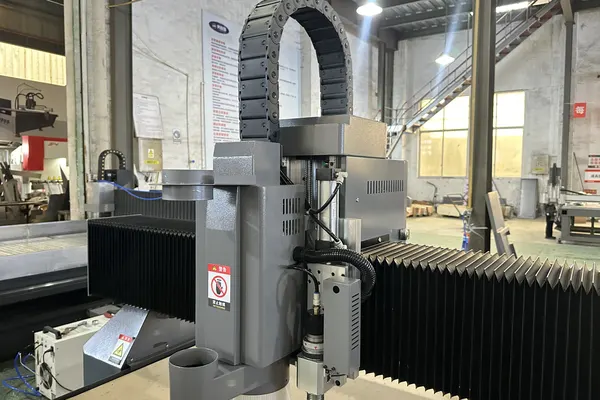
A moving gantry spans the full width of the bed and is driven from both ends simultaneously — synchronization between those two drive points is what keeps the gantry square to the bed as it travels, and any drift between the two sides shows up directly as positioning error that gets worse the further the gantry travels from its reference point.
This is why dual-drive synchronization quality is a real differentiator between large-format machines, not just a spec sheet checkbox. A gantry that’s begun to rack — one side leading the other by even a small amount — produces cuts that are accurate near the reference end and progressively less accurate further away, which is a difficult problem to diagnose without understanding gantry synchronization is the likely cause.
Rack-and-Pinion Dual-Drive Layout Explained
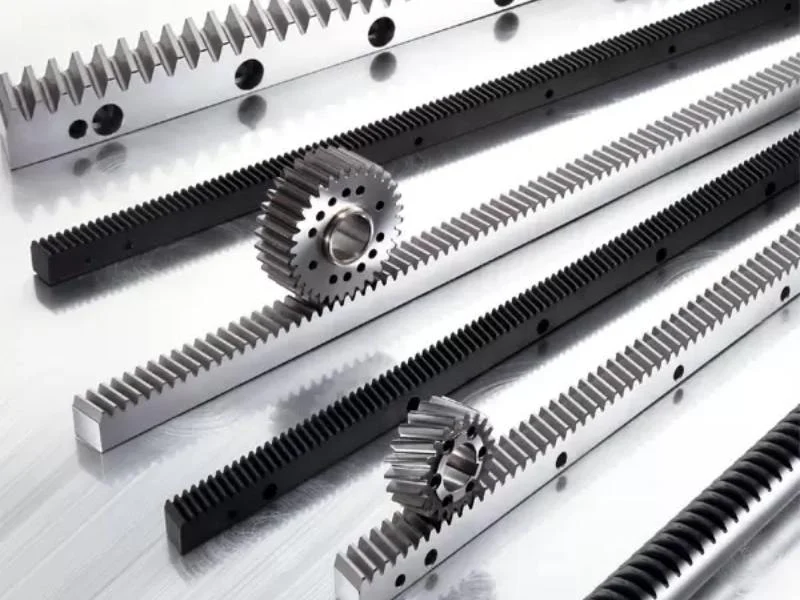
A rack-and-pinion dual-drive layout runs a pinion gear on each side of the gantry against a rack mounted along the full length of the bed, with both pinions driven in coordination — this setup delivers the driving force needed to move a large gantry structure quickly while maintaining the synchronization both sides need to stay square.
The rack-and-pinion approach suits large-format travel distances better than a ball-screw drive would at this scale, since ball screws become impractical to manufacture and maintain at very long travel lengths. This is part of why large-format machines have a different drivetrain architecture than compact or precision-focused machines optimized for a different working envelope.
Speed and Accuracy Tradeoffs
Moving-gantry large-format machines are generally optimized for covering large working envelopes efficiently rather than for the tightest possible positioning accuracy — a machine like the M4020 prioritizes bed size and speed, while a precision-focused machine like the M3015 prioritizes tight positioning accuracy over working envelope.
This isn’t a limitation of moving-gantry design specifically — it reflects what each machine is engineered to optimize for. A large-format machine’s rack-and-pinion drive and larger structural mass are built for covering distance efficiently across a big bed; a precision machine’s direct-drive axes and smaller working envelope are built for holding the tightest possible tolerance on a more compact range of travel.
When to Choose M4020 Instead of M3015
Choose the M4020 when your panel size is the limiting factor — parts too large for the M3015’s working envelope; choose the M3015 when positioning accuracy is the priority and your part sizes fit comfortably within its smaller bed.
These aren’t competing options for the same job — see our M1631 vs M3015 vs M4020 comparison for the full breakdown of load capacity, precision and format tradeoffs across the M-series line. If your parts routinely get cut down to fit a smaller bed, the M4020 removes that constraint; if your parts already fit the M3015’s envelope, its direct-drive precision is the more relevant advantage for tight-tolerance work.
See the full M4020 Large-Format CNC Machining Center specifications, or our large-format machining center buying guide for the full RFQ checklist.
Frequently Asked Questions
Why don’t large-format machines use a moving table instead of a moving gantry?
Moving a large, heavy panel accurately between passes becomes a harder engineering problem than moving a lighter gantry structure once bed size reaches the large-format class — moving-gantry design scales better as bed size grows.
What happens if a dual-drive gantry loses synchronization?
The gantry can “rack” — one side leading the other slightly — producing cuts that are accurate near the reference end and progressively less accurate further away as the gantry travels.
Why do large-format machines use rack-and-pinion instead of ball screws?
Ball screws become impractical to manufacture and maintain at very long travel lengths, while rack-and-pinion drive scales more practically to the travel distances a large-format bed requires.
Is a moving-gantry machine less accurate than a moving-table one?
Not inherently — moving-gantry design is optimized for covering large working envelopes efficiently. A precision-focused machine with a smaller envelope and direct-drive axes, like the M3015, is built to prioritize tighter tolerance over bed size instead.
How do I decide between the M4020 and M3015?
Panel size is usually the deciding factor — choose the M4020 if your parts don’t fit the M3015’s smaller working envelope, or the M3015 if your parts fit comfortably and positioning accuracy is the priority.
Does gantry synchronization need regular maintenance?
Yes — dual-drive synchronization should be checked as part of regular rack and guide maintenance, since developing wear or lubrication gaps can affect how well both sides of the gantry stay coordinated over time.