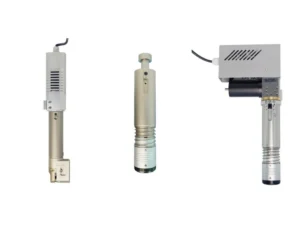
A rotary knife is a tool option on a CNC textile cutter.
Open mesh and breathable cloth can lose vacuum hold-down even when the blade is suitable. A wheel that cuts a straight sample may also struggle with small notches or a fabric that stretches after release. Buyers need to judge the complete material, pattern and holding setup.
This guide shows how to choose a trial and what to verify in the machine quote. Our knife type comparison covers the wider tool family; the CNC textile cutting machine overview covers complete equipment.
What Is the Rotary Knife Option on a CNC Textile Cutter?
The rotary knife is a circular cutting tool fitted to a compatible CNC cutting head. As the cutting head follows a programmed contour, the wheel rotates against the fabric. A buyer should distinguish this option from a handheld round knife and from a dedicated round-knife machine; their feed systems, hold-down and cutting workflows are different.
“Rotary knife”, “round knife” and “rotary wheel” are often used loosely in product listings. The terms do not tell you whether the wheel is driven, what blade geometry it uses, whether the machine supports it, or which fabrics have been tested. Ask for the exact head and blade configuration in the quotation rather than assuming that a textile cutting table includes it as standard.
A useful specification identifies whether the wheel is driven or turns through contact with the material. It also identifies the blade diameter, edge shape, available replacement blades and the mounting head. These details are more useful than the generic word “round” when comparing quotations: two offers can use that word while supplying different tooling. The supplier should confirm how the chosen wheel enters and leaves the fabric, how tool offset is handled at corners, and whether the blade can complete the smallest feature in your file. If those answers are missing, do not infer them from a photograph of the table or from a generic tool list.
MNT describes the rotary wheel as an optional tool to evaluate within a CNC textile cutting setup. The machine remains the product being configured. An application page can explain how tool selection affects a textile job; the machine overview covers table size, feeding, other tool options and the wider buying decision.
MNT’s current online specifications list a rotary option for the C6090, C2516T and C3232. These listings establish what the website offers to quote; they do not prove that a particular head is installed, that every blade fits every carriage, or that your fabric passes a trial. Request the current tool drawing and a written configuration for the selected machine before ordering.
Which Textile Materials Are Candidates for a Rotary Wheel?
Thin, flexible, single-ply fabric with a stable cutting path is a candidate for a rotary wheel trial. Woven cloth, some knits, nonwovens and selected technical textiles can be tested, but “fabric” is not one material specification. Coating, yarn structure, stretch, thickness and backing can change the result.
Open mesh and breathable fabric are especially easy to misjudge. A porous sheet can leak air through the vacuum bed regardless of the blade selected. If the fabric moves, a suitable blade alone will not hold registration or prevent a distorted edge. Fabric construction matters more than the phrase “breathable material” in a search query.
Air permeability can be measured rather than guessed. ASTM D737 covers air permeability of textile fabrics. Fabric thickness is a separate measurement; ASTM D1777 describes how it is measured and why the applied pressure matters. Neither standard specifies a cutting blade or guarantees vacuum performance. A buyer can use both measurements alongside a physical sample when discussing hold-down with the machine supplier.
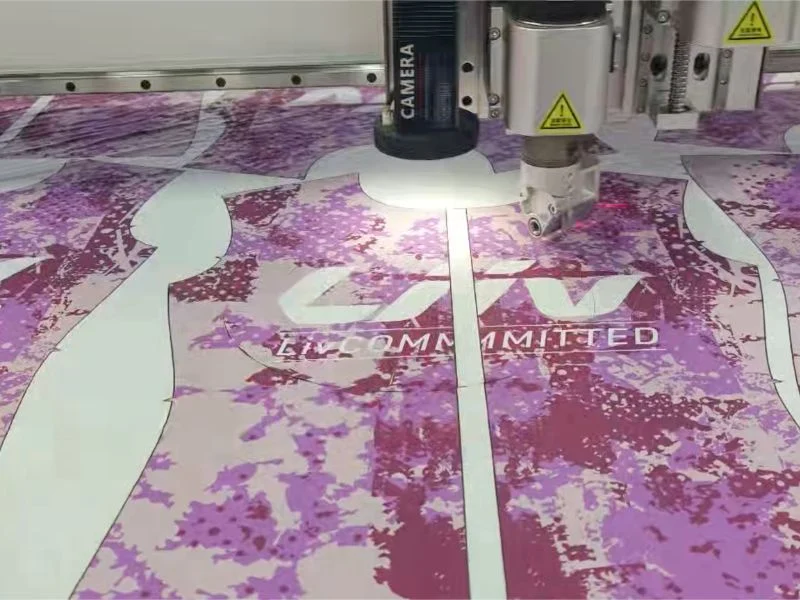
This single-ply CNC cutting workflow does not identify the tool shown as a rotary wheel. The material and cutting head still require a separate trial for this application.
Why Does Hold-Down Matter as Much as the Blade?
A rotary wheel can follow the programmed path only if the textile stays stable on the table. Air passing through mesh or a loosely constructed fabric can reduce effective vacuum at the sheet. Stretch and wrinkles create another failure mode: the machine follows the digital path while the material underneath has moved.
Start with the fabric in the form actually supplied: roll or sheet, face up or face down, and with its normal coating or backing. Then review the vacuum zone, sacrificial underlay, feed tension and alignment method together. A denser backing or different underlay may help one job and harm another, so it belongs in a recorded trial rather than a universal setting chart.
The test should include the difficult part of the pattern. A long outer contour can look acceptable while narrow bridges, small notches or sharp internal corners lift or distort. Check the first and last parts of a roll, not just a clean sample from the middle. If printed registration is required, inspect the cut against the print after feeding and unloading.
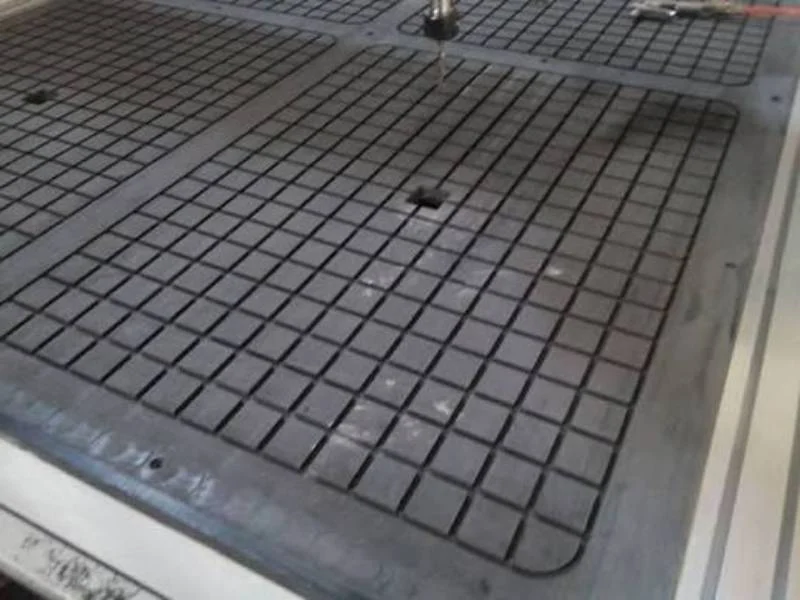
A zoned vacuum table is one part of the holding system; the appropriate zone and underlay depend on the supplied textile.
When Should You Test an Oscillating Knife Instead?
Test an oscillating knife when the job has tight corners, small notches, thicker or layered material, or an edge that the wheel cannot complete consistently. The comparison is task-specific. It should be run on the same material, pattern and acceptance criteria rather than inferred from tool labels.
For an open weave, compare fibre pull, edge distortion and incomplete separation. For a stretch knit, compare shape after unloading as well as while it remains on the vacuum bed. For coated or laminated fabric, check whether the coating delaminates or the blade leaves an unacceptable edge. For printed fabric, compare alignment to the printed reference, not only the digital outline.
| Job condition | Rotary wheel trial | Oscillating knife trial | Decision evidence |
|---|---|---|---|
| Long contours on thin single ply | Check continuous cut and fabric movement | Check edge and cycle time | Usable edges across a full pattern |
| Open mesh or air-permeable textile | Check hold-down and yarn movement | Check snagging and edge distortion | Shape after release from the table |
| Small internal features | Check corner radius and incomplete cuts | Check accuracy at notches and holes | Acceptance of the smallest feature |
| Thicker, layered or coated textile | Check full separation and layer shift | Check edge and coating response | Repeatable result through the full stack |
These are trial priorities, not published capacity limits. Machine speed, blade geometry and material build must be confirmed for the offered configuration. The broader blade selection guide explains why no single tool covers every flexible material.
What Should a Buyer Send for a Useful Cutting Trial?
Send the real material and the hardest representative pattern, then define what counts as an acceptable part. A generic photo of a textile does not reveal permeability, coating or stretch. A square test coupon does not show what happens at narrow details or after conveyor feeding.
- Material: fibre composition, weave or knit, coating or laminate, thickness, roll width and the orientation used in production.
- Pattern: a usable DXF or other agreed vector file, smallest notch or hole, long outer contour and any printed registration marks.
- Process: single ply or stack, required throughput in parts per shift, feeding method and downstream handling.
- Acceptance: allowable fray, fibre pull, edge distortion, dimensional tolerance, print-to-cut alignment and whether the part must stay flat after unloading.
Request a side-by-side trial where practical: the same fabric and pattern with the rotary wheel and an alternative tool, each with its recorded holding setup. Ask the supplier to identify the machine model, tool head, blade, spare blade supply, vacuum arrangement and any separately quoted feeding or vision option. The result should be a configuration proposal tied to your material, not a claim that a round knife cuts all textiles.
Record more than one finished part. A first cut can hide problems that appear after the fabric has fed across the bed or after the blade has warmed and gathered fibres. Label the samples by tool and holding setup, inspect them after unloading, and repeat the smallest feature. Keep the original CAD file and the cut pieces together so the supplier can see whether any dimensional change came from cutting, material stretch or handling.
For a production run, ask how the supplier will check blade wear, replace the wheel and recover alignment after a tool change. Agree which observations are pass or fail before the demonstration: for example, an incomplete slit, a pulled yarn at a notch or a shifted print boundary. A useful trial report records both acceptable pieces and failures; a close-up of one selected edge does not establish repeatability or throughput.
If the supplier cannot show the requested head, sample or acceptance result, treat compatibility as unconfirmed until it is demonstrated. That protects both the buyer and the machine supplier from an avoidable mismatch.
How Does This Guide Relate to the CNC Textile Cutting Machine?
This article answers the tool and material question; the CNC textile cutting machine page owns the full equipment decision. A buyer choosing table size, roll handling, registration and production workflow should start with the CNC textile cutting machine. The rotary wheel is one configuration question within that decision.
There is also a different product class: a handheld round knife or a machine sold specifically around a fixed circular blade. This article does not represent those products as an MNT model. If the purchase request is for a replacement blade, handheld cutter or dedicated round-knife machine, first confirm the exact product form with the supplier.
For a real project, send the material and cut file through the contact route linked from the machine overview. Ask for a documented recommendation covering the rotary tool option, hold-down, sample result and quotation scope.
Frequently Asked Questions
Is a CNC round knife a complete textile cutting machine?
No. In this guide, the round knife is a rotary wheel tool option on a compatible CNC textile cutter. A dedicated round-knife machine and a handheld fabric cutter are different products. Confirm the machine and tool head in the quotation.
Will a rotary wheel cut breathable or mesh fabric?
It may, but the outcome depends on fabric construction, vacuum hold-down, blade geometry and the cut pattern. Test the actual material and judge the part after it leaves the table.
Does a porous textile need a different vacuum setup?
Often it does. Air can pass through open fabric and reduce holding force. Review zoning, underlay, feed tension and material orientation in a trial; no single setting applies to every porous fabric.
When is an oscillating knife preferable to a rotary wheel?
Test an oscillating knife when the wheel leaves incomplete cuts, misses small internal details or cannot handle the material build. Compare both tools on the same pattern and fabric before specifying one.
Can the same table use rotary and oscillating tools?
That depends on the exact machine and tool carriage offered. Request the supported tool list and confirm whether each head is included, optional or unavailable for the proposed model.
What proof should I request before ordering the rotary option?
Ask for the specified tool head and blade, a sample cut on your production material, inspection of the difficult features and a quotation listing vacuum, feeding and registration options.