The wrong blade doesn’t fail loudly. It fails as a torn edge on fabric, a melted-looking cut on foam, or a chipped rather than sheared edge on a carbon fiber layup — and most operators reach for a sharper blade before checking whether it’s the right blade for the material at all.
Oscillating and drag knife blades come in different edge geometries, thicknesses and coatings for a reason: a blade ground for clean single-layer fabric behaves badly on multi-layer leather, and a blade sized for foam wanders and deflects in dense rubber or composite. Matching blade to material and thickness is one of the cheapest variables in a cutting operation to get right, because the blade itself costs far less than the scrapped material or downtime a wrong choice produces.
This chart breaks down blade selection by material family and thickness band, then covers the materials that chew through blades fastest and how to spot wear before it shows up in a bad cut. It applies to any oscillating knife platform, including the machines on our oscillating knife cutting machine page.
How Blade Geometry Matches the Material
A straight-edge blade shears cleanly through single-layer, low-stretch material; a scalloped or wave-edge blade grips and cuts fibrous or slippery material that a straight edge tends to push aside instead of cutting through. The edge geometry determines how the blade engages the material at the moment of contact, which matters more than raw sharpness for anything other than the thinnest, cleanest materials.
Blade thickness affects deflection: a thin blade cuts a narrower kerf and turns tighter corners, but flexes more under load in dense or thick material, which is what causes an angled rather than vertical cut wall. A thicker blade resists deflection in dense material but produces a wider kerf and struggles with tight interior corners on detailed parts.
Coating matters most on abrasive materials — a titanium-nitride or similar coated blade holds an edge longer against fiberglass-backed board, coated fabrics and abrasive foam than an uncoated blade, at a higher per-blade cost that’s usually justified by the reduction in change-out frequency.
Blade Selection Chart by Material and Thickness
Use this as a starting reference — always confirm on a test cut, since fillers, coatings and layer count shift the right choice even within one material family (a filled elastomer compound, for instance, wears a blade faster than a pure one at the same thickness).
| Material | Typical thickness | Blade type | Notes |
|---|---|---|---|
| Leather (single layer) | 1–3 mm | Straight edge, standard | Sharp edge critical for automotive/footwear finish quality |
| Leather (multi-layer stack) | up to 6–8 mm stacked | Straight edge, extended reach | Deeper penetration needed; check deflection on stack edges |
| Apparel fabric / textile | <1–2 mm | Straight edge or rotary | Rotary often preferred for high-speed single-ply runs |
| Cardboard / corrugated | 2–10 mm | Straight edge, standard to heavy | Coated/waxed board wears blades faster than plain kraft |
| Foam (PE, EVA, PU) | 3–25 mm | Straight edge, long reach | Depth control matters more than edge geometry here |
| Rubber sheet (EPDM, NBR, neoprene, silicone) | 1–10 mm | Straight edge, coated | Filled/reinforced rubber dulls blades faster than pure elastomer |
| Gasket material (cork, felt, composite) | 0.5–5 mm | Straight edge, standard | Fine detail work; blade sharpness affects gasket seal quality directly |
| Aramid / carbon fiber dry fabric | 0.2–1 mm per ply | Coated straight edge | Fastest-wearing material on this list; see below |
| Prepreg composite | 0.2–0.5 mm per ply | Coated straight edge, cold blade | Tack from resin builds up on blade; frequent cleaning needed |
For material-specific setups on rubber and gasket stock, our rubber cutting machine page covers cutting parameters by compound; for carbon fiber and prepreg, see the carbon fiber cutting machine page.
Materials That Wear Blades Fastest
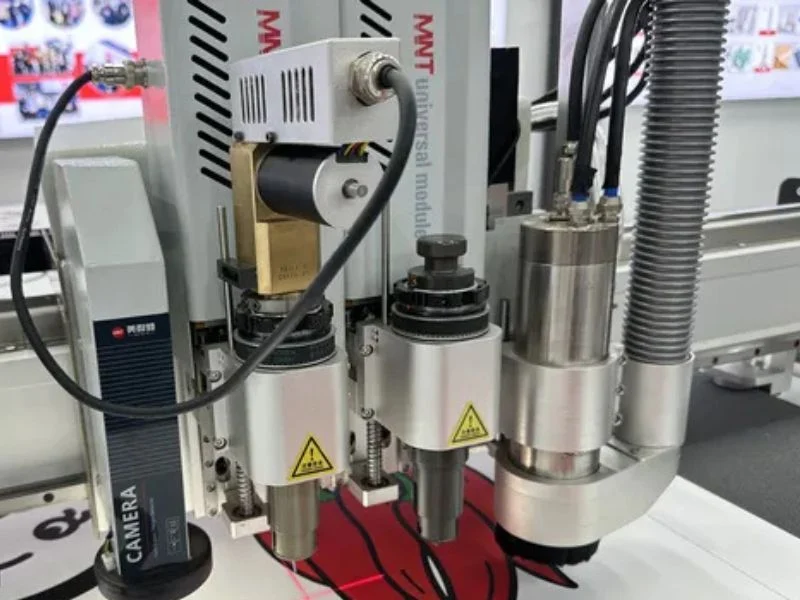
Aramid fiber, dry carbon fiber and fiberglass-reinforced material dull a blade faster than almost anything else run on an oscillating or drag knife — often within a single shift of continuous cutting. The fibers themselves are abrasive at a microscopic level, and unlike a soft material that a slightly dull blade will still tear through, these materials show edge quality loss almost immediately once the blade starts to go.
Coated fabric and rubber with mineral fillers are the next tier — not as fast-wearing as reinforced fiber, but noticeably harder on blades than plain elastomer or single-layer fabric. Fillers used for rubber compound properties like fire resistance or abrasion resistance are often the same particles that accelerate blade wear during cutting.
Track blade life by material family rather than assuming one blade-change interval fits every job on the schedule. A shop alternating between foam and aramid in the same week needs a materially different blade-change cadence for each, and treating them the same either wastes good blades or runs bad ones too long.
Cutting Depth: Why “Just a Bit Deeper” Is the Wrong Instinct
Set blade depth to penetrate the material plus a small controlled amount into the cutting strip or vacuum mat beneath it — typically a fraction of a millimeter, not a deliberate deep plunge — because overcutting wears the mat and dulls the blade tip faster without improving cut quality.
The instinct to cut deeper when a blade seems to be struggling usually treats a symptom of the wrong problem: a blade that isn’t fully separating material is more often dull, wrong-geometry, or moving too fast for the material than genuinely under-penetrating. Increasing depth on a dull blade just wears the backing surface faster while the actual cut quality stays poor.
Check depth setting any time you change material thickness or switch to a new batch of the same material — thickness tolerance varies more between material lots than most operators expect, and a depth setting dialed in for one roll of foam or one hide can be measurably off for the next.
Reading Blade Wear Before It Shows in the Cut
Inspect the blade edge under good light, not just the cut result — a blade can look sharp to the eye while already rounded enough at the microscopic level to start producing a torn rather than sheared edge. By the time wear shows up clearly in the finished part, several parts before it were likely already marginal.
Watch for three early signs: increased cutting sound or vibration at the same feed rate, a cut that separates but leaves visible fiber or fuzz along the edge instead of a clean line, and slightly increased force needed to fully part the material at corners. Any one of these on its own can be a fluke; two together usually means it’s time to swap the blade rather than push it further.
Frequently Asked Questions
What blade type is best for cutting leather?
A standard straight-edge blade for single-layer leather; for multi-layer stacks, an extended-reach straight-edge blade that can fully penetrate the stack without excessive deflection at the edges of the pile.
Why does my blade dull faster on some jobs than others?
Aramid, dry carbon fiber and fiberglass-reinforced materials wear blades fastest due to the abrasive nature of the fibers; filled rubber and coated fabrics are next. Track blade life by material family rather than expecting one consistent change interval.
Should I increase blade depth if the material isn’t fully cutting through?
Check blade sharpness and geometry first — an incomplete cut is more often a dull or wrong-type blade than insufficient depth, and cutting deeper on a dull blade just accelerates wear on the backing mat without fixing the actual problem.
What’s the difference between coated and uncoated blades?
Coated blades (typically titanium-nitride or similar) hold an edge longer on abrasive materials like fiberglass-backed board or filled rubber, at a higher per-blade cost that’s usually worthwhile once change-out frequency on uncoated blades gets high enough.
How do I know when to switch from a straight-edge to a scalloped blade?
If a straight edge is pushing fibrous or slippery material aside instead of cleanly cutting through it — common on some textiles and coated fabrics — a scalloped or wave-edge blade that grips the material at the point of contact usually solves it.
Does prepreg composite need a different blade than dry carbon fiber?
Both wear blades quickly, but prepreg’s resin tack adds buildup on the blade that needs more frequent cleaning; a cold-blade approach and coated edge help manage both the abrasion and the tack.