A welded steel frame is the standard choice for CNC machines, and for most cutting work it’s the right one — steel is strong, weldable, and cheap to fabricate at scale. Precision fiber laser cutting on thin metal and small, intricate parts is one of the few applications where a different material, granite or marble, genuinely outperforms steel for reasons rooted in physics rather than marketing.
The case for a marble machine frame isn’t about looking different from a typical steel-framed laser — though it does. It’s about three specific physical properties: thermal stability, vibration damping, and long-term dimensional stability under internal stress. Each one matters more as part size shrinks and required tolerance tightens, which is exactly the work a machine like the X6040 is built for.
This guide explains why frame material matters for precision cutting, and when that difference is actually worth paying for versus when it isn’t.
Thermal Stability and Internal Stress
Marble and granite expand and contract less than steel per degree of temperature change, and — critically — they don’t carry the internal stress that welded steel structures do from the welding process itself, which means a marble frame doesn’t gradually relieve residual stress and shift dimensionally over its early service life the way a welded frame can.
Welded steel frames are typically stress-relieved after fabrication specifically to manage this issue, and quality manufacturers do this well. But it’s a process added to compensate for a characteristic the base material has; marble’s natural stability doesn’t require the same compensation. For work where dimensional drift of even a few microns over the machine’s life matters, this is a meaningful structural advantage, not a marginal one.
Vibration Damping for Small Contours
Marble and granite have higher internal damping than steel — they absorb and dissipate vibration energy faster rather than resonating — which matters directly on small, intricate contours where the cutting head is constantly accelerating and decelerating through tight direction changes, each one a potential vibration source.
Steel structures, by contrast, transmit vibration more readily and take longer to settle after a direction change. On large-format cutting with longer, straighter tool paths, this difference matters less — there’s more distance between direction changes for any vibration to settle. On fine, detailed parts with constant rapid direction changes, vibration that hasn’t fully settled between moves shows up directly as edge quality and dimensional inconsistency.
Repeatability and Long-Term Accuracy
A frame material that doesn’t drift with temperature and doesn’t carry residual internal stress holds its calibrated geometry more consistently over years of production, which is what long-term repeatability actually depends on — not just how accurate the machine was on the day it was calibrated.
This is a different claim than day-one accuracy, which a well-built steel-framed machine can also achieve. The advantage shows up in how well that accuracy holds up — machines with dimensionally unstable frames need more frequent recalibration to maintain the same tolerance, while a stable frame material extends the interval between recalibrations needed to hold the same result.
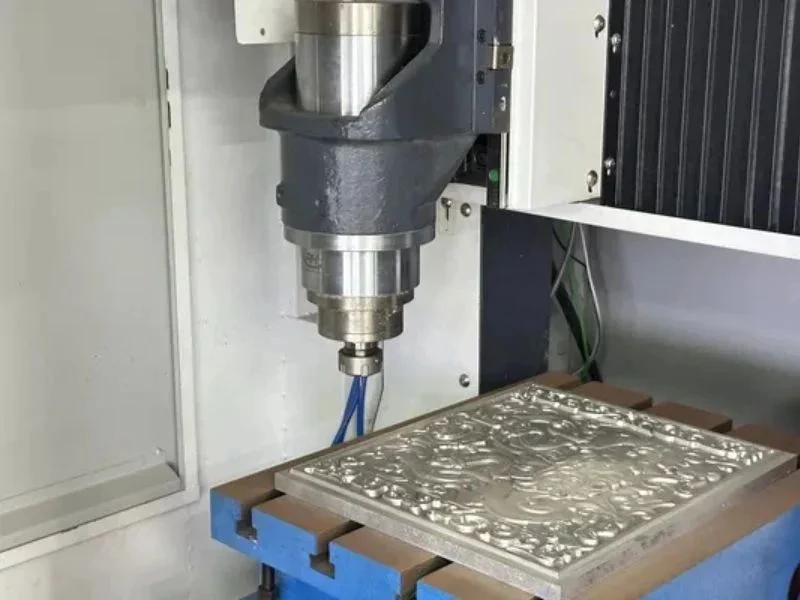
How Frame Structure Affects Fine Part Quality
Every factor above compounds directly into fine part quality: thermal stability keeps the machine’s geometry consistent across a shift as ambient temperature shifts, vibration damping keeps edges clean on tight contours, and long-term stability keeps repeatability consistent from the first production run to the thousandth.
None of these factors matter much on a single isolated cut — they matter on sustained production, where small, compounding errors from thermal drift, vibration, or frame stress accumulate into a real quality problem over time. This is why frame material is a production-scale consideration, not something that shows up in a single demonstration cut a buyer sees during a sales visit.
When Marble-Frame Precision Matters Most
Marble-frame precision earns its cost specifically for thin-gauge metal, small and intricate parts, and applications like electronics, jewelry and precision hardware where tolerance requirements are tight and part features are fine enough that vibration and thermal drift have an outsized effect relative to part size.
For general sheet metal fabrication and larger-format cutting where tolerance requirements are looser and cutting paths are longer and straighter, a well-built steel frame remains the appropriate, cost-effective choice — marble-frame precision is solving a specific problem that doesn’t exist at that scale of work.
See our precision fiber laser cutter buying guide for the full range of decisions this level of precision involves, and the full X6040 Precision Fiber Laser Cutting Machine specifications.
Frequently Asked Questions
Is a marble frame just for looks, or does it actually improve cutting?
It’s a genuine engineering choice — marble’s lower thermal expansion, higher vibration damping, and freedom from welding-induced internal stress all contribute to sustained precision on fine, intricate work, not just visual differentiation from steel-framed machines.
Does a marble frame matter for large-format sheet metal cutting?
Less so — large-format work with longer, straighter tool paths and looser tolerance requirements doesn’t benefit from marble’s advantages the way fine, small-part work with constant direction changes does.
Why does welding introduce internal stress into steel frames?
The welding process itself introduces residual stress into the structure, which quality manufacturers manage through stress-relieving after fabrication — but this compensates for a characteristic the material has rather than eliminating the underlying issue entirely.
Does frame material affect how often the machine needs recalibration?
Yes — a dimensionally stable frame extends the interval between recalibrations needed to hold the same tolerance, since it doesn’t drift with temperature or relieve internal stress over time the way some steel structures can.
What kind of parts benefit most from marble-frame precision?
Thin-gauge metal and small, intricate parts in applications like electronics, jewelry and precision hardware, where tight tolerance and fine features make vibration and thermal drift disproportionately significant.
Is marble more fragile than steel for a machine frame?
Machine-grade granite and marble used for this purpose are engineered for structural use and are not fragile in normal production use — the material choice is about dimensional stability and damping characteristics, not durability trade-offs.