Choosing between a die-less digital cutter and traditional die-cutting for cardboard is really a choice about volume, speed and flexibility. One is built for samples, short runs and constant design changes; the other for millions of identical boxes. Pick the wrong one and you either wait weeks for a die you did not need, or run a digital knife on a job that truly wanted a die. This guide compares them across setup, speed, cost, flexibility and quality, so you can match the method to the work.
The Short Answer: Die-Less for Samples, Die-Cutting for Mass Volume
For sample making, custom boxes and short-to-medium runs, a die-less digital cutter wins; for very high-volume runs of one unchanging carton, traditional die-cutting still leads. The line between them is drawn by quantity and how often the design changes.
A die-less cutter needs only a file, so it turns a design into a finished, creased blank the same day. Die-cutting needs a steel die made first, which is slow and costly per design but extremely fast and cheap per piece once it runs. The rest of this comparison is really about where that trade-off tips.
It helps to think of them as two phases rather than two competitors. Development, sampling and short runs live on the die-less side; locked, high-volume production lives on the die-cutting side. Many packaging plants own both and route each job to the method whose economics fit it best. The same dieless cutting machine that samples cartons also cuts gaskets, foam and labels, which is often what justifies it in a mixed converting plant.
Understanding where your work sits on that spectrum is the whole decision. Most of the pressure in packaging today — faster launches, more SKUs, e-commerce variety, sustainability redesigns — pushes toward short runs and frequent change, which is why die-less has grown from a sampling tool into a production method in its own right.
How Each Method Works
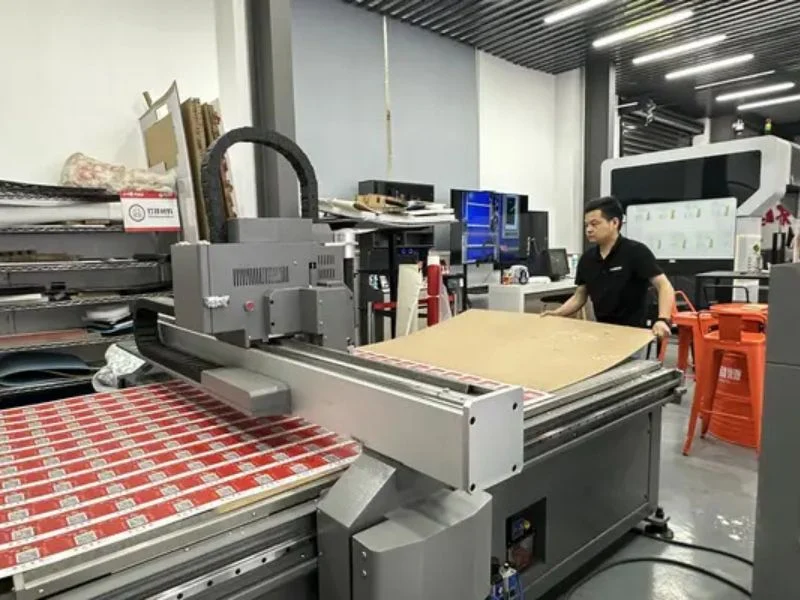
A die-less digital cutter runs an oscillating knife and creasing wheel from a file; die-cutting stamps the board with a custom-built steel die. The two could not be more different in setup.
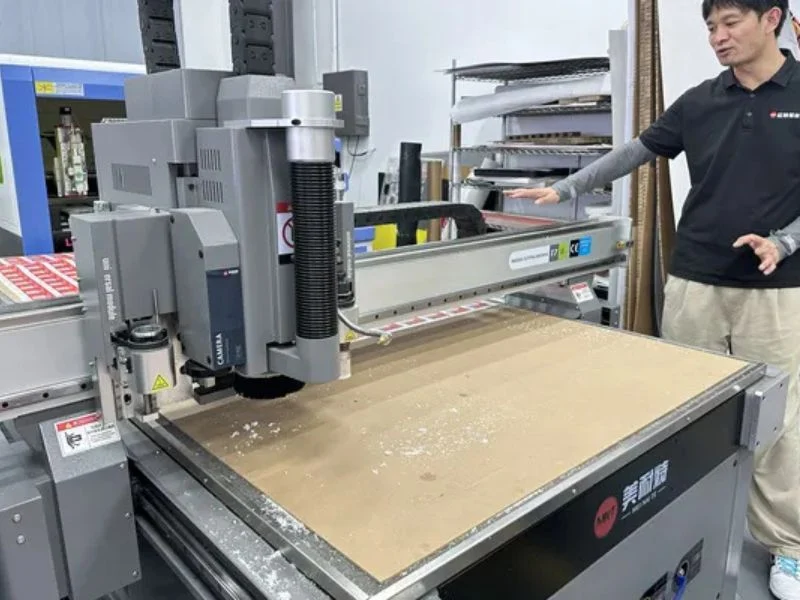
On a digital cutter, a servo head carries an oscillating knife, a creasing wheel and often a V-cut tool over a vacuum flatbed. The CNC system runs cut lines and score lines straight from a CNC file, so nothing physical has to be tooled up before the first cut.
Die-cutting works by pressing the board against a die — a board mounted with sharp steel rule for cutting and blunt rule for creasing, shaped for one specific design. Making that die takes time and money, but once it exists, a press can stamp out cartons very quickly.
So the digital cutter front-loads nothing and cuts from data; the die-cutter front-loads a physical tool and then runs fast. Everything below follows from that one structural difference.
The consequence is that a digital cutter’s capability lives in software and quick tool changes, while a die-cutter’s capability lives in a shelf of physical dies. One scales by adding files; the other scales by building, storing and maintaining a steel tool for every design it has ever run.
There is a maintenance angle as well. Steel dies wear, nick and need refurbishing over long runs, and a damaged die can stop a job until it is repaired or remade. A digital cutter’s blade is a quick, inexpensive swap, so a worn tool means minutes of downtime rather than days.
Speed to First Sample
A die-less cutter produces a first sample the same day; die-cutting waits days or weeks for the die to be made first. For anyone iterating on packaging, that gap decides the schedule.
When a designer finishes a corrugated box layout, a digital cutter can cut and crease a real, foldable sample within the hour. The customer holds the actual box, checks the fit, and approves or revises immediately.
With die-cutting, that same first sample cannot exist until a die is built, which typically means days of lead time and a tooling charge. If the design then changes, the clock resets. For sampling and prototyping, the die-less route is simply a different speed of business.
This is why packaging suppliers increasingly run a digital cutter for the sampling stage even when they die-cut the final mass production — the two methods serve different phases of the same project.
Speed to sample also shapes how many design rounds you can afford. When each iteration takes an hour instead of a week, a customer can try three or four versions of a box before committing — improving the final packaging rather than settling for the first die cheap enough to cut.
For time-sensitive launches, that responsiveness can decide whether packaging is ready for a product ship date. A design approved on Monday can be sampling that afternoon and in short-run production the same week, with no tooling sitting on the critical path.
Cost Structure
Die-less has near-zero setup cost per design; die-cutting front-loads a steel-die cost that only pays back at high volume. The right choice depends entirely on how many identical pieces you run.
A digital cutter’s cost per job is basically machine time and an inexpensive blade — there is no tooling to amortize. That makes short runs, one-offs and frequently changing designs economical, because each new design adds no tooling bill.
Die-cutting spreads the fixed cost of the die across the run. On a single carton produced by the hundreds of thousands, that die cost per piece becomes tiny and the fast stamping wins. But on a few hundred boxes, or a design that will change, the die cost never gets spread thin enough to justify itself.
The practical rule: the more identical pieces and the more stable the design, the more die-cutting’s economics improve. The more variety and change, the more die-less pulls ahead.
There is also a hidden cost in dies that never get used again. A steel die for a discontinued product or a one-time promotion is money spent on tooling that sits idle after a single run. Die-less work has no such orphaned tooling — the file is simply archived at no cost.
Storage and handling add up too. A die-cutting operation accumulates racks of dies that must be stored, retrieved and maintained, each tied to one design. A digital cutter replaces that physical library with a folder of files, freeing floor space and removing tool-management labor.
For low-to-medium volumes, the math is usually decisive. Across a few hundred to a few thousand boxes, the absence of any die cost keeps the digital route cheaper per job even though its per-piece cutting is slower — because there is no fixed tooling charge to spread in the first place.
A simple example makes the break-even concrete. If a steel die costs several hundred dollars and the run is only 500 boxes, that tooling alone can exceed the value of the whole job, so the digital route wins easily. Spread the same die across 500,000 identical boxes and its cost becomes a rounding error per piece — at which point the press’s speed takes over. The whole decision is really a search for where, between those extremes, your own volume falls.
Flexibility and Design Changes
With die-less, you change a design by editing the file; with die-cutting, every change means building a new die. For modern packaging, where designs iterate constantly, that flexibility is a major advantage.
Brands revise packaging often — a new size, a tweaked window, a seasonal shape. On a digital cutter, those revisions are file edits that cut immediately, so a supplier can turn around variations in hours and run a dozen SKUs without a dozen dies.
Die-cutting locks each design into a physical tool. A revision is not an edit; it is a new die with new lead time and cost. For high-mix, short-life packaging, that rigidity becomes expensive and slow, which is exactly the work digital cutting was built for.
Short product life cycles make this sharper still. When a package may only run for one season, spending on a die that outlives the product makes little sense, whereas a digital file costs nothing to keep and nothing to change. For promotional, seasonal and e-commerce packaging, that agility is the whole point.
It also lowers the barrier to customization. Personalized boxes, regional variants and limited editions become practical when each version is a file rather than a die, which is why on-demand and short-run branded packaging has grown right alongside digital cutting.
Cut and Crease Quality
A die-less cutter cuts and creases in one pass from one file; die-cutting builds matched cut and crease rules into the die. Both can produce clean, fold-ready blanks — the difference is again setup and flexibility, not the finished result.
On a digital cutter, the creasing wheel scores fold lines to a controlled depth and the knife cuts the outline, all referenced to the same file. Crease depth and position can be tuned per material without rebuilding anything, so switching from thin folding boxboard to heavy double-wall corrugated is a settings change.
A well-made die also creases and cuts together, and on long identical runs it is very consistent. But adjusting crease depth or fixing a fold problem means reworking the physical die. The digital cutter keeps that control in software, which matters most when materials and designs vary.
Kiss-cutting and partial-depth cuts extend this further. A digital cutter controls cut depth precisely — cutting fully through one layer while only scoring another — which suits labels, windows and complex structural packaging without building that behavior into a die.
That software control also makes quality repeatable without a physical reference. Crease depth, cut force and tool choice are saved with the job file, so re-running a design months later reproduces the same result — no need to locate and inspect an aging die.
For structural and folding cartons, that repeatability makes short-run production viable — a supplier can promise the tenth batch folds exactly like the first without a physical die to guarantee it, which is the confidence a customer needs to order digitally rather than tool up.
When Die-Cutting Still Wins
For very large runs of one unchanging carton, die-cutting’s fast stamping and low per-piece cost still beat a digital knife. Being honest about that is how you choose correctly rather than dogmatically.
Once a design is final and the volume runs into the hundreds of thousands or millions, the die cost disappears into the per-piece math and the press simply stamps faster than a knife can trace. High-speed rotary and flatbed die-cutting remain the standard for mass carton production for good reason.
The clean split: if the work is samples, short runs, custom boxes or anything that changes, choose die-less. If it is a locked design at mass volume, die-cutting earns its tooling. Many packaging plants run both — digital for development and short runs, die-cutting for the big stable orders.
Board type can tip the balance too. Extremely high-speed runs of thin, uniform carton stock favor die-cutting’s stamping, while thick, varied or rigid boards — honeycomb, heavy corrugated, foam board — often cut better and more economically on a digital knife regardless of volume.
Consistency of demand matters as much as raw volume. A carton ordered in steady, predictable millions rewards a die; the same annual quantity ordered in unpredictable bursts of varying design is often better served digitally, because the flexibility offsets the higher per-piece cost.
The direction of travel is clear even so. As runs shorten, SKUs multiply and brands demand faster turnaround, the share of packaging that fits die-less keeps growing — which is why even large die-cutting operations now add a digital cutter to cover the development and short-run end of their business rather than sending that work elsewhere.
Die-Less vs Die-Cutting: Full Comparison
The table summarizes how the two methods compare across the factors that decide a cardboard cutting purchase.
| Criteria | Die-Less Digital Cutter | Traditional Die-Cutting |
|---|---|---|
| Tooling | None — cuts from a file | Steel die per design |
| First sample | Same day | Days to weeks (die making) |
| Setup cost per design | Near zero | High (die cost) |
| Cost per piece (short run) | Low | High |
| Cost per piece (mass run) | Higher | Very low |
| Design changes | Edit the file | New die each time |
| Cut + crease | One pass, tunable in software | Built into the die |
| Best fit | Samples, short runs, custom, high-mix | Mass runs of one fixed design |
Bottom Line for Packaging Producers
For most packaging work today — samples, short runs and frequently changing designs — die-less digital cutting is the flexible, lower-risk choice. It removes the die cost and lead time that make die-cutting slow to start and expensive to change.
The risk profile matters as much as the cost. Die-cutting bets on a design being right and high-volume before you spend on tooling; die-less lets you prove the design and the demand first, then scale. For most producers, starting die-less and moving stable winners to die-cutting is the lower-risk path.
Reserve die-cutting for locked, high-volume cartons where its per-piece speed and cost are unbeatable. For everything upstream of that — development, prototyping, custom and short-run work — a die-less machine keeps you fast and flexible. See the full specification and material range on our cardboard cutting machine.
FAQ
What does die-less cutting mean?
It means cutting cardboard without a steel die. A digital cutter runs an oscillating knife and creasing wheel straight from a design file, so there is no tooling to make — you cut and crease directly from data.
Is die-less cheaper than die-cutting?
For samples and short runs, yes — there is no die cost to absorb. For very high-volume runs of one fixed design, die-cutting’s per-piece cost is lower because the die cost spreads across millions of pieces.
How fast can I get a cardboard sample without a die?
Usually the same day. Once the design file is ready, a digital cutter can cut and crease a real, foldable sample within the hour — no die-making lead time.
Can a die-less cutter crease as well as cut?
Yes. A creasing wheel scores the fold lines and the knife cuts the outline from the same file in one pass, so the blank comes off ready to fold. Crease depth is tuned in software per material.
When should I still use die-cutting?
For very large runs of a single, finalized carton design. At mass volume the die cost per piece becomes negligible and stamping is faster than a knife, so die-cutting wins on locked, high-volume jobs.
Can one machine handle corrugated, chipboard and foam board?
Yes. A digital cutter adjusts tool and depth for corrugated, chipboard, honeycomb and foam/KT board, so one machine covers the common packaging and display materials.
Do digital cardboard cutters replace die-cutting entirely?
No — they serve different volumes. Digital cutting owns sampling, short runs and high-mix work, while die-cutting still leads on very large runs of one fixed carton. Many plants use both, moving stable high-volume designs to a die.
Is die-less cutting suitable for production, not just samples?
Yes. While it started as a sampling tool, die-less cutting now handles real short-to-medium production runs — custom boxes, seasonal packaging and high-mix orders — economically, because there is no die cost to absorb per design.