Converters cutting foam, rubber, gaskets, textiles and packaging material usually inherit whichever process their shop started with — and stick with it long after volume, design-change frequency or material mix has shifted enough to make a different process cheaper.
Steel-rule die cutting, laser cutting and digital knife cutting solve the same basic problem — separating flexible sheet material into parts — through three fundamentally different mechanisms, each with a different cost structure. A die cut part is nearly free once the die is paid for; a laser-cut part needs no tooling at all but can leave a heat-affected edge on the wrong material; a digital knife-cut part sits between the two, trading die cutting’s per-part cost at scale for zero tooling investment and same-day design changes.
This guide compares all three on tooling cost, lead time, edge quality and where each one actually wins, so the choice is based on your volume and material rather than whichever process happened to be installed first.
The Short Answer
Die cutting wins on cost per part at high volume once the die is paid for; laser cutting wins on zero tooling but risks a heat-affected edge on many flexible materials; digital knife cutting wins on flexibility — no die, no melted edge, and same-day design changes — at a moderate per-part cost. None of the three is universally cheaper; the right choice depends on volume, how often the design changes, and whether the material tolerates heat at the cut edge.
| Steel-rule die cutting | Laser cutting | Digital knife cutting | |
|---|---|---|---|
| Tooling cost | High — a die per part shape | None | None |
| Lead time to first part | Days to weeks (die fabrication) | Same day | Same day |
| Cost per part at high volume | Lowest | Moderate to high | Moderate |
| Cost per part at low volume / prototyping | Highest (die cost dominates) | Low | Low |
| Edge quality on foam, rubber, textiles | Clean, cold cut | Risk of melting, scorching or fumes | Clean, cold cut |
| Design change cost | New die required | File edit only | File edit only |
How Die Cutting Works — and Why It Still Wins at Scale
Die cutting stamps material against a shaped steel rule or rotary die, producing a part in a single press stroke — once the die is made, the marginal cost per part is very low, which is exactly why high-volume, stable-design production still runs on dies. A steel-rule die is essentially a custom-shaped blade set into a wood or steel base, pressed through material in a clamshell or rotary press.
The economics only work when the design is stable and the volume is high enough to spread the die cost across enough parts. A die that costs several hundred to a few thousand dollars to build, and takes one to several weeks to fabricate, is a poor fit for a design that changes every few months or a production run of a few hundred parts — which is exactly the gap laser and digital knife cutting fill.
How Laser Cutting Works — and Where the Heat-Affected Edge Becomes a Problem
Laser cutting uses a focused beam to melt, burn or vaporize material along the cut path, which needs zero tooling but leaves a heat-affected edge that’s a real defect on many flexible materials — melted foam edges, scorched fabric, or a rubber edge that’s chemically changed by the heat rather than cleanly sheared. Laser cutting excels on rigid, heat-tolerant material like acrylic and certain metals, where the edge finish from melting is acceptable or even desirable.
On foam, most rubber compounds, many textiles and adhesive-backed material, the heat-affected edge is a genuine quality problem, not a cosmetic one — melted foam cells lose their cushioning property right at the edge, and scorched fabric can fray or discolor in a way that fails inspection. Laser cutting on these materials also often produces fumes that need extraction, adding a process requirement that a cold-cutting method doesn’t.
How Digital Knife Cutting Fits Between the Two
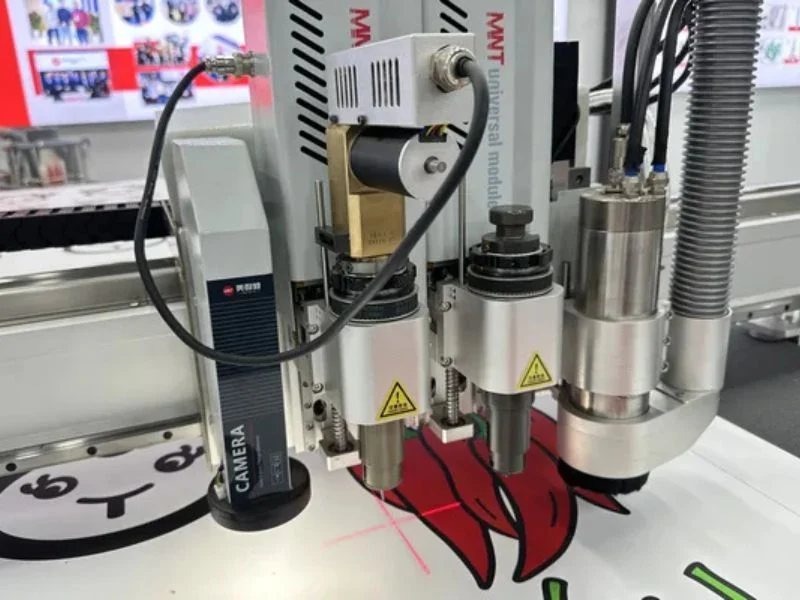
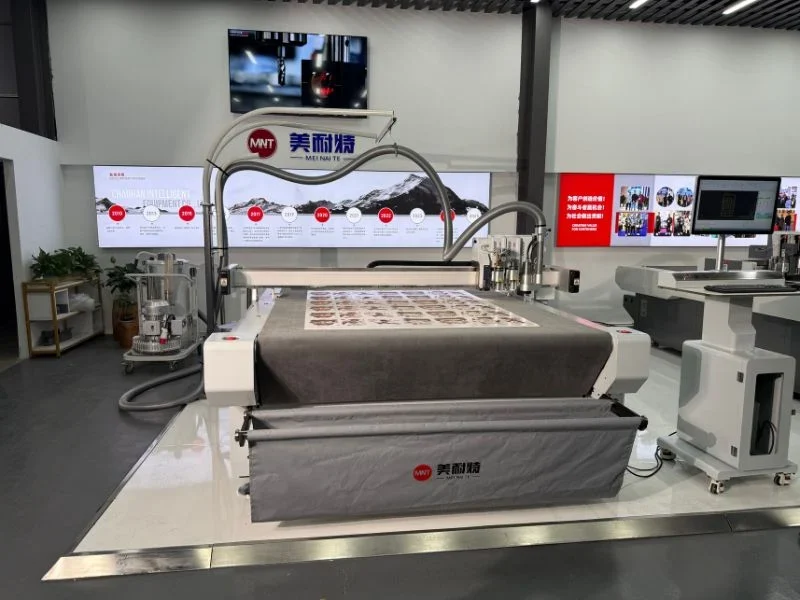
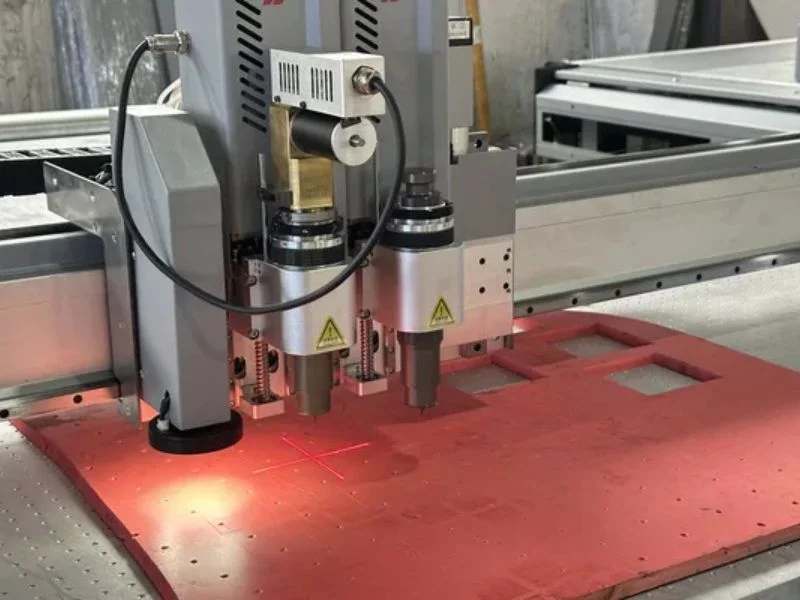
Digital knife cutting — an oscillating or drag blade guided by a CNC-controlled digital cutting table — needs no die and produces the same cold, clean-sheared edge as a steel-rule die, at a per-part cost that sits between die cutting’s high tooling investment and laser cutting’s heat-edge risk. This is the process gap most converters underestimate: it isn’t a cheaper laser or a slower die press, it’s a genuinely different cost curve.
Because there’s no die, a design change is a file edit rather than a new tooling order — same-day, at zero incremental tooling cost. Because the blade cuts cold, materials that laser cutting damages come off the table with the same edge quality a steel-rule die would produce. The tradeoff is per-part cycle time: a digital knife cutter is generally slower per part than a die press running at full production speed, which is why die cutting still wins once volume is high and the design is stable.
Cost Crossover: When Each Process Actually Wins
The volume and design-stability point where die cutting’s low per-part cost overtakes its high tooling investment is the real decision line — below that point, digital knife cutting or laser cutting (material permitting) is usually cheaper overall, even though the per-part cost looks higher on paper.
Run the comparison against your own numbers: total die cost divided by expected production volume gives a per-part tooling cost that has to be added to the die process’s press-time cost, then compared against a digital knife cutter’s per-part cycle time cost with zero tooling investment. For a design that will run for years at high volume, the die almost always wins eventually.
For a design that changes seasonally, runs a few hundred to a few thousand units, or is still being validated with a customer, the crossover point where the die pays for itself may never actually arrive.
When to Move From Steel-Rule Dies to Digital Cutting
The clearest signal it’s time to move a job off steel-rule dies is when die storage, die maintenance, or design-change frequency is costing more than the die itself ever saved — common in gasket, foam and packaging shops carrying hundreds of dies for parts that each run infrequently.
Converters storing large die libraries for low-volume or infrequently ordered parts are often paying storage and maintenance cost on tooling that a digital knife cutter would produce on demand with no inventory at all. The same logic applies to prototyping and short-run custom orders — building a die to validate a design before committing to volume production rarely makes economic sense when a digital cutting table can produce the same part same-day with no tooling risk if the design changes.
Die Wear Is a Hidden Cost Digital Cutting Doesn’t Have
A steel-rule die dulls and deforms with use, and the part it produces on cut number 50,000 is rarely identical to the part from cut number 1 — digital knife cutting produces the same edge quality on the last part of a run as the first, because there’s no physical tool wearing down. This matters more on tight-tolerance gaskets and seals than most die-cutting operations account for.
Re-sharpening or rebuilding a worn die adds cost and downtime that rarely shows up in the original tooling quote, and a die that’s been rebuilt several times over its service life can drift from the original part dimensions in ways that are hard to catch without dedicated inspection. A shop weighing digital cutting purely on a per-part cost basis against a die’s marginal cost is missing this side of the comparison — die wear is a real, recurring cost, just one that arrives gradually instead of as a single line item.
A Hybrid Approach: Keep the Highest-Volume Dies, Move the Rest
Most converters don’t need to choose one process exclusively — the practical move is keeping steel-rule dies for the handful of designs that run at genuinely high, stable volume, and shifting everything else to digital knife cutting. This is how the economics actually play out in most shops once they run the numbers by part rather than as a blanket policy.
A die library audit usually turns up a small number of parts that justify their tooling cost many times over, and a much larger number that are marginal or outright losing money once storage, maintenance and occasional re-cutting are counted. Moving that long tail to a digital cutting table — without touching the handful of dies that are genuinely earning their keep — is typically where the biggest cost improvement shows up, faster than trying to replace an entire die inventory at once.
For rubber-specific cutting setups by compound, see our rubber cutting machine page. For the knife and tool head options on a digital cutting platform, see oscillating knife cutting machine; for flatbed cutting of packaging and signage material, see flatbed cutter.
Frequently Asked Questions
Is laser cutting always cheaper than die cutting?
No — laser cutting has no tooling cost, but per-part cutting time is often slower than a die press at full production speed, so at high volume a die can still be cheaper overall once its tooling cost is spread across enough parts.
Can laser cutting be used on foam and rubber?
It can, but many foam and rubber compounds develop a heat-affected edge — melted cell structure or scorching — that’s a real quality defect, not just cosmetic. Digital knife cutting produces a cold, clean-sheared edge on these materials instead.
How much does a steel-rule die cost and how long does it take?
Costs and lead times vary by part complexity and size, but expect a range from several hundred to a few thousand dollars and one to several weeks for fabrication — which is why die cutting favors stable, high-volume designs over frequently changing ones.
When does it make sense to switch from dies to digital cutting?
When die storage, maintenance or design-change frequency is costing more than the die itself saves — common in shops carrying large die libraries for parts that run infrequently or in small volumes.
Does digital knife cutting produce the same edge quality as a steel-rule die?
Yes — both are cold-cutting processes that shear material rather than melt it, producing comparable edge quality. The main difference is tooling cost and lead time, not edge finish.
What materials are best suited to laser cutting instead of knife or die cutting?
Rigid, heat-tolerant materials like acrylic and certain metals, where a melted or heat-affected edge is acceptable or even part of the desired finish, rather than a defect.